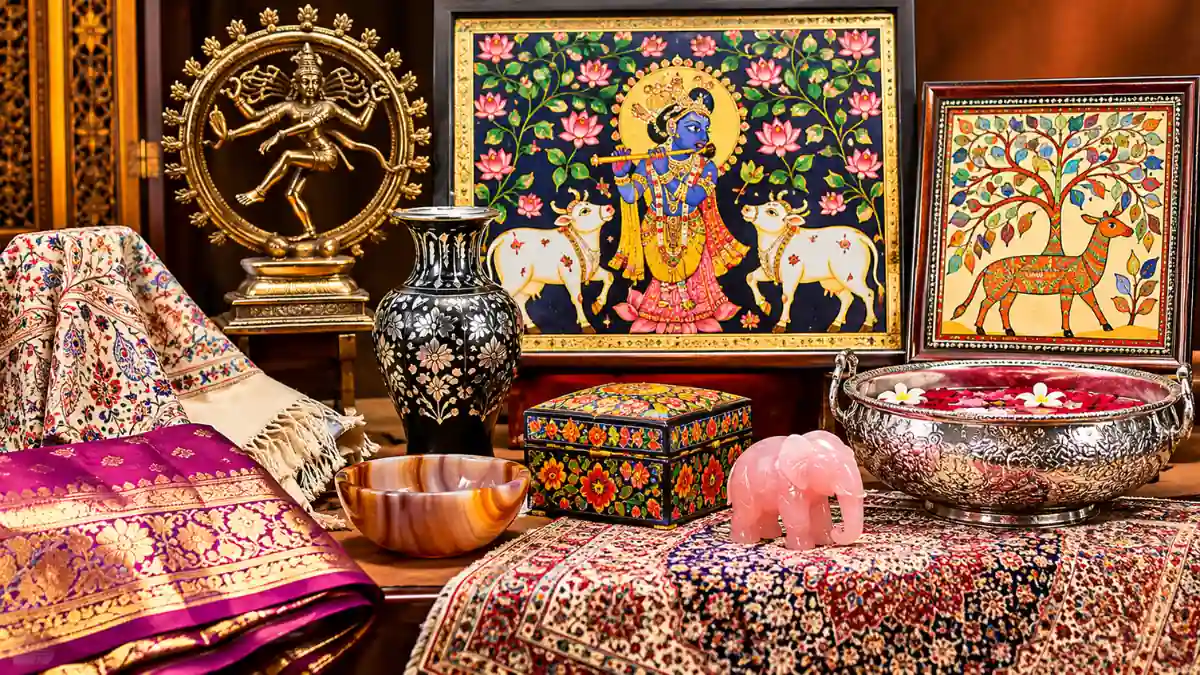
14 Traditional Indian Art Forms that PM Modi Gifted to World Leaders During the ASEAN-India and East Asia Summits 2026: Prime Minister Narendra Modi presented several traditional Indian handicrafts, paintings and textiles to world leaders during his November 2026 visit to Manila, Philippines.
The gifts included a Pichwai painting from Rajasthan, a Banarasi Katan silk stole from Uttar Pradesh and a Kashmiri silk carpet, among other creations. These gifts highlighted India's rich cultural heritage and the traditional skills of its artisans.
But do you know where these 14 traditional items originated, how they are made and what makes them special? Here is a look at their origins, history and interesting facts.
List of 14 Traditional Indian Art and Craft Items and Their States of Origin
|
No.
|
Traditional Indian item
|
State or region of origin
|
|
1.
|
Pichwai Painting
|
Nathdwara, Rajasthan
|
|
2.
|
Jaipur Blue Pottery
|
Jaipur, Rajasthan
|
|
3.
|
Banarasi Katan Silk
|
Varanasi, Uttar Pradesh
|
|
4.
|
Kashmiri Silk Carpet
|
Jammu and Kashmir
|
|
5.
|
Pashmina Shawl
|
Kashmir and Ladakh
|
|
6.
|
Papier-Mache Box
|
Kashmir
|
|
7.
|
Bidriware Silver Inlay Vase
|
Bidar, Karnataka
|
|
8.
|
Chola Bronze Sculpture
|
Tamil Nadu
|
|
9.
|
Rose Quartz Elephant
|
Rajasthan
|
|
10.
|
Silver-Worked Urli
|
Traditional Indian metal craft
|
|
11.
|
Gond Painting
|
Central India, particularly Madhya Pradesh
|
|
12.
|
Rogan Art Painting
|
Kutch, Gujarat
|
|
13.
|
Agate Bowl
|
Khambhat, Gujarat
|
|
14.
|
Traditional Leather Wall Hanging
|
Indian folk-art tradition
|
1. Pichwai Painting: Nathdwara, Rajasthan
Pichwai painting is a traditional Indian art form that originated in Nathdwara, Rajasthan. It is closely associated with the Shrinathji temple and the worship of Lord Krishna.
The word 'Pichwai' refers to a decorative painting placed behind the idol of a deity. These paintings are traditionally created on cloth using natural or mineral-based colours.
Special features of Pichwai painting:
Related Stories
-
It often depicts Lord Krishna in his Shrinathji form.
Lotus flowers, cows, trees and peacocks are common designs.
Artists use detailed patterns and bright colours.
Gold detailing gives some Pichwai paintings a rich appearance.
GK Fact: Nathdwara in Rajasthan is one of the most important centres of traditional Pichwai painting.
2. Jaipur Blue Pottery: Rajasthan
Jaipur Blue Pottery is one of the most recognisable traditional crafts of Rajasthan. Unlike ordinary pottery, which is generally made using clay, this craft uses a quartz-based mixture.
The pottery is known for its glossy surface and attractive blue designs. Artisans hand-paint different patterns before glazing and firing the products.
Special features of Jaipur Blue Pottery:
-
It uses quartz instead of ordinary clay as its main material.
-
Cobalt blue is one of its most popular colours.
-
Floral designs, birds and geometric patterns are commonly used.
-
It is used to make plates, bowls, tiles, vases and decorative objects.
GK Fact: Jaipur Blue Pottery is known for its distinctive quartz-based manufacturing technique.
3. Banarasi Katan Silk: Varanasi, Uttar Pradesh
Banarasi Katan silk is a traditional textile associated with Varanasi, Uttar Pradesh. It is famous for its fine silk fabric and beautiful weaving patterns.
Katan silk is made using twisted silk yarns, which give the fabric strength and a smooth texture. Skilled weavers create intricate designs using traditional looms.
Special features of Banarasi Katan silk:
-
It is made using fine silk yarn.
-
It is known for its smooth texture and rich appearance.
-
Traditional motifs include flowers, leaves and decorative patterns.
-
It is widely used in sarees, stoles and other traditional garments.
GK Fact: Varanasi, also known as Banaras, is one of India's most famous centres of silk weaving.
4. Kashmiri Silk Carpet: Jammu and Kashmir
Kashmiri silk carpets are famous for their detailed designs, soft texture and traditional hand-knotting techniques.
These carpets are made using fine silk threads. Skilled artisans tie thousands of knots by hand to create intricate patterns. Depending on the size and complexity, making a single carpet can take several months or even years.
Special features of Kashmiri silk carpets:
-
They are traditionally hand-knotted.
-
Floral patterns and chinar leaf designs are popular.
-
They have a distinctive shine and soft texture.
-
Their detailed craftsmanship makes them valuable decorative items.
GK Fact: The chinar leaf is an important design element in Kashmiri art and traditional handicrafts.
5. Pashmina Shawl: Kashmir and Ladakh
Pashmina is a fine type of cashmere fibre obtained from the soft undercoat of the Changthangi goat, which lives in the high-altitude regions of Ladakh.
Pashmina shawls are famous for their softness, warmth and lightweight texture. The fibre is carefully collected, processed and woven into fine fabric.
Special features of Pashmina:
-
It comes from the undercoat of the Changthangi goat.
-
It is extremely soft and lightweight.
-
Traditional shawls are woven by skilled artisans.
-
Some Pashmina shawls also feature detailed embroidery.
GK Fact: Changthang, a high-altitude region of Ladakh, is closely associated with the production of fine Pashmina fibre.
Why Are Traditional Indian Handicrafts Important?
India has a long history of traditional art, textiles, metalwork and handicrafts. These crafts are not simply decorative products; they also represent the history, identity and cultural traditions of different regions.
Some important reasons why these handicrafts matter include:
-
Preservation of cultural heritage: Traditional crafts preserve artistic techniques passed down through generations.
-
Employment for artisans: Handicrafts provide livelihoods to skilled workers and traditional artisan communities.
-
Recognition of regional identity: Many crafts are closely associated with a particular town, district or state.
-
Promotion of Indian culture: Traditional Indian products introduce the country's cultural diversity to international audiences.
-
Support for local industries: Handicrafts help promote small businesses, local production and traditional industries.
Conclusion
From Rajasthan's Pichwai paintings to Kashmir's Pashmina shawls and Karnataka's Bidriware, India's traditional handicrafts represent the country's remarkable cultural diversity. Each item carries a story of its region, the people who make it and the skills developed over generations. Their presentation to international leaders also brings attention to India's traditional artisans and the importance of preserving these valuable crafts.