Councils of Buddhism: First Buddhist Council
Explore the First Buddhist Council of 483 BCE, its venue, leaders, objectives, and outcomes. Learn how Buddha’s teachings were preserved, forming the foundation of Tripitaka and Buddhist tradition worldwide.
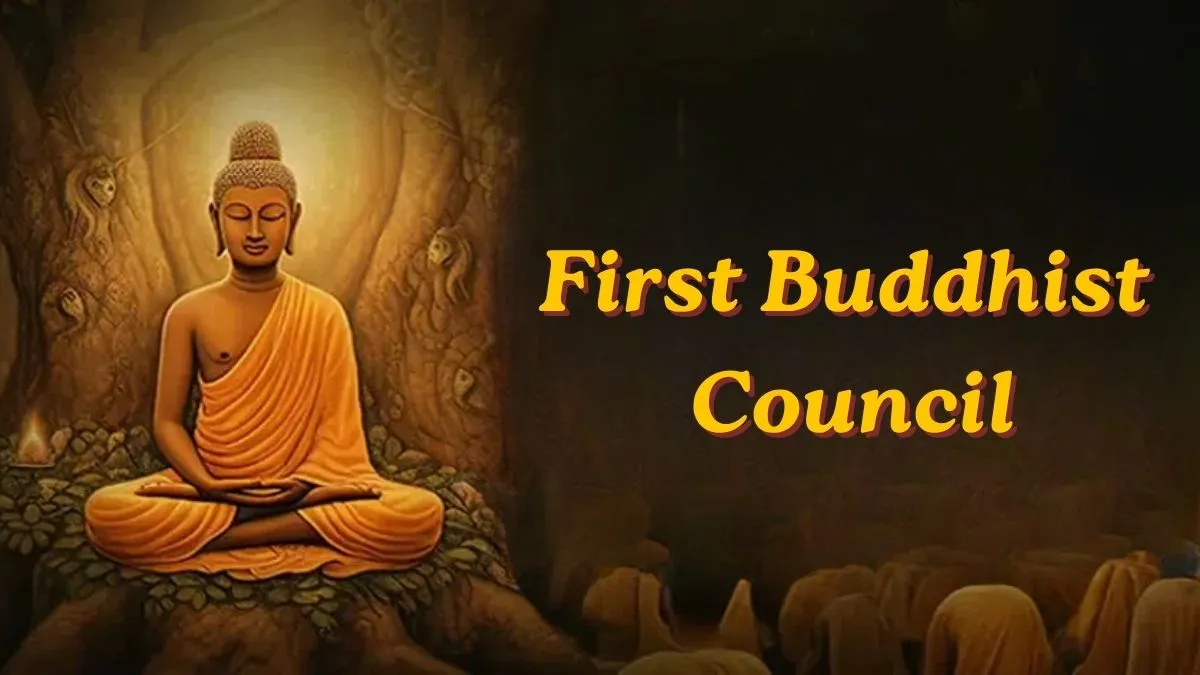
Buddhism is one of the oldest and major religions, which began in India around the 6th century BCE in the Gangetic Plain during the second phase of urbanisation and societal changes in India.
The teaching of Buddhism was spread throughout Central and Southeast Asia, including China, Korea, Japan, and other countries.
Over the period, after the death of the Shakyamuni Buddha, his teaching style, knowledge, and scriptural texts began to fade.
To preserve the Buddhist teaching style, his ideas, and philosophy, many Buddhist monks organised a meeting to approve the texts of scripture and to settle Buddhist doctrinal disputes.
These conventions or meetings are organised for the accurate preservation and transmission of Buddha’s teachings that should be passed from generation to generation, and this meeting or convention is known as the “Buddhist Council”.
In the Councils of Buddhism, there were four major Buddhistr council were held. Today, in this article, we will learn about the First Buddhist Council, which was held in 483 BCE.
First Buddhist Council
The First Buddhist Council was a significant religious assembly of early Buddhist monks aimed at compiling and standardising the teachings of Buddha. It marked the beginning of the formal transmission of Buddhist knowledge through a structured oral tradition.
First Buddhist Council held in which year?
The First Buddhist Council was held around 483 BCE, shortly after the death of Gautama Buddha. It took place during the first rainy season retreat (Varsha Vassa), a traditional period when monks stay in one place for spiritual discussions and practices.
Where was the first Buddhist council held?
The first Buddhist council was held at Saptaparni Cave at Rajgir (ancient Rajagriha) in present-day Bihar.
This location was chosen due to its strong association with Buddha’s teachings and its importance as a political and spiritual centre of the Magadha kingdom.
Who were the patrons and leaders of the first Buddhist council?
The council was patronised by King Ajatashatru, the ruler of Magadha at that time.
The meeting was presided over by the senior monk Mahakassapa (Mahakashyapa), who played a key role in organising the council and maintaining discipline among the monks.
What were the main objectives of the first Buddhist council?
The primary aim of the First Buddhist Council was:
-
To preserve the teachings (Dhamma) of Buddha
-
To establish monastic discipline (Vinaya)
-
To prevent disagreements and maintain unity in the Sangha
Since Buddha himself did not write anything, his teachings had to be preserved through oral tradition.
What were the outcomes of the first Buddhist council?
The outcomes of the first Buddhist council were to compile all the Buddhist Scriptures, and for this, two important disciples played a major role in this process, which were:
1. Upali – He recited the rules of monastic discipline (Vinaya)
2. Ananda – He recited Buddha’s teachings (Suttas), beginning with the phrase “Thus have I heard…”
These recitations later became part of the Tripitaka, the sacred Buddhist texts:
1. Vinaya Pitaka – The Basket of the Discipline
The Vinaya Pitaka was the first division of the Tripitaka in the textual framework upon which the monastic community, the Sangha, is built. This first Pitaka deals with the rules and regulations to follow the monastic order under the direction of Upali, who was considered the closest disciple of Buddha.
2. Sutta Pitaka – The Basket of Suttas
The Sutta Pitaka was the second division of the Tripitaka, which consists of more than 10,000 suttas (discourses), which were delivered by Buddha to his close disciples. It was compiled and developed under the guidance of the Ananda.
| Note: Later on, the Abhidhamma Pitaka (Philosophy Basket) was added under Tripitaka in the Third Buddhist Council |
What is the significance of the First Buddhist Council?
The significance of the First Buddhist Council was crucial for several reasons:
-
It standardised Buddha’s teachings for the first time
-
It also established the oral tradition, which preserved teachings for centuries
-
It helped maintain discipline and unity in the Buddhist community
-
It laid the foundation for future Buddhist councils and the development of Buddhist literature
Conclusion
Among the Four Councils of Buddhism, the First Buddhist Council was a landmark event in the history of India. This council was held to preserve the teachings of Gautama Buddha in style, his ideas, his philosophy, and it safeguarded a spiritual legacy that continues to influence millions worldwide.
The First Buddhist Council helps the nation and worldwide to structure the approach of knowledge preservation, which is one of the earliest forms of organised religious scholars in Indian History.

Prabhat Mishra is a Subject Matter Expert and digital journalist with an extensive background in the competitive exam landscape and over 4 years of experience in education, national and international news, and current affairs. Over his tenure with top knowledge platforms like Mentorship India, IAS BABA, IAS SARTHI, and now Jagran Josh, he has a deep understanding of government exams like UPSC and State PCS, including UP and Bihar, as he has already qualified for the UPPCS 2022 Mains and Bihar 68th Mains. With his core expertise in history, polity, geography & current affairs, he specialises in creating well-researched, aspirant-centric content and simplifying complex topics for competitive examinations.

-1789463871140_t.webp)