Which Countries Are Not Part of BRICS in the Indian Subcontinent?
Which countries in the Indian subcontinent are not members of BRICS? Learn about the BRICS members and non-members in South Asia and their status.
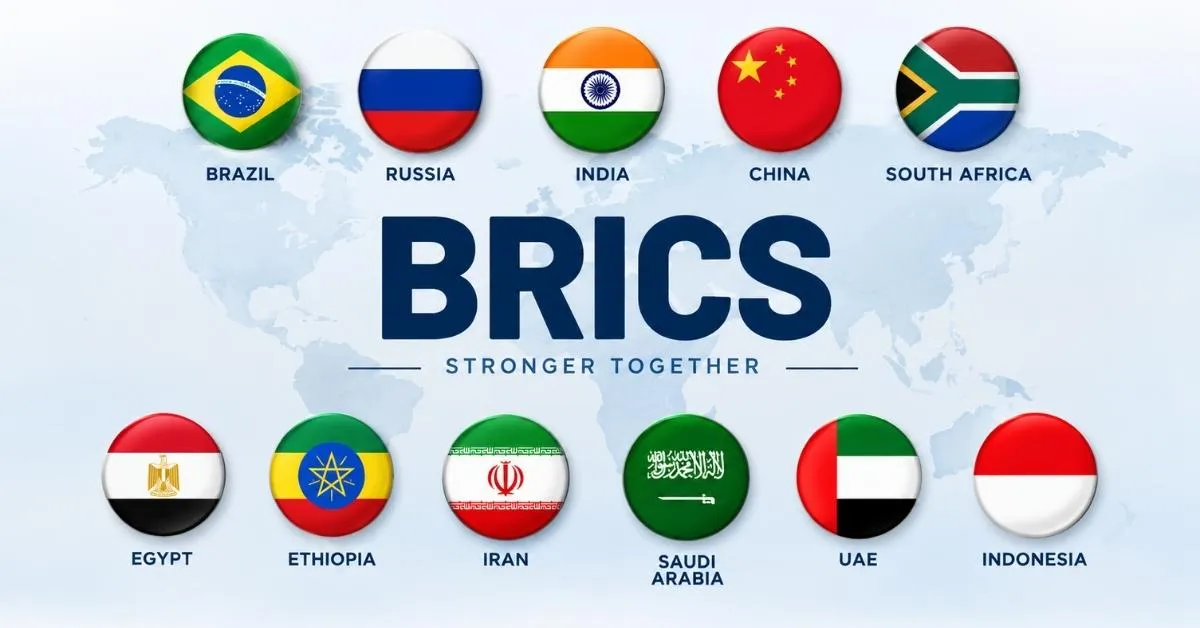
As BRICS expands its membership from five to eleven countries, it now ranks among the most significant groupings representing developing countries and emerging economies.BRICS brings together Brazil, Russia, India and China (founding members in 2009), South Africa (2010), Egypt, Ethiopia, Iran, Saudi Arabia and the UAE (2024) and Indonesia (2025), forming a powerful bloc of emerging economies that promotes trade, development and Global South cooperation.
As these members cover nearly half of the world’s population and about 40% of the world economy, only India is a full member in the Indian subcontinent. Countries like Nepal, Bhutan, Bangladesh and Sri Lanka are still out of BRICS.
What is the Indian Subcontinent?
The Indian subcontinent generally includes:
-
India
-
Pakistan
-
Bangladesh
-
Nepal
-
Bhutan
-
Sri Lanka
-
Maldives
-
Afghanistan
These countries share geographical, historical and cultural connections, but their participation in international organizations differs significantly.
Countries that are Not Part of BRICS in the Indian Subcontinent
Among the major nations forming the Indian Subcontinent, six countries are not members of BRICS:
-
Pakistan: Came up with a formal request of joining BRICS but has not been accepted as a member.
-
Bangladesh: Has obtained membership in NDB formed by BRICS but is not a full summit member.
-
Sri Lanka: Has shown interest in joining BRICS, but it is not a full member.
-
Nepal: Has dealings with BRICS countries but is not part of the BRICS group.
-
Bhutan: Lacks membership or any formal partnership status in BRICS.
-
Maldives: Has bilateral trading relations with BRICS countries but is not formally a member.
Why is India the Sole Member of BRICS in the Region?
India was among the original members of BRICS when the organization was formed under its previous title in 2006. Its vast economy, large population, growth in its influence around the world, and involvement in international affairs have made it an important component of BRICS.
At this point, India continues to determine the agenda of BRICS in relation to the issues of development, innovation, sustainability and cooperation among countries of the Global South.
Why is BRICS Important?
BRICS is a significant cooperation platform for developing economies. It pushes for reforms in global governance institutions, realistic representation for developing nations in these bodies and tackling economic issues of certain BRICS members.
The BRICS now embodies around 49.5% of the population of the globe and approximately 40% of the world economy.
BRICS has evolved into a strong coalition made up of 11 members, but India is still the only representative of the Indian subcontinental nations. There is no participation by any of the countries from the region that include Bangladesh, Pakistan, Nepal, Sri Lanka, Bhutan, Maldives and Afghanistan. Though BRICS is gaining prominence in world affairs, its importance will only increase.

Manisha Waldia is a distinguished content strategist with 5 years of experience crafting premium educational content for UPSC and State PCS, with a focus on deep conceptual analysis across Polity, Geography, History, and Environment. She currently brings this expertise to Jagran Josh, where she covers major national and international events, current affairs, and static general knowledge. Over her career, Manisha's specialized insights have led her to curate high-impact materials and serve as a UPSC Mains answer-evaluator for India’s top institutes—including Drishti IAS, Shubhra Ranjan IAS, Study IQ, GS Score, and PWonlyIAS. She has also worked alongside leading NGOs like Oxfam India and Avani Kumaon.
Contact: manisha.waldia@jagrannewmedia.com