CBSE Class 10 Science Sample Paper 2027: Central Board of Secondary Education, CBSE Class 10 Science board exam is an important milestone for students, the foundation for their future academic journey. To perform well and achieve good scores, thorough preparation and continuous practice are essential and extremely important. The CBSE Class 10 Science Sample Paper for the 2026–27 academic session is an invaluable study tool, offering students a clear understanding of the latest exam pattern, question format, marking scheme, and time management strategies. By practicing these official model papers and solutions, students can assess their preparation level, identify their areas for improvement, and boost their confidence to ace in the upcoming board exams.
CBSE Class 10 Science Sample Paper 2026-27: Highlights
Students can check the table below for CBSE Class 10 Science Exam 2026 details:
|
Particulars
|
Details
|
|
Conducting Body
|
Central Board of Secondary Education (CBSE)
|
|
Subject
|
Science
|
|
Exam Date (Board Exam 2027)
|
To be announced
|
|
Academic Session
|
2026–27
|
|
Sections Included
|
Biology (Section A), Chemistry (Section B), Physics (Section C)
|
|
Medium
|
English and Hindi
|
|
Official Website
|
cbse.gov.in
|
CBSE Class 10 Science Sample Paper 2027
General Instructions:
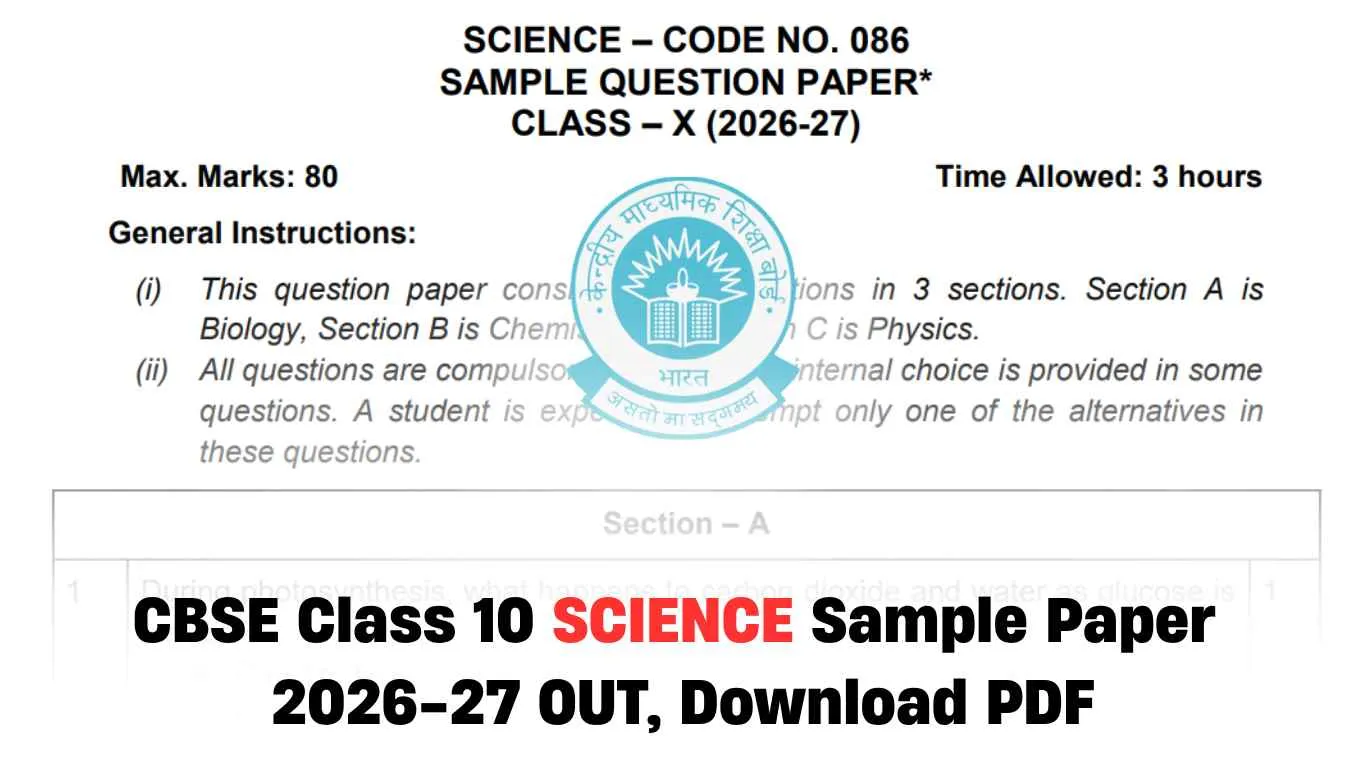
(i) This question paper consists of 39 questions in 3 sections. Section A is Biology, Section B is Chemistry and Section C is Physics.
(ii) All questions are compulsory. However, an internal choice is provided in some questions. A student is expected to attempt only one of the alternatives in these questions.
Section – A |
|
1 During photosynthesis, what happens to carbon dioxide and water as glucose is 2 Lime water turns cloudy in the presence of a gas, which is a by-product of respiration. Shown below are four setups kept in sunlight for 24 hours. In which setup is lime water expected to be the cloudiest?formed?
A. Carbon dioxide gains hydrogen, while water loses electrons. B. Carbon dioxide loses oxygen, while water gains oxygen. C. Carbon dioxide is oxidised, while water is reduced. D. Both carbon dioxide and water undergo reduction. 2 Lime water turns cloudy in the presence of a gas, which is a by-product of respiration. Shown below are four setups kept in sunlight for 24 hours. In which setup is lime water expected to be the cloudiest?
A. P
B. Q C. R D. S 3 During urine formation, tubular reabsorption and secretion take place in the kidneys. Which of the following sets correctly indicates both the substances that are reabsorbed in the kidneys?
A. Glucose and salts B. Glucose and starch C. Glycogen and salts D. Glycogen and starch 4 In a controlled experiment, the anthers of a mustard plant's flowers were carefully removed in the bud stage before they matured. The bud was covered with a paper bag. What will be the most likely result for these flowers?
A. They will still produce seeds and fruit through self-pollination. B. They will attract more insects and produce larger flowers but no fruit. C. They will not produce any seeds or fruits. D. They will produce seeds and fruits that are genetically identical to the parent. 5 The Vas deferens and the Oviduct are both targets for surgical contraception (Vasectomy and Tubectomy respectively). Analysing the process of reproduction, what common biological event is prevented by blocking both these structures?
A. The production of gametes (sperm and egg). B. The implantation of the fertilized egg into the uterine wall. C. The successful meeting and fusion of the male and the female gametes. D. The release of hormones - testosterone and estrogen. 6 The male gamete of an apple plant has seventeen chromosomes. What is the number of chromosomes in the female gamete and in the cells of the adult plant respectively?
A. 17,17 B. 17,34 C. 34,34 D. 34,51 7 A fish living in a pond ecosystem feeds on small aquatic insects (larvae). These insect larvae, in turn, feed on green algae and small photosynthetic bacteria. In this specific food chain, what is the trophic level classification of fish?
A. Producer B. Primary Consumer C. Secondary Consumer D. Tertiary Consumer The following two questions consist of two statements – Assertion (A) and Reason (R). Answer these questions by selecting the appropriate option given below:
A. Both A and R are true, and R is the correct explanation of A. B. Both A and R are true, and R is not the correct explanation of A. C. A is true but R is false. D. A is false but R is true. 8 Assertion (A): The rate of breathing in aquatic organisms is much lower than in the terrestrial organisms.
Reason (R): The amount of oxygen dissolved in water is less as compared to the amount of oxygen in air. 9 Assertion (A): In an ecosystem, 1% of energy is available for transfer from one trophic level to the next.
Reason (R): An average of 10% of the food eaten by organisms is available for flow in the form of chemical energy. 10 A. Due to narrowing of the bile duct, the bile secretion from the liver to the small intestine was obstructed. How will the process of digestion be affected?
B. How does the length of the intestine depend on the nature of food habit in different animals? 11 Students to attempt either option A or B.
A. Which parts of the brain perform certain actions for which we do not have any thinking control? What are such actions called, give two examples. OR B. How is the information of touch in the ‘sensitive plant' controlled and coordinated? 12 What changes are observed in the uterus subsequent to implantation of the young embryo in a human female?
13 How do muscles move at the cellular level and respond when processed messages are received from the brain?
14 Study the food chain given below:
A. In the given food chain, the amount of energy available at the fourth trophic level is 10 kJ, what will be the energy available at the producer level?
B. Is it possible to have three more trophic levels in the above food chain? Justify. C. Which of these trophic levels will have the maximum amount of pesticide, if it had washed down in the water body from agricultural fields. Why? 15 In order to study patterns of inheritance, Neha had performed typical Mendelian experiments with pea plants in the field. In experiment one, she crossed a pea plant having white flowers (vv) with another pea plant bearing violet flowers (VV). In another experiment, in addition to the colour of the flower she also focussed on the height of the pea plant. This time she crossed a pea plant having violet flowers and tall height (VVTT) with another pea plant having white flowers and short height (vvtt).
What percentage is expected for the following traits as a result of these experiments? Give a reason. A. Violet flowers in F1 and F2 generation in experiment one? B. Tall height plants with white flowers in F2 generation in experiment two? Attempt either sub-part C or D.
C. Percentage of medium height plants with light violet flowers in F1 and F2 generations in experiment two? Give a reason. OR D. Percentage of short height plants with white flowers in F1 and F2 generations in experiment two? 16 Attempt either option A or B
A. Observe the structure of hearts A, B and C shown above and answer the following questions
I. Which of the hearts depicted above is present in both birds and Mammals and how are they able to maintain their body temperature? Give reason for your answer. II. Which of the hearts depicted above is present in fishes, how does circulation of blood take place in them? OR B. I. Observe both the diagrams A and B. Which diagram indicates inhalation? Describe how it occurs. II.If diffusion were to move oxygen in our body, it is estimated that it would take 3 years for a molecule of oxygen to get to our toes from our lungs. Then, how is oxygen delivered to all parts of our body?
|
Section – B |
|
17 Chameleons contain crystals that reflect light and produce colour. Adjusting the spacing between these crystals, they can alter the wavelengths of light reflected,
thus changing their skin colour. Based on the above information, we can infer that the change in colour by chameleons is a: A. chemical change because change in colour takes place. B. chemical change because wavelength of reflected light changes. C. physical change because the space between crystals is adjusted. D. physical change because light is reflected by crystals. 18 Rishita summarizes the chlor-alkali process in the following table.
Identify the options that are correctly matched.
A. I, II and III B. I and III C. II and IV D. I, II, III and IV 19 Manjeet wants to wash clothes, but the water available is hard. He compares the action of soap and detergent in hard water, to decide which one to use for washing his clothes. He observes:
Which of the following inferences is correct?
A. Ca²⁺ and Mg²⁺ ions react with soap, forming insoluble compounds, whereas detergents do not form such insoluble salts.
B. Soap is acidic, and detergents are basic. C. Soap react with Na+ ions in hard water to form scum while detergents do not react with Na+ ions. D. Detergents form lather easily because they are ionic compounds and react with Ca²⁺ and Mg²⁺ ions while soaps do not react with hard water. 20 Which of the following salts contain water of crystallisation:
(i) Plaster of Paris, (ii) Washing soda, (iii) Baking soda and (iv) Gypsum. A. (i), (ii) and (iii) B. (i), (iii) and (iv) C. (ii), (iii) and (iv) D. (i), (ii) and (iv) 🡇
🡇
🡇
To download complete question paper PDF along with marking scheme for CBSE Class 10 Science Sample Paper 2027 for board exams. Students can tap on the link below and get the PDF for free to download and start their prepration in advance to score good grades in 2027 board exams.
DOWNLOAD: CBSE Class 10 Science Sample Paper 2027 PDF |
CBSE Class 10th Science Marking Scheme 2026-27
To get the answer key for CBSE Class 10th Science sample paper, students can download the PDF below easily and check the marking scheme:
How to download CBSE Sample Paper and Marking Scheme 2027
Students can follow these below mentioned steps to access the Class 10 sample papers:
- 1. Visit the official CBSE website at cbse.gov.in.
- 2. Go to the Board Examinations section.
- 3. Click on Sample Question Papers.
- 4. Select Class X and pick the subjects as per the subjects choosen for board exam.
- 5. Download the PDF and save it for future use.
Also Read: CBSE Class 10 Syllabus 2026-27 subject-wise, Download PDF