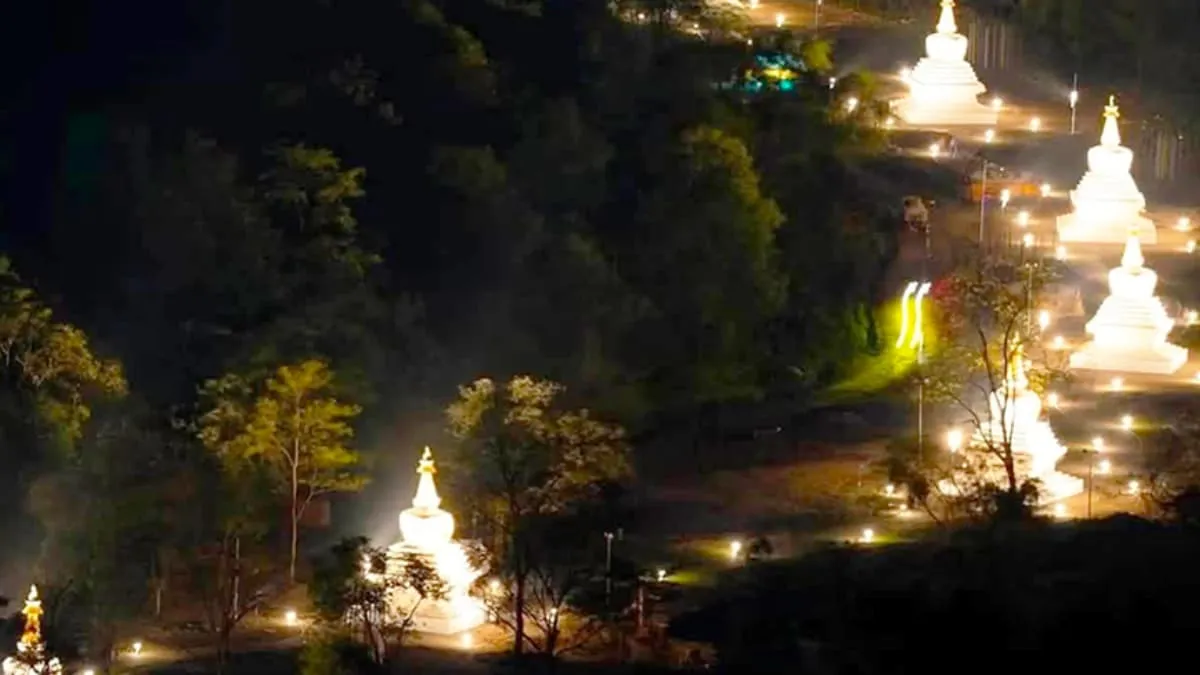
Bhutan has created history by building and consecrating 108 Buddhist stupas in just nine hours at Gelephu Mindfulness City. The achievement, completed on November 1, 2026, brought together around 40,000 volunteers and received recognition from Guinness World Records.
Bhutan has entered the Guinness World Records after successfully constructing and consecrating 108 Buddhist stupas, also known as Jangchub Chortens, simultaneously at multiple locations within nine hours. The historic initiative took place along the banks of the Mau Chhu River in Gelephu Mindfulness City (GMC), southern Bhutan.
The project was envisioned by Bhutan's King Jigme Khesar Namgyel Wangchuck to establish a spiritual foundation for the country's upcoming Gelephu Mindfulness City. Thousands of volunteers, monks and artisans participated in this remarkable religious and community initiative.
The achievement was officially announced on November 3, 2026, by Gelephu Mindfulness City Governor Dr Lotay Tshering.
Bhutan's 108 Stupas: Key Highlights
Here are the important facts about Bhutan's record-breaking achievement:
Related Stories
|
Particulars
|
Details
|
|
Country
|
Bhutan
|
|
Achievement
|
108 Buddhist stupas built and consecrated
|
|
World record
|
Guinness World Record
|
|
Date of achievement
|
November 1, 2026
|
|
Time taken
|
Nine hours
|
|
Starting time
|
3:00 AM
|
|
Location
|
Gelephu Mindfulness City
|
|
River
|
Mau Chhu River
|
|
Number of volunteers
|
Around 40,000
|
|
Height of each stupa
|
15 metres
|
|
Distance between stupas
|
108 metres
|
|
Project
|
Project 108
|
|
King of Bhutan
|
Jigme Khesar Namgyel Wangchuck
|
Source: Bhutan Broadcasting Service and Government of India.
Source: bbs
How Did Bhutan Build 108 Stupas in Just Nine Hours?
The construction initiative began at approximately 3:00 AM on November 1, 2026, along the Mau Chhu River in Gelephu.
Around 40,000 volunteers from different parts of Bhutan participated in the project. They were organised into teams of approximately 20 to 23 members and assigned to designated construction sites.
Instead of building the structures one after another, the teams worked simultaneously at 108 different locations. This coordinated effort allowed Bhutan to complete the construction within nine hours.
After construction, Buddhist monks performed traditional consecration rituals at the respective sites.
According to Bhutan Broadcasting Service, Guinness World Records required at least 85 newly constructed stupas to be built simultaneously and consecrated according to local religious traditions. The achievement was verified through documentation, videos and the presence of monks at the sites.
A Guinness World Records adjudicator confirmed the achievement after examining the evidence.
What Are the 108 Buddhist Stupas or Jangchub Chortens?
A stupa is a Buddhist religious monument associated with the teachings and life of Lord Buddha. It represents peace, wisdom, enlightenment and the spiritual journey towards liberation.
In Bhutan and Tibetan Buddhist traditions, stupas are commonly known as Chortens.
The 108 structures built in Bhutan are called Jangchub Chortens, which are associated with enlightenment.
These monuments are important places for Buddhist prayers, meditation and religious offerings. Devotees also walk around them in a clockwise direction as a spiritual practice known as circumambulation or Kora.
Why Is the Number 108 Important in Buddhism?
The number 108 holds special religious and spiritual significance in Buddhism.
It is traditionally associated with the 108 human afflictions or mental defilements that Buddhist teachings seek to overcome through spiritual practice.
The number is also reflected in Buddhist prayer traditions, including the use of prayer beads containing 108 beads.
Therefore, Bhutan's decision to construct exactly 108 stupas represents more than a world record. It also reflects the country's Buddhist traditions and its aspirations for peace, compassion and spiritual well-being.
Where Are the 108 Stupas Located?
All 108 Jangchub Chortens have been constructed along an approximately 11.7-kilometre stretch of the Mau Chhu River in Gelephu Mindfulness City, southern Bhutan.
Each stupa is approximately 15 metres tall, and consecutive structures are separated by 108 metres.
Together, they form a spiritual corridor that is expected to become an important destination for Buddhist pilgrims and visitors.
The project is also part of Bhutan's broader vision for Gelephu Mindfulness City, which aims to combine economic development with environmental sustainability, cultural heritage and spiritual values.
One of the 108 Stupas Dedicated to PM Narendra Modi
An important highlight of the ceremony was the dedication of one of the 108 stupas to Indian Prime Minister Narendra Modi.
Bhutan's King Jigme Khesar Namgyel Wangchuck dedicated Jangchub Chorten No. 76 to PM Modi in recognition of the close friendship and longstanding relationship between India and Bhutan.
Union Minister Kiren Rijiju represented India at the historic ceremony. He joined the Bhutanese King and unveiled the plaque associated with the dedication.
The gesture highlighted the shared Buddhist heritage, cultural connections and strong diplomatic relations between the two neighbouring countries.
The Indian government has also supported Bhutan's Gelephu Mindfulness City initiative, reflecting the growing cooperation between the two nations.
Why Was November 1, 2026, Chosen for the Ceremony?
The construction and consecration of the 108 stupas coincided with two important occasions in Bhutan.
1. Lhabab Düchen: It is an important Buddhist festival that commemorates the descent of Lord Buddha from the heavenly realm of Trāyastriṃśa to Earth. It is considered an auspicious occasion for religious activities and spiritual practices.
2. 18th Coronation Anniversary of Bhutan's King: November 1, 2026, also marked the 18th anniversary of the coronation of King Jigme Khesar Namgyel Wangchuck.
The coincidence of these occasions made the inauguration particularly significant for Bhutan's people and Buddhist communities.
What Is Gelephu Mindfulness City?
Gelephu Mindfulness City is an ambitious development initiative envisioned by Bhutan's King Jigme Khesar Namgyel Wangchuck.
The city is planned as a centre for economic opportunities, innovation, sustainable development and mindful living.
Located in southern Bhutan, close to the Indian state of Assam, the project aims to create a modern urban centre while preserving Bhutan's cultural identity and environmental values.
The construction of 108 stupas is an important part of this vision, establishing a spiritual and cultural foundation for the proposed city.
Conclusion
Bhutan's achievement of constructing and consecrating 108 Buddhist stupas in just nine hours is more than a Guinness World Record. It represents the country's strong Buddhist heritage, community participation and commitment to preserving its spiritual traditions.
Through Project 108, Bhutan has also connected its cultural identity with the future development of Gelephu Mindfulness City. The initiative demonstrates how traditional values and modern development can work together to build a vision centred on peace, sustainability and collective well-being.