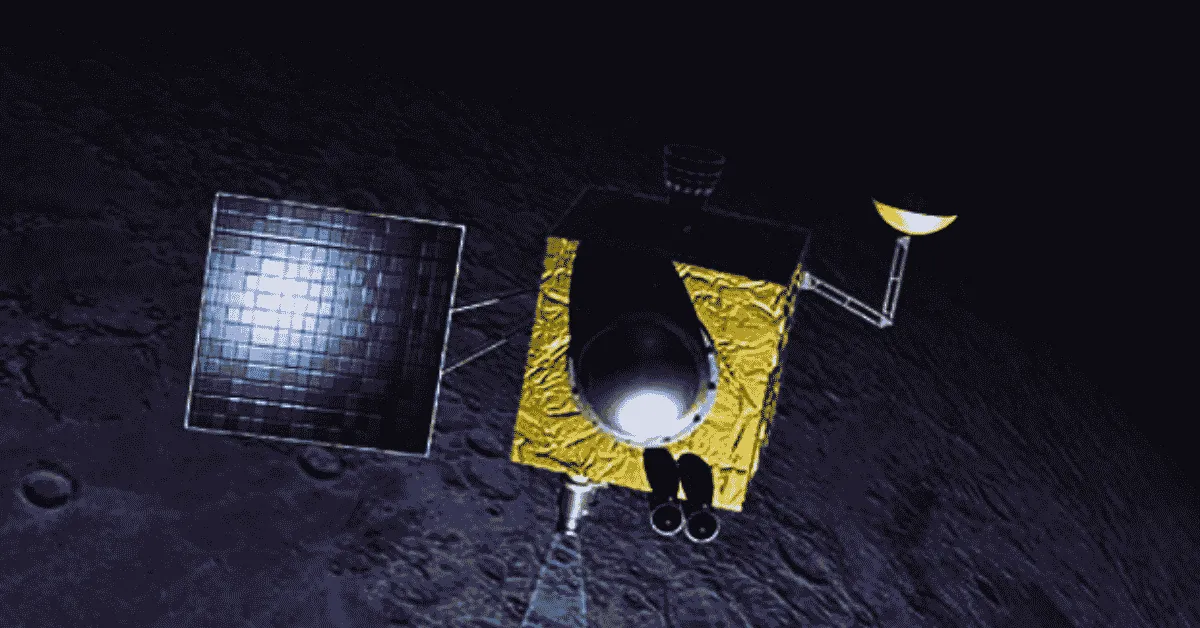
India's revolutionary first lunar spacecraft, Chandrayaan-1, keeps on making a mark in space history even long after its active mission has ended. In a spectacular development, planetary scientists have discovered the geological "ghost" of a huge hidden impact basin on the Moon. This discovery was made by a research team from the Physical Research Laboratory (PRL) located in Ahmadabad.
The basin named the Australe Basin is believed to be older than the South Pole-Aitken Basin, which has long been regarded as the oldest and the biggest impact crater on the Moon.
Uncovering a "Ghost" Crater: How the Researchers Discovered It?
The Australe Basin underwent numerous physical changes during billions of years, caused by erosion, sedimentation and volcanic eruptions. Because the physical crater rim is almost vanishing, scientists applied forensic techniques.
-
The Mineralogical Fingerprint: Large-scale cosmic impacts will not leave behind only a hole but rather will excavate underlying rocks and push them outside.
NASA's Moon Mineralogy Mapper (M3): The researchers processed archived data of the high-resolution imaging spectrometer installed in the Chandrayaan-1 spacecraft.
Ring Distribution: The distinct circular distribution of the mineral orthopyroxene and low-calcium basalts around the Mare Australe area has been mapped by scientists thus confirming the existence of a large ancient structure.
|
Parameter
|
Detail
|
|
Mission Involved
|
Chandrayaan-1 (Launched by ISRO in 2008)
|
|
Key Discovery
|
Australe Basin (Hidden/Eroded Impact Basin)
|
|
Research Institute
|
Physical Research Laboratory (PRL), Ahmedabad
|
|
Instrument Used
|
Moon Mineralogy Mapper (M3)
|
|
Significance
|
Potentially older than the South Pole-Aitken Basin
|
The Significance of the Australe Basin to Science
In a study published in The Planetary Science Journal authors provide vital insights into the turbulent formative years of Earth’s natural satellite:
-
Older Than Previously-Discovered Basins: It is believed that the Australe Basin may be older than the South Pole-Aitken Basin. Thus holding important clues concerning the early formation of the Moon’s crust.
-
Interesting Volcanic Activity: The basalts present in this region are uncommon in that they possess low calcium yet high magnesium content unlike typical lunar volcanoes.
-
Importance To Future Missions: With many international space agencies fixated on visiting the lunar south pole such as India with their Chandrayaan-4 mission. It is essential to have knowledge of how ancient material had been dispersed in this area.
Chandrayaan-1 (The Mission Behind the Discovery)
The Chandrayaan-1 mission was launched on October 22, 2008, using the Polar Satellite Launch Vehicle (PSLV-C11) from the Satish Dhawan Space Centre in Sriharikota.
Importance: This was India’s first deep-space mission to the moon
-
Major Milestone in History: Despite the operational phase having been cut short in August 2009, Chandrayaan-1 went on to achieve historical significance by supplying concrete proof of water presence on the lunar surface.
-
International Partnerships: The spacecraft was equipped with 11 scientific instruments comprising both homemade and international payloads from NASA, the European Space Agency and Bulgaria.
-
NASA’s M3 Moon Mineralogy Mapper instrument helped collect mineral information that was used in the find of the Austral Basin.
Upcoming coming ISRO Lunar Missions
Chandrayaan-4: An advanced multi-component mission with the objective of landing on the Moon and collecting lunar rocks and soil in a safe way to return these samples back to Earth for further studies.
Chandrayaan-5/LUPEX (Lunar Polar Exploration): A collaborative project of ISRO and Japan's JAXA with the aim to explore the areas of the lunar south pole that are always dark and discover the existence of water ice and other materials there.
This discovery shows how valuable continuing availability of archival deep-space data remains. Years later, projects like Chandrayaan-1 still provide useful information for current lunar exploration projects like NASA's Artemis and ISRO's future plan.