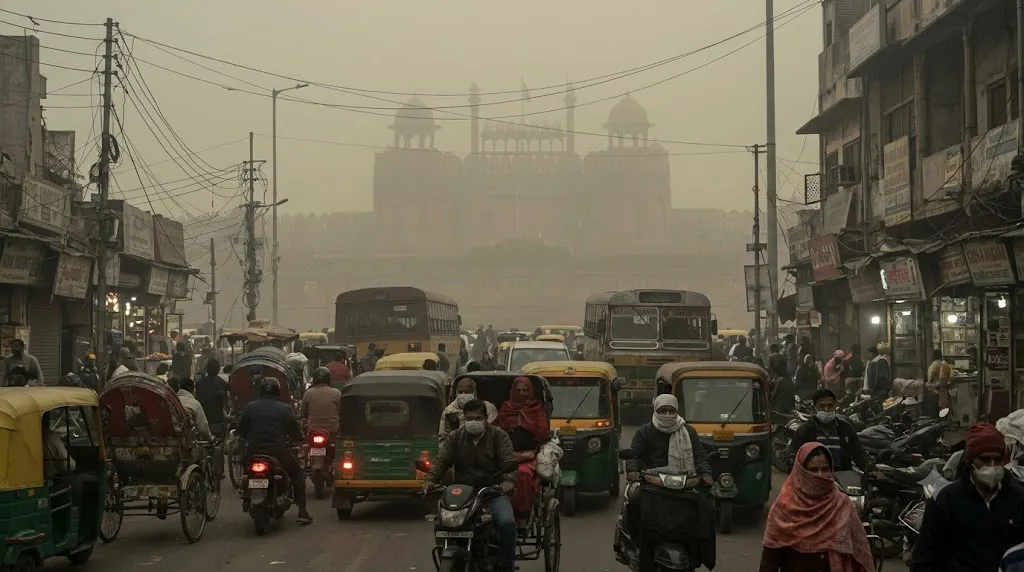
Delhi’s Diwali-night pollution levels were significantly higher than initially reflected in the official monitoring records. The Delhi Pollution Control Committee (DPCC) released previously missing air-quality readings on November 9, 2026, revealing that PM2.5 concentration reached 3,744 micrograms per cubic metre (µg/m³) in Mundka at 2 am. The reading was more than 60 times the national 24-hour PM2.5 standard of 60 µg/m³. Several other monitoring stations also recorded concentrations above 2,000 µg/m³ during the early hours of November 9. Keep reading to know in detail.
Delhi Diwali Pollution: What Did the Latest DPCC Data Reveal?
The DPCC released the missing readings at around 8 pm on November 9. The data showed an extreme rise in fine particulate matter across several parts of the capital. Mundka recorded the highest PM2.5 concentration, followed by JNU and NSUT West Campus.
Related Stories
| Particulars | Details |
| Date of Diwali | November 8, 2026 |
| Date of Data Release | November 9, 2026 |
| Agency | Delhi Pollution Control Committee (DPCC) |
| Highest PM2.5 Reading | 3,744 µg/m³ (over 60 times the national standard) |
| Location with Highest Reading | Mundka |
| Time of Highest Reading | 2:00 AM, November 9 |
| National 24-hour PM2.5 Standard | 60 µg/m³ |
| Monitoring Stations with PM2.5 Above 2,000 µg/m³ | 11 |
The figures show how sharply pollution increased during the hours following Diwali celebrations. The highest concentration was recorded during the early morning, when firecracker smoke and unfavourable weather conditions contributed to poor air quality.
Which Delhi Areas Recorded the Highest PM2.5 Levels?
Mundka recorded the highest PM2.5 concentration at 3,744 µg/m³ at 2 am on November 9. JNU and NSUT West Campus also recorded levels above 3,000 µg/m³. The DPCC data showed that 11 monitoring stations recorded PM2.5 concentrations above 2,000 µg/m³.
| Monitoring Location | PM2.5 Concentration | Time |
| Mundka | 3,744 µg/m³ | 2 am |
| Jawaharlal Nehru University (JNU) | 3,023 µg/m³ | 4 am |
| NSUT West Campus | 3,008 µg/m³ | 5 am |
| Mandir Marg | Above 2,000 µg/m³ | Early morning |
| Nehru Nagar | Above 2,000 µg/m³ | Early morning |
| Wazirpur | Above 2,000 µg/m³ | Early morning |
Note: Exact readings and times for Mandir Marg, Nehru Nagar and Wazirpur were not specified in the reported summary.
PM2.5 in Delhi Crossed 60 Times the National Standard
The national 24-hour standard for PM2.5 is 60 µg/m³. The highest reading in Mundka, at 3,744 µg/m³, was more than 62 times this benchmark. PM2.5 refers to fine particulate matter with a diameter of 2.5 micrometres or less. These particles are small enough to enter deep into the lungs and may even enter the bloodstream.