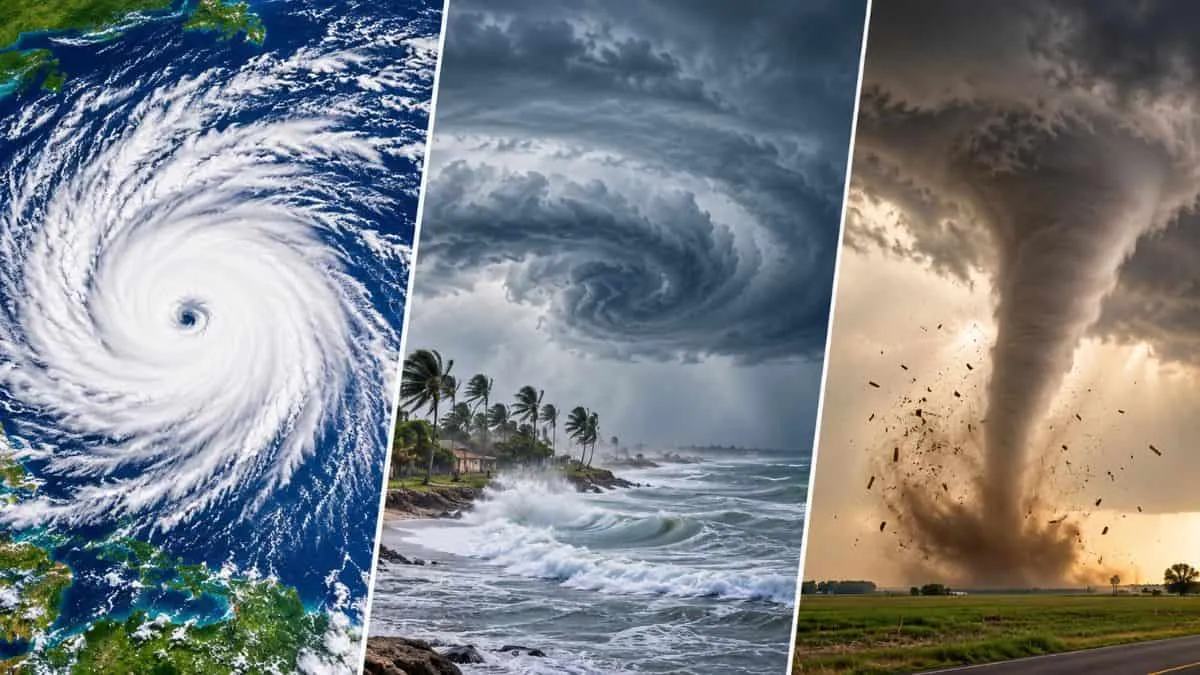
Hurricane vs Cyclone vs Tornado: You have all often heard the word Hurricane, Cyclone and Tornado in the weather news, and in recently, a deep depression over the Bay of Bengal moved toward the north Andhra Pradesh to the south Odisha coast causing heavy rainfall, and strong winds.
This is due to Cyclone Arnab, which is causing the rain and thunderstorms, and the name of this cyclone is given in the North Indian Ocean cyclone naming list.
But all these conditions are also caused by Hurricanes, and even Tornadoes. Then what is the difference between a hurricane, a cyclone, and a tornado?
The only difference between these three is where they are formed which means it depends on the location, how large they are, and how they are moving.
A Hurricane and cyclone are different name for large tropical stroms, and the Tornado is much smaller than these two, but often causes powerful wind-storms.
So, let's explore this article and first learn what a hurricane, Cyclone, and Tornado, and how they are different.
What Is a Hurricane?
A hurricane is a powerful tropical storm that forms over warm ocean water. It has strong winds that rotate around a centre called the eye.
The word hurricane is mainly used for tropical storms in the Atlantic Ocean and the northeastern Pacific Ocean.
Hurricanes can become very large and may bring heavy rain, strong winds and flooding.
What Is a Cyclone?
A cyclone is a large rotating storm system. In everyday weather reports, the word is often used for tropical storms that form over warm seas.
The term cyclone is commonly used in the Indian Ocean and South Pacific regions. For example, storms that form in the Bay of Bengal or the Arabian Sea are called cyclones.
Cyclones can cause strong winds, heavy rainfall, flooding and damage to buildings and trees.
What Is a Tornado?
A tornado is a narrow, rapidly rotating column of air that extends from a thunderstorm cloud down to the ground.
Tornadoes are usually much smaller than hurricanes or cyclones, but their winds can be extremely strong. They can damage houses, vehicles, trees and other structures along their path.
Tornadoes usually last for a shorter time than hurricanes and cyclones.
Hurricane vs Cyclone vs Tornado
|
Feature
|
Hurricane
|
Cyclone
|
Tornado
|
|
What is it?
|
A powerful tropical storm
|
A large rotating storm, often a tropical storm
|
A rapidly rotating column of air
|
|
Where does it form?
|
Warm oceans
|
Usually warm oceans in regions such as the Indian Ocean
|
Usually over land during severe thunderstorms
|
|
Common regions
|
Atlantic and northeastern Pacific
|
Indian Ocean and South Pacific
|
Many parts of the world, especially the central United States
|
|
Size
|
Very large
|
Very large
|
Much smaller
|
|
Main source of energy
|
Warm ocean water
|
Warm ocean water
|
Powerful thunderstorms
|
|
Duration
|
Can last for days
|
Can last for days
|
Usually minutes to about an hour, though some can last longer
|
|
Area affected
|
Hundreds of kilometres
|
Hundreds of kilometres
|
Usually a much narrower path
|
|
Main dangers
|
Strong winds, heavy rain, flooding and storm surge
|
Strong winds, heavy rain, flooding and storm surge
|
Very strong winds and flying debris
|
|
Example
|
Atlantic hurricane
|
Bay of Bengal cyclone
|
Tornado in the United States
|
Are Hurricanes and Cyclones the Same?
Hurricanes and cyclones are closely related to each other, because these both are the types of tropical cyclones that develop over warm ocean water.
But they are different by names only because of their occurrence in different location, as they are called by different names in different oceans regions, which are:
-
In the Atlantic Ocean, they are called hurricanes.
-
In the northeastern Pacific Ocean, they are also called hurricanes.
-
In the Indian Ocean, they are generally called cyclones.
-
In the northwestern Pacific Ocean, they are called typhoons.
So, hurricane, cyclone and typhoon can refer to the same broad type of tropical storm, but the name changes according to the region.
Key Differences at a Glance
|
Point
|
Hurricane/Cyclone
|
Tornado
|
|
Formation
|
Usually forms over warm ocean water
|
Usually develops from severe thunderstorms
|
|
Size
|
Very large
|
Small compared with tropical storms
|
|
Duration
|
Often several days
|
Usually much shorter
|
|
Area covered
|
Large region
|
Narrow path
|
|
Rainfall
|
Can produce widespread heavy rain
|
Rain is usually linked to the parent thunderstorm
|
|
Main danger
|
Strong winds, flooding and storm surge
|
Extremely strong winds and flying debris
|
Important GK Facts
-
Hurricanes and cyclones are types of tropical cyclones.
-
Hurricane is the common name used in the Atlantic and northeastern Pacific.
-
Cyclone is commonly used in regions such as the Indian Ocean.
-
Typhoon is the name used in the northwestern Pacific.
-
Tornadoes are much smaller than hurricanes and cyclones.
-
A hurricane or cyclone can affect a very large area.
-
A tornado usually affects a narrow path.
-
Hurricanes and cyclones mainly get their energy from warm ocean water.
-
Tornadoes are generally associated with powerful thunderstorms.