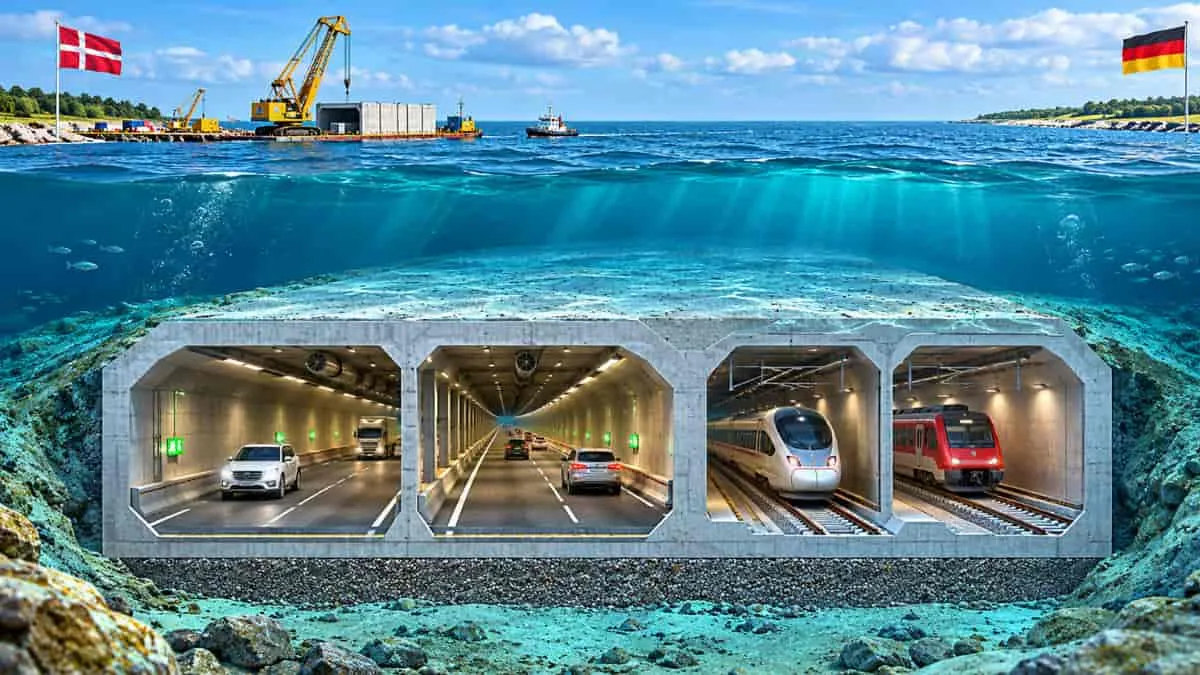
World's Longest Immersed Tunnel: Imagine travelling through a tunnel deep under the sea, where cars and high-speed trains can travel side by side. This is not a scene from a science-fiction movie. It is a real construction project taking shape between Denmark and Germany.
This tunnel is known as the Fehmarnbelt Tunnel, this 18-kilometre-long underwater tunnel will connect the two European countries beneath the Baltic Sea. Once completed, it will become the world's longest immersed road and rail tunnel.
What makes this project special is that it will allow both road vehicles and trains to travel through the same tunnel structure. It is also expected to make travel between Denmark and Germany much faster and easier.
Source: geoengineer
What Is the Fehmarnbelt Tunnel?
The Fehmarnbelt Tunnel is an underwater road and railway tunnel being built between Denmark and Germany. It will pass beneath the Fehmarnbelt Strait, a part of the Baltic Sea that separates the two countries.
The tunnel will connect:
Related Stories
-
Rødbyhavn: Located on the Danish island of Lolland.
Puttgarden: Located on the German island of Fehmarn.
The project is special because it will carry both road traffic and railway traffic. However, cars and trains will not share the same lanes. They will use separate sections inside the tunnel.
According to the official project information, the tunnel will have four road lanes (two in each direction) and two electrified railway tracks.
Fehmarnbelt Tunnel: Key Facts at a Glance
|
Aspcets
|
Details
|
|
Name
|
Fehmarnbelt Tunnel
|
|
Length
|
Around 18 km
|
|
Location
|
Between Denmark and Germany
|
|
Sea
|
Baltic Sea
|
|
Danish connection
|
Rodbyhavn, Lolland
|
|
German connection
|
Puttgarden, Fehmarn
|
|
Type
|
Immersed tunnel
|
|
Road facility
|
Four lanes
|
|
Railway facility
|
Two electrified railway tracks
|
|
Train speed
|
Up to 200 km/h
|
|
Car travel time
|
Around 10 minutes
|
|
Train travel time
|
Around 7 minutes
|
|
Expected completion
|
2029
|
|
Project authority
|
Femern A/S
|
Source: Official Fehmarnbelt Tunnel project factsheet and European Commission.
Why Is the Fehmarnbelt Tunnel So Important?
The Fehmarnbelt Tunnel is not an ordinary underwater tunnel. It is being built to carry both cars and trains under the sea.
Here are some of the main features that make this project different:
-
World's longest immersed tunnel: At around 18 km, it will set a world record for an immersed tunnel.
-
Cars and trains together: It will have separate routes for road vehicles and railway traffic.
-
Faster travel: The journey between Rødbyhavn and Puttgarden will take around 10 minutes by car and 7 minutes by train.
-
High-speed railway: Passenger trains will be able to travel at speeds of up to 200 km/h.
-
Better European connectivity: It will improve transport links between Scandinavia and mainland Europe.
How Will an 18 Km Tunnel Be Built Under the Sea?
One of the most interesting things about this project is its construction method.
Instead of digging the entire tunnel through the seabed, engineers are making large concrete sections on land. These sections are then transported by water and placed inside a prepared trench on the seabed.
This construction method is called an immersed tunnel technique.
The process works in the following steps:
1. Building concrete sections: Large tunnel sections are manufactured at a special factory near Rodbyhavn in Denmark.
2. Transporting the sections: Special vessels and tugboats carry these huge sections towards the prepared tunnel trench.
3. Lowering them underwater: Engineers carefully lower each section into the trench on the seabed.
4. Connecting the sections: The sections are joined together to create one continuous tunnel.
5. Covering the tunnel: Gravel, sand and stones are placed around and over the tunnel to keep it safely in position.
The project includes 79 standard tunnel elements and 10 special elements. Each standard element is around 217 metres long and weighs approximately 73,000 tonnes.
How Will Cars and Trains Run Inside the Same Tunnel?
The Fehmarnbelt Tunnel will have separate sections for cars and trains. This means road vehicles and railway trains will not run on the same track or road.
Its design includes:
-
Four road lanes: Two lanes for traffic in one direction and two lanes for traffic in the opposite direction.
-
Two railway tracks: Electrified tracks for passenger and goods trains.
-
Separate tunnel tubes: Road and railway traffic will use separate tubes for safer and better movement.
This arrangement will allow different types of transport to cross the sea through one large tunnel project.
What Is an Immersed Tunnel?
An immersed tunnel is a tunnel built using large sections that are made on land and then placed underwater.
In simple words, engineers first prepare a deep trench on the seabed. They then lower the ready-made concrete sections into this trench and connect them to form a long tunnel.
This method is different from traditional tunnels, where workers dig through rocks or soil to make a passage.
Interesting fact: The Fehmarnbelt Tunnel will be placed in a trench beneath the Baltic Sea, with the deepest part of the tunnel track around 40 metres below sea level.
How Much Time Will It Take to Cross the Tunnel?
One of the biggest advantages of the Fehmarnbelt Tunnel will be the time it saves for travellers.
At present, people mainly use ferries to cross this stretch of the Baltic Sea. The ferry journey takes around 45 minutes, without counting waiting and loading time.
After the tunnel opens, the same journey will become much shorter.
|
Mode of Transport
|
Expected Travel Time
|
|
Car
|
10 minutes
|
|
Train
|
7 minutes
|
|
Ferry (present route)
|
Around 45 minutes
|
What Is the Current Construction Status of the Fehmarnbelt Tunnel?
The Fehmarnbelt Tunnel is under construction, and important construction work has already been completed.
Some important developments include:
-
May 2026: The first tunnel element was successfully placed on the seabed.
-
June 2026: The second tunnel element was successfully installed.
-
August 2026: The third tunnel element was immersed.
-
September 28, 2026: The fourth tunnel element was installed, bringing the completed immersed section close to 900 metres.
The tunnel is expected to become operational in 2029.
5 Interesting Facts About the Fehmarnbelt Tunnel
-
It will be around 18 kilometres long.
-
It will become the world's longest immersed tunnel.
-
Each standard concrete tunnel element will be around 217 metres long.
-
A standard element weighs approximately 73,000 tonnes.
-
Once operational, a train will cross the tunnel in around 7 minutes.