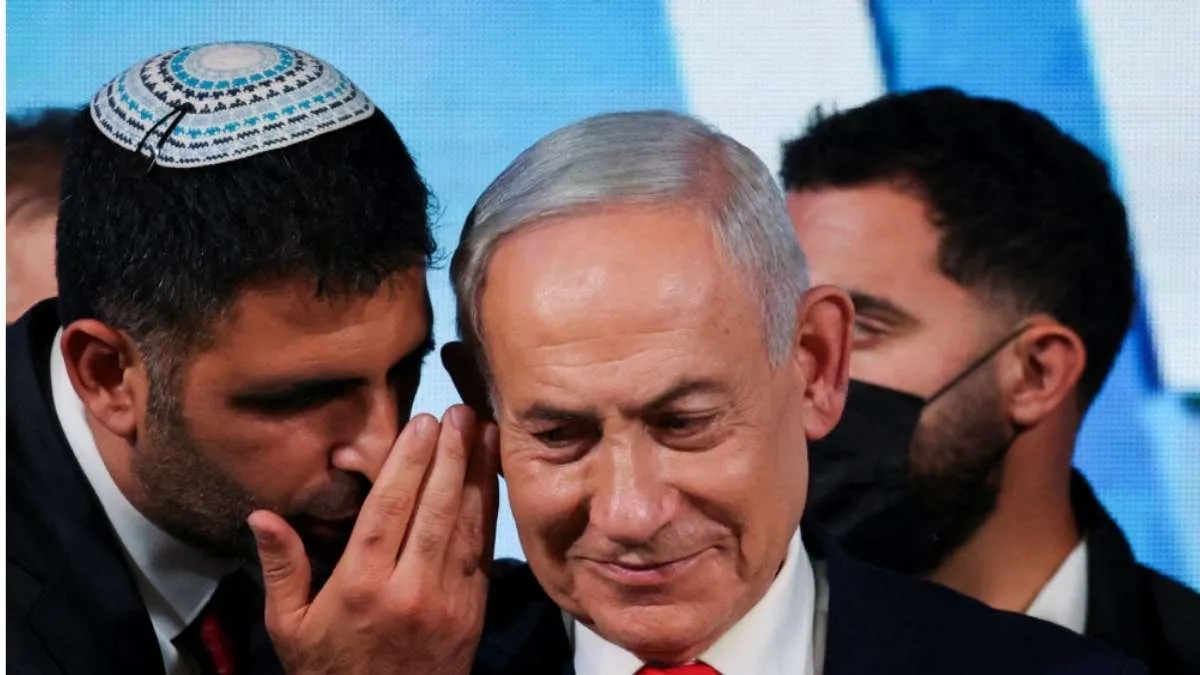
Israel’s political fortune remains uncanny after the completion of vote counting in the country’s parliamentary elections on October 27, as Prime Minister Benjamin Netanyahu’s ruling alliance failed to win the majority to form the next government.
Israel Election 26: Why nobody Won?
According to the recent election figures, Netanyahu’s bloc has secured 53 seats in the 120-member Knesset, while the opposition alliance spearheaded by former military chief Gadi Eisenkot has secured 48 seats. The Arab-led parties have together won 19 seats, thus possibly positioning them in a crucial position during government formation.
A political alliance needs at least 61 seats to carve out a majority in parliament. However, neither of the two main political oppositions has reached that threshold, thus causing possibly difficult coalition negotiations.
Netanyahu’s Likud party became the largest individual political party, by getting 27 seats. Eisenkot’s Yashar party came second with 21 seats, succeeded by Naftali Bennett’s B’Yachad alliance with 12 seats.
Related Stories
Who Will become PM and Form Government in Israel?
The election results feature a massive challenge for Netanyahu, whose governing coalition has lost considerable parliamentary strength. Nevertheless, he remains a primary contender to lead the next government, particularly because the opposition faces difficulties in bringing together parties with differing political positions.
The Arab-led parties could prove crucial in setting the outcome. However, numerous opposition leaders have showcased reservations about comprising a government relying on their support. This has intensified Eisenkot’s efforts to assemble a viable parliamentary majority.
Meanwhile, the likelihood of a national unity government has also surfaced as a possible solution to the political deadlock. However, disagreements between Netanyahu and opposition leaders make such a settlement difficult.
President Isaac Herzog is slated to win the official election results before consulting political parties and deciding which candidate should be granted the opportunity to comprise a government.
Meanwhile, the election has also been accompanied by allegations igniting potential electoral irregularities and foreign intervention. Israeli security authorities are reviewing the claims, although election officials have sustained that the integrity of the voting process has not been affected.
If coalition negotiations fail, Israel could face another election, thus prolonging the country's political upheavel.
What happens when no one gets a majority in Israel Election 2026?
As no party is able to form a majority, then a new election is expected to be declared in the next few months, and the similar process would begin all over again.
Aformentioned, the Netanyahu government would continue as a caretaker, and public services would not be hit. Still, as a caretaker, Netanyahu would not possess that much right to implement important policy changes.
And another poll may not completely resolve the issue.