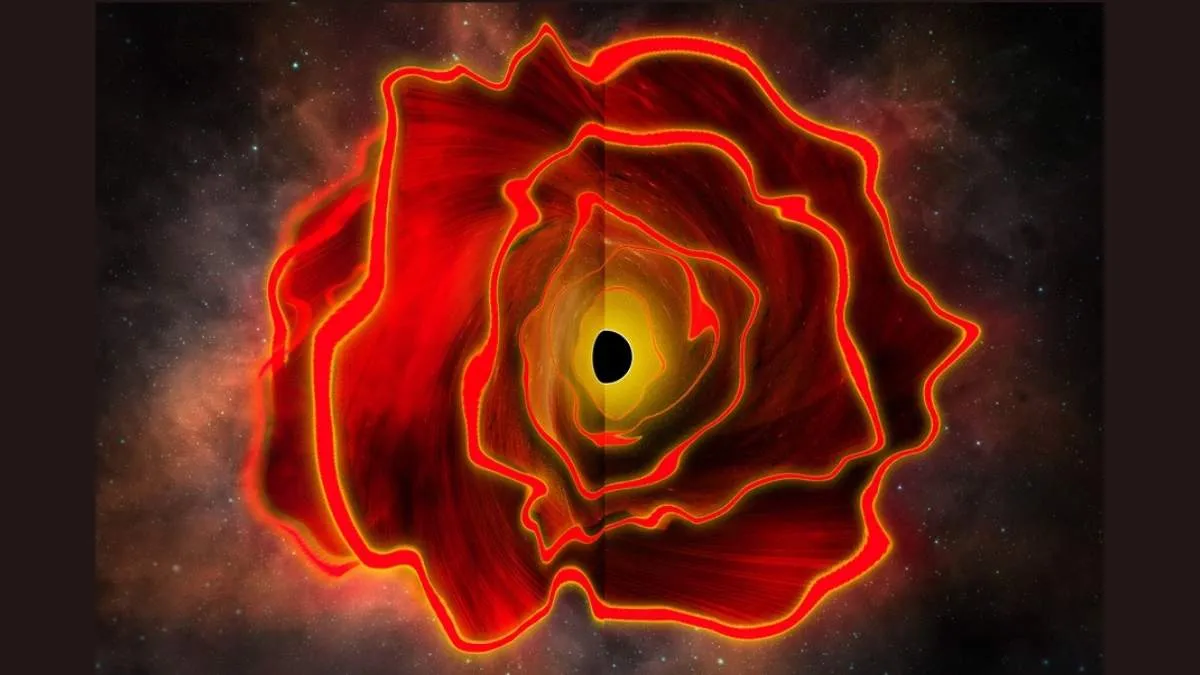
International researchers while analysing deep space imagery from NASA’s James Webb Space Telescope (JWST) have discovered a cosmic body termed a black hole star. The newly discovered Black Hole star is located in the constellation Cetus. This mysterious space object is cataloged as MoM-BH*-1 which is formed 660 million years after the Big Bang.
Dr. Rohan Naidu of MIT’s Kavli Institute notes that this object "shines with the energy typically associated with black holes but at the same time bears signatures classically associated with stars."
Let’s read more about what is a Black Hole star to better understand its discovery as a science and space enthusiast hereonwards.
What is a Black Hole Star?
Scientists for months were puzzled over mysterious little red dots appearing across every JWST deep field imagery of space. Computer simulations published in Nature reveal that MoM-BH*-1 is not a standard star powered by nuclear fusion. It is in fact a central black hole wrapped in dense clouds of gas. That gas gets so hot that it glows brightly like a giant star.
|
Feature
|
Regular Star
|
Black Hole Star (MoM-BH*-1)
|
|
Energy Source
|
Nuclear fusion in core
|
Gas falling into a black hole
|
|
Size
|
Up to a few million miles
|
Size of our entire solar system
|
|
Brightness
|
Standard star light
|
100 billion times brighter than normal stars
|
|
Color
|
Yellow, white, or red
|
Deep red with a sharp light cutoff
|
Why This Black Hole Star Discovery Matters
For a long time astrophysicists questioned how supermassive black holes grew so quickly in the early universe. And this discovery within the Black Hole suggests that black hole stars act as the missing evolutionary link. They serve as seeds for large black holes like the one at the center of our Milky Way.
These hybrid objects also provides critical insights into how early galaxies like ours were formed and grew. By bridging the gap between stellar physics and giant black holes scientists are gaining a clearer picture of cosmic history.