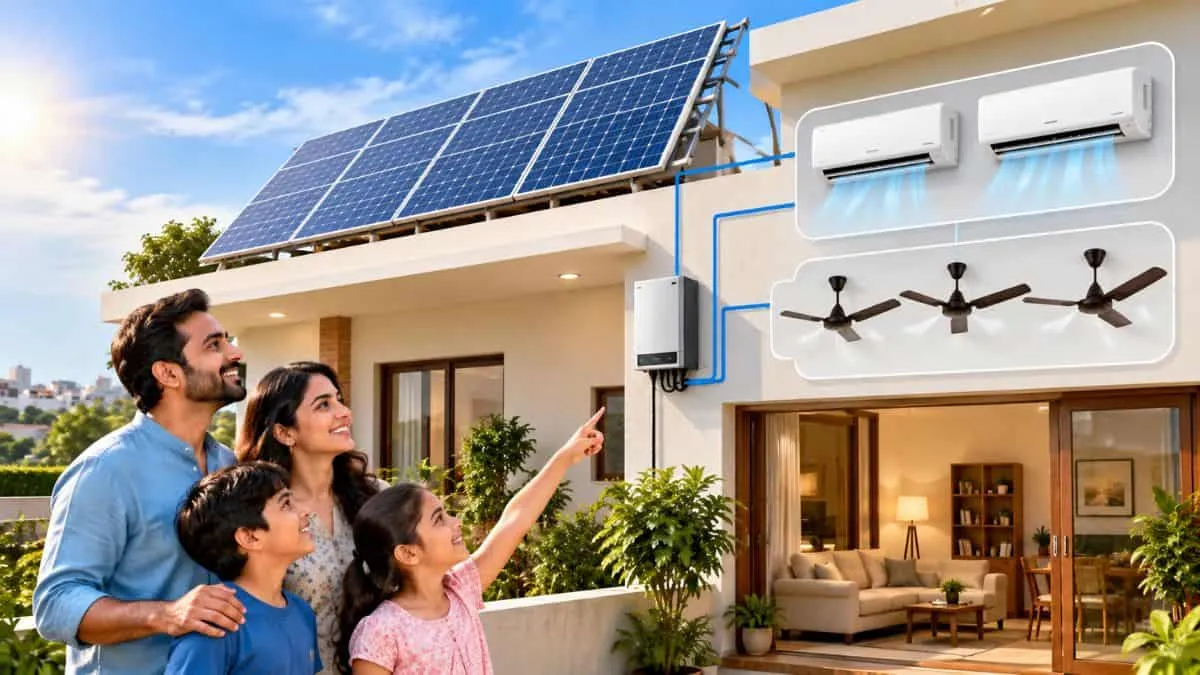
Summer means more use of air conditioners, fans and other electrical appliances at home. With the rising cost of electricity, many are now considering rooftop solar as a solution to lower their electricity bills.
The PM Surya Ghar: Muft Bijli Yojana has also boosted the interest of households in rooftop solar systems.
However, if you have 2 inverter ACs and 3 fans at home, you might have one question to answer: How many solar panels are needed to run 2 inverter ACs and 3 fans?
There is no single solution to every house as electricity consumption varies from house to house, depending on the AC capacity, running hours, fan wattage and other appliances used.
But we can come up with an approximation by looking at a typical household.
How Much Electricity Do Two Inverter ACs and Three Fans Use?
Suppose you have two 1.5-ton inverter ACs at home. The power needs of an inverter AC constantly fluctuate. May use more power when cooling is required quickly, and less when cooling is required after the set temperature is achieved.
Such an AC can be purchased around 1200-1500 watts depending on the ease of calculation. So, two ACs can consume approximately 2,400-3,000 watts.
Next add three ceiling fans. Three fans could consume 180-225 watts, while one fan consumes about 60-75 watts.
Thus, if the two ACs and three fans are all operating at the same time, the load can be estimated to be about 2.6 to 3.2 kW.
This is just a sample. The actual consumption of your ACs can be higher or lower depending on their energy rating, temperature setting and usage.
How Many Solar Panels Will You Need?
This is where the size of the solar system becomes important.
For example, if you choose 550-watt solar panels, a 5 kW system would require about 10 panels, while a 6 kW system would require about 11 panels.
|
Solar System
|
Approx. 550-Watt Panels
|
|
3 kW
|
6 panels
|
|
4 kW
|
8 panels
|
|
5 kW
|
10 panels
|
|
6 kW
|
11 panels
|
For a house with two inverter ACs and three fans, a 5 kW or 6 kW system can be considered as a starting point, particularly if the home also has a refrigerator, washing machine, television, lights, water pump and other appliances.
So, if you are using 550-watt panels, you may need around 10 to 11 panels for a 5–6 kW system.
But this does not mean that every house with two ACs must install exactly 10 or 11 panels. Your electricity bill is a better indicator of the system size you actually need.
Can a 3 kW Solar System Run Two ACs?
If some common household appliances like fans, lights, refrigerator, TV and other small loads are needed, then a 3kW rooftop solar system can help them.
Two ACs can, however, add up the electricity consumption significantly however. When both of the ACs are operating, not to mention the fans and other equipment, sometimes a 3kW system might not be able to generate enough solar power to meet the total.
This is why, if a household uses two ACs regularly, then it may be better to consider a larger AC that is 5 kW or 6 kW.
What Is the PM Surya Ghar Yojana?
PM Surya Ghar: Muft Bijli Yojana, the scheme of the government, is designed to boost the installation of rooftop solar panels among residential households.
Under the Central Financial Assistance structure, eligible residential consumers can receive:
-
₹30,000 per kW for the first 2 kW
-
₹18,000 for the additional 1 kW
-
Maximum central subsidy of ₹78,000
How Much Roof Space Will You Need?
The number of panels is also linked to the available roof space.
A rough planning estimate is around 100 square feet of rooftop area for every 1 kW of solar capacity. The actual space can vary depending on the panel size, layout and mounting structure.
For example:
|
Solar Capacity
|
Approx. Roof Area
|
|
3 kW
|
Around 300 sq ft
|
|
4 kW
|
Around 400 sq ft
|
|
5 kW
|
Around 500 sq ft
|
|
6 kW
|
Around 600 sq ft
|
The roof should ideally have good sunlight and as little shadow as possible during the day.
Will the ACs Work on Solar at Night?
It's a key point that house owners need to grasp prior to installing rooftop solar.
Solar power is created by solar panels when the sun is shining. A conventional grid-tied solar power system thus cannot generate solar power during the night.
In the day, the electricity produced by the panels can be utilized by the home. When the power generated is more than the household's consumption, the surplus power can be fed into the grid, as per the prevailing net metering policy.
The house typically uses electricity from the grid at night.
For those who wish to use electricity generated by the sun even after dark, a battery storage system would be required. That's a different configuration, and will cost more.
Do You Need Only Solar Panels?
No. In addition, other components are vital to a rooftop solar system, notably the Solar inverter and mounting structure.
The inverter should be appropriate for the solar power system and the electrical needs of the household. It's also crucial to inspect the sanctioned load of your electrical link before installation.
For two A/cs it is advisable to think of your total home load; not just the ACs and fans.
Check Your Electricity Bill Before Installing Solar
The simplest method to determine your requirement is to check your electricity bills over the last couple of months.
Just look at the amount of energy that your family typically consumes. Also, note if you use your air conditioning a lot during the summer months.
For instance, a family using two ACs for several hours daily will have different needs compared to another family that only uses the AC during their nighttime hours.
That's why sometimes two houses with the same number of ACs require different amounts of solar power.
So, How Many Panels Are Needed?
Let's take an example here, in case of 2 inverter ACs and 3 fan units, one can consider the 5-6 kW rooftop solar system for the household consumption.
If 550-watt panels are used:
- 5 kW system → around 10 panels
- 6 kW system → around 11 panels
A 6 kW system is better suited for a house with a larger electric consumption, particularly if the ACs are in use on a regular basis, as well as other appliances. The final capacity, however, should be done based on the actual use of electricity, the available sunlight and the electricity sanctioned to the house.
With the existing subsidy available under the PM Surya Ghar scheme, rooftop solar can become more affordable, however, the size of the solar system should not be the only determining factor for subsidy.