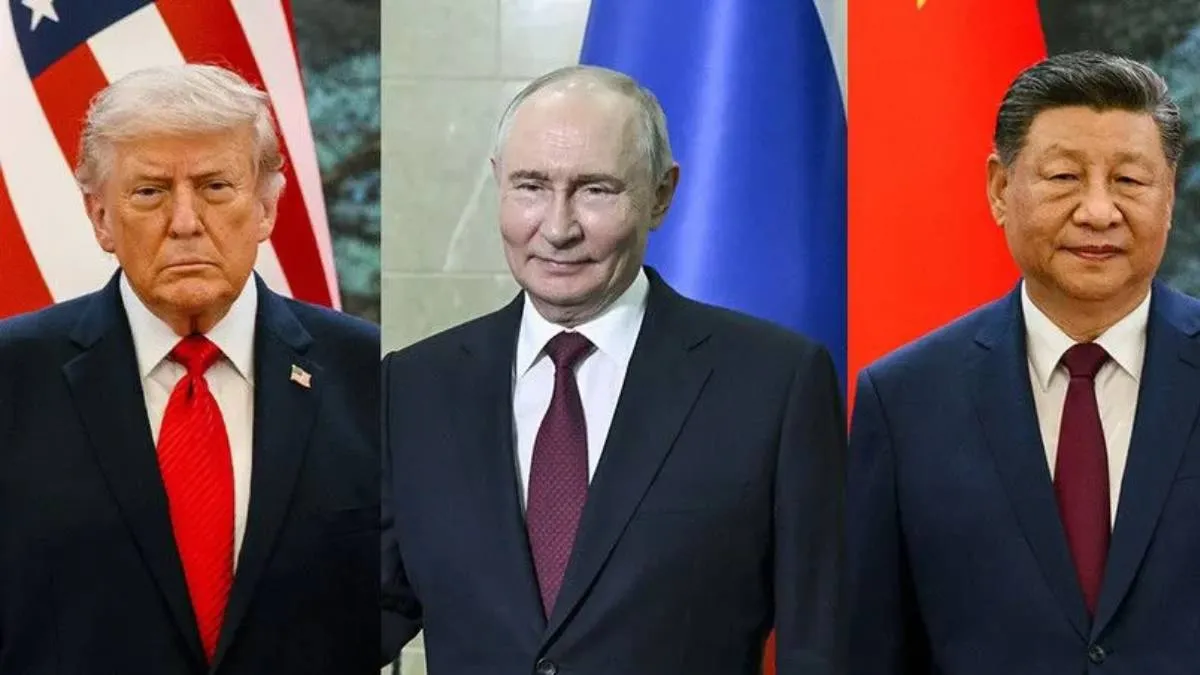
The leaders of the United States, China and Russia are planning a first-ever trilateral meeting at the APEC summit in Shenzhen. US President Donald Trump, Chinese President Xi Jinping and Russian President Vladimir Putin are likely to meet on Thursday, November 19.
The White House confirmed the meet on Friday, and the Kremlin confirmed it on Saturday. The meeting comes amid the Iran war conflict, Russia-Ukraine war and US-China competition. Experts forecast symbolism rather than massive historic agreements.
Agenda of Trump-XI-Putin Historic Meet
Trump wants to deliberate upon nuclear weapons with Xi and Putin and explore a latest agreement spanning across the three countries’ arsenals. The previous nuclear arms treaty between the US and Russia, known as New START, expired in February. Its end scrapped restrictions on the two largest nuclear stockpiles for the maiden time in more than five decades.
A senior US official stated that the meeting could initiate a conversation on nuclear disarmament, but no deal is confirmed. Pentagon estimates place China’s arsenal at more than 600 warheads, compared with over 5,000 each for the United States and Russia. Meanwhile, China has shown negligible interest in a trilateral arms-control contract, partly because its stockpile is lesser.
Related Stories
Different priorities converge at first-ever trilateral meeting in 2026
The leaders are approaching the meeting with varied goals. Trump plans to discuss the Iran war with Xi and Putin, but a US official said Ukraine would not be on his agenda for the trilateral meet. Moreover, Putin may seek to appear on equal diplomatic wavelength with the US and China.
While, Xi’s decision to host the talks could reflect China’s influence. However, the meeting may complicate China’s bid as a supporter of multilateralism and free trade during the APEC summit, visited by 21 economies.
As the US president's improvisational approach clashes with Xi's typical approach to high-profile events. And Trump's hope for arms control hits against the reality that China — which has far lesser nuclear weapons than the US or Russia — perceives itself a nuclear underdog.
"This is something the Chinese hate," said Edgard Kagan, a former senior Biden White House official for East Asia. "I think it’s fair to say the Chinese do not want arms control discussions with the United States. And they certainly don’t want to do it with the United States and Russia, because it suggests that they accept the framing that they are now a major nuclear power that should be subject to similar restrictions."
Major global implications of the APEC Summit 2026
Ukrainian President Volodymyr Zelenskyy has exuded concerns that the leaders could finalise a settlement without Ukraine’s presence. Thus, the prospective talks has fuelled comparisons with the 1945 Yalta Conference, where major Allied powers discussed Europe’s post-war adjustments. Meanwhile, Kremlin spokesman Dmitry Peskov dismissed the comparison, saying any result could not be enforced on other countries.
Even before the meeting, China and Russia have sustained close relations, and their leaders have met repeatedly. Trump has also held individual meetings with Xi and Putin. However, positioning all three together for the first time would be unprecedented.
Thus, the Shenzhen meeting may be critically watched less for instant deals than for signals about nuclear security, the Iran conflict, global power shift and world order.