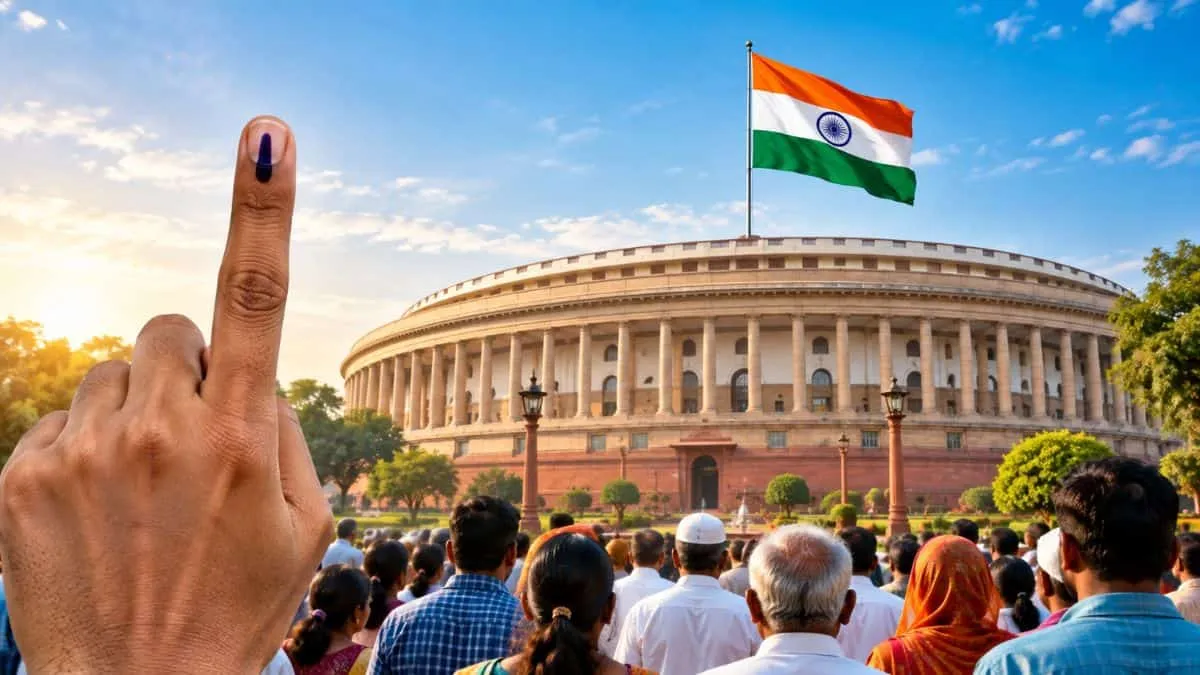
India is the largest democracy in the world. India is called the “largest democracy in the world” and the largest practicing democracy by the Election Commission of India (ECI) itself. India is a very large country, has regular elections, and upholds a democratic system based on the Constitution.
Democracy means a type of government in which citizens elect their leaders. In India citizens who are eligible to vote can vote for those who represent them at the national and state levels.
Why Is India Called the Largest Democracy in the World?
India is Called the Largest Democracy in the World because there are a lot of people involved in the election process. There are hundreds of millions of voters in India. Elections take place all over the country, in cities, villages and remote areas.
The Lok Sabha election 2024 is a clear reference on the magnitude of India's democracy. The Election Commission of India estimated that the total number of registered electors in the last electoral rolls for the 2024 General Election was 968.8 million.
This was more than 72.8 million more than the 2019 value. There is also a provision for elections based on adult suffrage in the constitution of India.
The Rule of Article 326 of the Indian Constitution states that a person who is an Indian citizen, and is aged 18 or more is not disqualified by any law, may be enrolled as a voter.
India: Largest Democracy at a Glance
|
Aspects
|
Details
|
|
Largest democracy in the World
|
India
|
|
Democratic system
|
Parliamentary democracy
|
|
Election authority
|
Election Commission of India
|
|
Voting age
|
18 years
|
|
2024 registered electors
|
968.8 million
|
|
Lok Sabha constituencies
|
543
|
|
Lok Sabha term
|
5 years
|
|
Election Commission established
|
25 January 1950
|
|
Constitution came into force
|
26 January 1950
|
The Election Commission of India is a constitutional body responsible for conducting elections to Parliament, State Legislative Assemblies and the offices of the President and Vice-President.
How Does Democracy Work in India?
India follows a parliamentary system of government. The Lok Sabha and State Legislative Assemblies are elected by the people.
The Parliament at the National level is made up of the President, Lok Sabha and Rajya Sabha. Lok Sabha is elected from parliamentary constituencies and it represents the people.
The country is divided into 543 Parliamentary Constituencies for elections to the Lok Sabha. The Lok Sabha is elected by the people from each constituency.
There are also State Legislative Assemblies elected. This means that people can elect representatives for the central government, as well as their state governments.
India Elections
India has a very large population spread across different types of places. Elections therefore have to be conducted in cities, villages, mountains, forests, islands and other difficult areas.
The scale can be understood from the 2024 election figures. The ECI recorded 968.8 million electors in the final electoral rolls. More than 18.4 million electors were in the 18–19 age group, showing the participation of young voters in the democratic process.
The Election Commission also reported that the 2024 General Election involved 743 political parties and 20,271 candidates.
When was the First general election held in India?
India's first General Election was held in 1951–52. At that time, the country had about 173.2 million registered electors.
The number of voters has increased greatly over the years. The ECI's election data shows the growth from about 173 million electors in 1951–52 to nearly 970 million in 2024.
This long record of regular elections is an important part of India's democratic journey.
Growth in India's Electorate
|
General Election
|
Registered Electors
|
|
1951–52
|
173.2 million
|
|
1971
|
274.2 million
|
|
1991–92
|
511.5 million
|
|
2004
|
671.5 million
|
|
2014
|
834.1 million
|
|
2019
|
912.0 million
|
|
2024
|
968.8 million
|
Source:(Election Commission of India)
Voting Right In India
The constitution of India upholds the right to participate in elections as per the Universal Adult Franchise. The Constitution of India, Article 326, provides for adult suffrage for Lok Sabha and State Legislative Assemblies. As per law, Indian citizens, at least 18 years old, can be registered as voters.
The Constitution also states that an individual cannot be denied registration on a general electoral roll on the basis of religion, race, caste or sex, which is mentioned in the Article 325.
Who Conducts Elections in India?
The Election Commission of India (ECI) conducts and supervise elections in the country. It was constituted on 25th January, 1950, one day prior to the Constitution of India.
The Constitution provides the Election Commission with authority over the preparation of electoral rolls and over the conduct of elections to Parliament, State Legislatures, to the President and to the Vice-President.
Why Is India Democracy Different From Other Countries' Democracies?
There are lots of democratic nations around the globe. The number of eligible voters and the size of the electorate in India is, however, very large and the scale of electoral activity is very large.
There is also a democratic system in India at various levels. The citizens of the country elect members to the Lok Sabha and State Legislative Assemblies, and there are elected representatives of local governments as well.
India's electoral history is about 80th Independence Day of successful, transparent and credible elections, the ECI says, calling it the world's largest democracy.
Conclusion
India is the biggest democracy of the world. Its government is democratic, which is governed by the constitution and regular elections. India's electoral process is one of the largest democratic exercise in the world because of its size of the electorate.
India's democracy is immense with the 2024 General Election which has 968.8 million registered electors. India has been conducting its General Election since 1951–52 and has also provided a platform to the eligible citizens to elect their representatives.