Total Lunar Eclipse 2026: Chandra Grahan Date, Timings, and Visibility
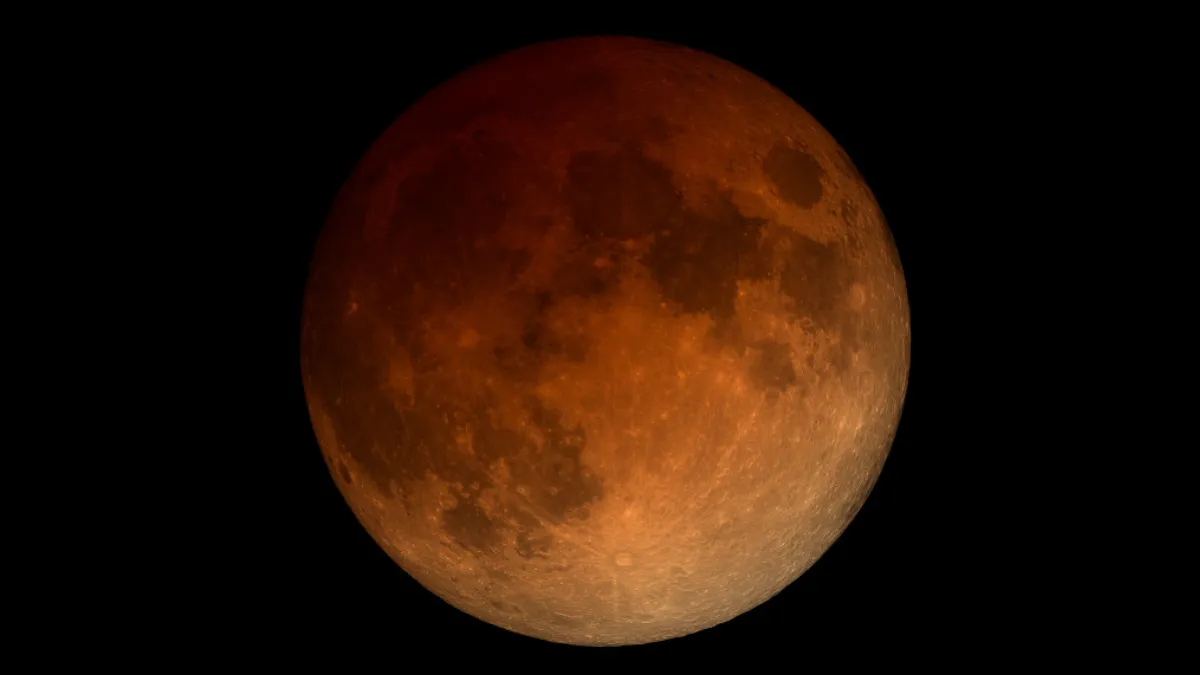
The March 3, 2026 total lunar eclipse will paint the Moon red as Earth’s shadow fully covers it. India will witness only the final phase after moonrise, making it a brief yet striking sky event. The phenomenon occurs when sunlight filtered through Earth’s atmosphere gives the Moon its Blood Moon glow.
Key Points
- Total Lunar Eclipse (Blood Moon) occurs March 3, 2026, visible in Americas, Europe, Africa, Asia.
- In India, the eclipse starts 2:14 PM IST, peak 6:33-6:40 PM; best views in eastern regions.
- Eclipse is safe to view without filters; use apps like TimeandDate for local timings.
The first big astronomical event of the year will occur in the sky on March 3 with the Total Lunar Eclipse of 2026, also known as the Chandra Grahan in India.
This beautiful Blood Moon, an event with the Moon appearing deep reddish in color will partially be seen over India immediately after moonrise. This will be a worthwhile skywatching event as Holi celebrations begin.
What are the Date and Timings for Solar Eclipse 2026?
Universal Time (UTC): Eclipse begins with the penumbral phase when the outer shadow of the Earth falls first on the Moon on March 3 at 08:44 UTC.
The total period is 11:04 UTC to 12:02 UTC and the total time of complete coverage of the shadow is 58 minutes. It completely ends at 14:22 UTC following over five and half hours in total.
India (IST) Times: To viewers in India, the action will start at 2:14 PM IST with the penumbral start, then umbral entry at around 3:20-3:21 PM. The peak of the eclipse is 6:33-6:40 PM and the eclipse stops at 6:46-47 PM.
The majority of the action takes place prior to sunset, thus Indians will only get to see the last 20-25 minutes after moonrise (usually 6:22-6:26 PM in such cities as Delhi or Mumbai), meaning a fast but theatrical performance.
Where to Watch the Solar Eclipse 2026?
The eclipse will be a delight to skywatchers all over the world since the whole of the Americas, Europe, Africa, and a good part of Asia will experience the eclipse as long as there is nighttime during totality.
Nationally in India, each region of the country gets its share after moonrise but the eastern areas are the better views, such as Kolkata or Guwahati would give the best view of the late stages with the least amount of obstruction.
The penumbral (outer shadow) effects may be largely experienced in the western cities such as Mumbai or Ahmedabad, and the reddish Moon will be peeking low in the eastern horizon in Delhi, Chennai and Bengaluru; and no special travelling is required since it is pan-India.
What is the Science Behind this Solar Eclipse?
Think of having the Sun, Earth and Moon spaced out so that they are directly in line with each other in space, that is all you need to have a total lunar eclipse.
The Sun, the Moon, and the Earth slide into each other, and the Moon is completely covered (with an eclipse magnitude of 100 percent) by the dark central shadow of the Earth (referred to as the umbra).
The trick lies herein that the atmosphere of the earth is a huge filter of sorts. It curves the sunlight around the earth scattering shorter colors blue in the process and allowing the longer red rays to enter to give the Moon its strange crimson appearance, to which it is given the name of Blood Moon.
The entire period of shadow is 58 minutes in the total 5 hours and 39 minutes of the entire event with the Moon at the constellation Leo at an apogee (11:34 UTC). This is the 27th of 71 Saros series eclipses 133 (of 133 total), occurring only 6.5 days after lunar perigee, thus the Moon is a little smaller than normal but no less impressive.
It is completely safe to your eyes due to watching, and you do not need filters and telescopes to observe it, which is in contrast to the dangerous aspects of solar eclipses.
Go out at about 6-7 PM IST after the moon has risen, locate a place where one has a clear view of the eastern horizon (not in the vicinity of tall buildings or bright city lights), and watch the reddish Moon coming up.
You can get free applications, such as TimeandDate, Stellarium, or SkySafari, to give you the exact local timings, simulation of the moon position, and signals to add more flavour to the experience without much trouble.
List of Solar and Lunar Eclipses in 2026, Check Dates and Time!

Kirti Sharma is a journalist in the education domain with three and a half years of experience creating high-quality content for the education technology (EdTech) and digital media industries. She has an expertise in covering education news. Kirti has experience in writing data backed informational pieces on General knowledge.
Kirti holds a Bachelor of Arts degree, which helped build her strong foundation in writing and research. Over the course of her career, she has brought her skills to a variety of well-known companies, including ThoughtPartners Global, Infinite Group, and MIM-Essay. Through these roles, she has learned how to take complex information and turn it into engaging, easy-to-understand content for readers online.