What is Super-Diamond & how it was created? Its Significance & Industrial Scientific Applications
Chinese scientists have developed a super diamond, an ultra-hard material with a hexagonal crystal structure (lonsdaleite), making it 40% harder than natural diamonds. This breakthrough holds immense industrial and scientific applications in cutting tools, aerospace, semiconductors, and laser technology, paving the way for next-generation materials with high thermal stability.
Chinese scientists have successfully developed a high-quality “super diamond” in the laboratory, exhibiting a hardness far greater than natural diamonds. This breakthrough holds significant industrial potential, particularly in sectors requiring ultra-hard materials for cutting, polishing, and drilling.
What is Super-Diamond?
A super diamond refers to an ultra-hard diamond with a hexagonal crystal structure, scientifically known as lonsdaleite. It is significantly 40% harder than natural diamonds, which typically have a cubic crystal structure. The material has been historically rare, found only in impact craters from meteorite collisions.
Understanding the Super Diamond
Super-diamonds possess a hexagonal structure which was first discovered in meteorites and are approximately 40% harder than natural ones. Here it is given its description in detail:
- Structure: Unlike traditional diamonds with a cubic crystalline structure, this newly synthesized diamond, known as lonsdaleite, possesses a hexagonal crystal structure.
- Origin: First discovered in meteorites, lonsdaleite had only been found in impact craters until now.
- Hardness: It is approximately 40% harder than natural diamonds, making it one of the toughest known materials.
- Thermal Stability: This diamond also exhibits higher thermal stability than nanodiamonds, enhancing its industrial applications.
Source: Jilin University
What is the Significance of the Super-Diamond?
This achievement not only advances material science but also provides valuable insights into diamond formation. Previously, attempts to create hexagonal diamonds in a laboratory had limited success, but this new technique may pave the way for more efficient fabrication methods.
Comparing Natural vs. Super Diamond
| Feature | Natural Diamond | Super Diamond (Lonsdaleite) |
| Crystal Structure | Cubic | Hexagonal |
| Hardness | Standard | 40% harder |
| Thermal Stability | Moderate | High |
| Occurrence | Naturally found | Lab-synthesized |
| Heat Resistance | ~800°C | ~1,100°C |
| Synthetic Production | Limited success | Breakthrough method |
How Super-Diamond was Created?
The Science Behind the Discovery
Most natural diamonds have a cubic atomic structure, which contributes to their renowned hardness. However, a hexagonal atomic structure, known as lonsdaleite, is theoretically even stronger. Lonsdaleite is naturally found in meteorite impact sites but is extremely rare and difficult to synthesize in a laboratory.
Researchers at Jilin University, China, have now successfully produced high-quality hexagonal diamonds by applying a precise combination of high temperature and pressure to compressed graphite. This method has led to the creation of an ultra-hard, heat-resistant material with unique structural properties
Scientific Validation
- The findings were published in the peer-reviewed journal Nature Materials on February 10.
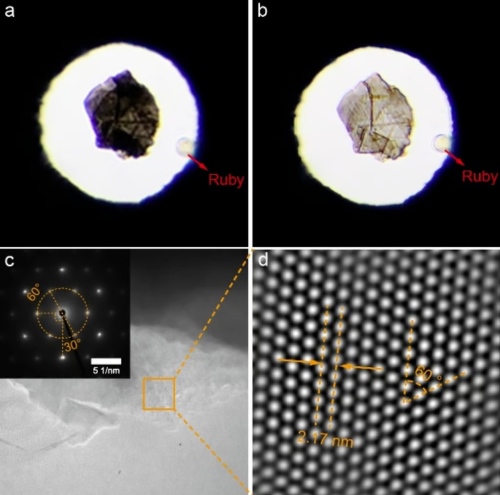
- Optical and electron microscope images confirmed the formation of well-crystallized, nearly pure hexagonal diamonds.
Industrial and Scientific Applications
This cutting-edge material could lead to numerous advancements across multiple industries:
1. Industrial Manufacturing
- Cutting Tools: Used in drilling, mining, and precision machining.
- Aerospace Engineering: Can withstand high-stress environments and extreme temperatures.
2. Electronics and Technology
- Semiconductors: Heat-resistant properties make it ideal for next-generation electronic devices.
- Laser Technology: Can be utilized in high-performance optics and laser applications.
3. Potential Use in Jewelry
Although primarily developed for industrial purposes, the remarkable hardness and durability of this super diamond could open new avenues in luxury jewelry, offering an alternative to natural diamonds.
Comparison with Previous Research
In 2021, a team of US researchers synthesized hexagonal diamonds large enough to measure their stiffness using sound waves. At the time, their study suggested that hexagonal diamonds could outperform cubic diamonds in industrial applications.
Future Prospects
- Scientists believe further research will help scale up production and refine the synthesis process.
- There is potential for this material to replace traditional diamonds in various high-tech applications.
- Researchers continue to explore the feasibility of using hexagonal diamonds in luxury jewelry.
Conclusion
The development of this super diamond represents a major technological milestone. With its unparalleled hardness and heat resistance, this material has the potential to redefine industries ranging from manufacturing to high-tech electronics. While industrial applications are the primary focus, the possibility of super diamonds in jewelry remains an exciting prospect for the future.
This discovery showcases China's growing leadership in advanced material science, setting the stage for groundbreaking innovations in synthetic diamonds and ultra-hard materials.

Prabhat Mishra is a Subject Matter Expert and digital journalist with an extensive background in the competitive exam landscape and over 4 years of experience in education, national and international news, and current affairs. Over his tenure with top knowledge platforms like Mentorship India, IAS BABA, IAS SARTHI, and now Jagran Josh, he has a deep understanding of government exams like UPSC and State PCS, including UP and Bihar, as he has already qualified for the UPPCS 2022 Mains and Bihar 68th Mains. With his core expertise in history, polity, geography & current affairs, he specialises in creating well-researched, aspirant-centric content and simplifying complex topics for competitive examinations.