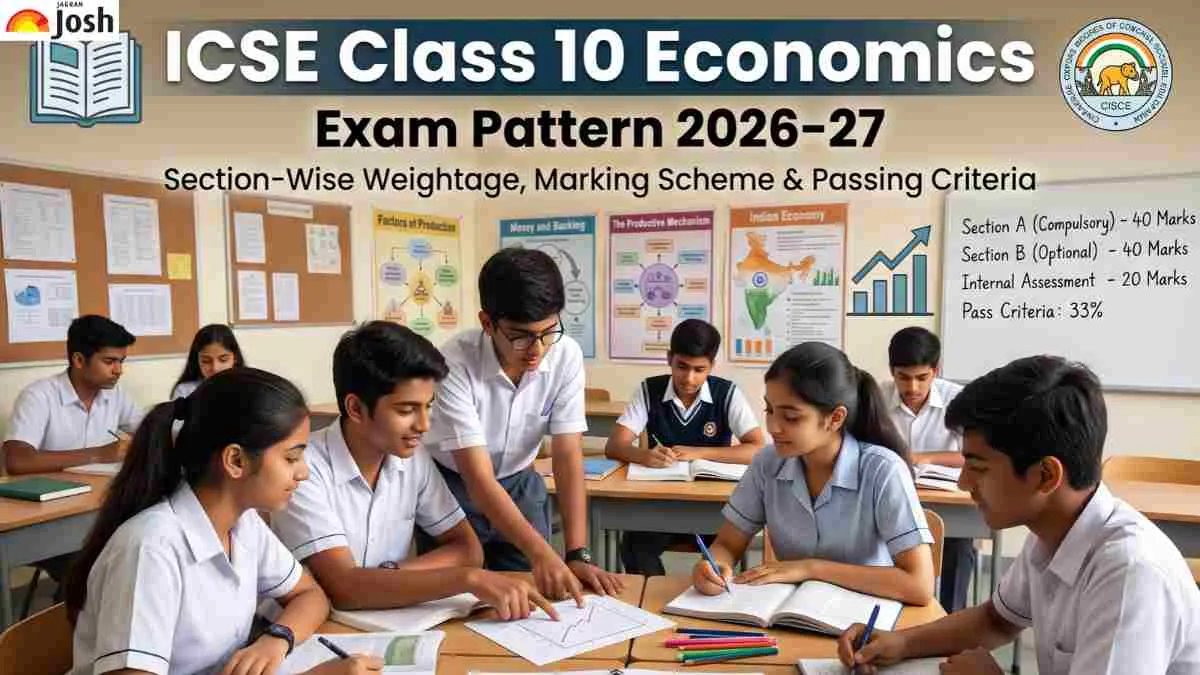
ICSE Class 10 Economics Exam Pattern 2026-27: The ICSE Class 10 Economics Syllabus (Group II Elective) provided by the Council for the Indian School Certificate Examinations (CISCE) familiarizes learners with fundamental concepts related to microeconomics and macroeconomics, such as consumption, production, money, government budget, and the economy. In order to secure good grades in the board exam, it is imperative that candidates have a sound knowledge of the pattern of questions, marking distribution, and distribution of topics.
Economic concepts, understanding, analysis, practical applications of economic concepts, and graphical solutions of economics will be assessed in this exam. Total examination structure will comprise of a 80-mark exam paper conducted externally over 2 hours and a 20-mark internal test.
Also Check: ICSE Class 10 Syllabus 2026-27
ICSE Class 10 Economics Question Paper Blueprint
There is also a writing time for the external theory exam, which consists of 2 hours and 15 minutes for preliminary reading time. The paper consists of two different parts:
Related Stories
|
Section / Part
|
Nature of Questions
|
Question Typology & Choices
|
Total Marks
|
|
Section A
|
Compulsory
|
16 Multiple Choice Questions (1 mark each) + short conceptual/definition-based questions (2 marks each) covering the complete syllabus
|
40 Marks
|
|
Section B
|
Optional Choice
|
6 structured long-answer questions (10 marks each, typically divided into sub-parts of 2+2+3+3 or 5+5); candidates must attempt any 4 questions
|
40 Marks
|
|
Total
|
—
|
Written Theory Paper Total
|
80 Marks
|
ICSE Class 10 Economics Exam Pattern 2026-27: Key Highlights
Below are the key highlights related to the ICSE Class 10 Economics Exam Pattern 2026-27:
|
Parameter
|
Examination Details
|
|
Academic Session
|
2026–2027 (Board Examination: February–March 2026)
|
|
Conducting Authority
|
Council for the Indian School Certificate Examinations (CISCE)
|
|
Subject Title
|
Economics (Group II Elective)
|
|
Total Marks
|
100 Marks (80 Marks External Theory + 20 Marks Internal Assessment)
|
|
Exam Duration
|
2 Hours (120 minutes) + 15 minutes reading time
|
|
Minimum Qualifying Marks
|
33% aggregate across theory and internal components
|
|
Section A (Compulsory)
|
40 Marks (Objective MCQs, short definitions, distinctions, and direct concept questions)
|
|
Section B (Choice-Based)
|
40 Marks (Attempt any 4 out of 6 structured descriptive questions)
|
|
Internal Assessment
|
20 Marks (One practical project/assignment, record documentation, and viva-voce)
|
|
Negative Marking
|
None
|
ICSE Class 10 Economics Topic-Wise Weightage & Marks Distribution
The syllabus for ICSE Economics Class 10 covers microeconomic processes, macroeconomic institutions, and consumer laws. Considering the standard mark allocations for the blueprint and specimen papers, the marking scheme by topic is as follows:
|
Topic / Unit
|
Key Concepts & Chapters Covered
|
Approximate Weightage
|
|
The Productive Mechanism
|
Factors of production (Land, Labour, Capital, Entrepreneur); division of labour; efficiency of Indian labour; process and need for capital formation
|
10 – 12 Marks
|
|
Theory of Demand and Supply
|
Law of demand & supply; schedules and curves; movements vs. shifts; determinants and exceptions; price elasticity of demand and supply (percentage method)
|
12 – 14 Marks
|
|
Market Structures
|
Meaning and features of Perfect Competition, Monopoly, Monopolistic Competition, and Oligopoly; distinctions between market types
|
8 – 10 Marks
|
|
Money and Banking
|
Barter system limitations; functions of money; Commercial Banks (credit creation, deposit/loan types); Central Bank (functions, quantitative and qualitative credit control); Demonetisation
|
12 – 14 Marks
|
|
Inflation
|
Meaning; WPI, CPI, and Food Basket concepts; stages (creeping, walking, running, hyperinflation); cost-push and demand-pull inflation; impacts on production and distribution
|
8 – 10 Marks
|
|
Public Finance
|
Meaning and scope; public revenue vs. public expenditure; direct and indirect taxes (merits/demerits); progressive, regressive, proportional taxes; GST overview
|
8 – 10 Marks
|
|
Consumer Awareness
|
Consumer exploitation causes; consumer rights and duties; Consumer Protection Act (COPRA), RTI, and food adulteration safety standards
|
6 – 8 Marks
|
|
Total Theory Marks
|
All Units Combined (Attempt 80 Marks from 100+ total marks including options)
|
80 Marks
|
ICSE Class 10 Economics Exam Pattern 2026-27: Internal Assessment & Evaluation Scheme (20 Marks)
Weight of Internal Assessment is 20%. It contains project coursework to be done during the academic year:
-
Internal Assessment Elements: The candidates prepare analytical report on the subject of economics (it could include carrying out field surveys on consumer awareness, visits to commercial bank branches, analysis of factors causing price changes in basic necessities, impact of GST, etc.).
Marks Distribution:
-
Subject Teacher (Internal Assessment): 10 Marks
-
External Examiner: 10 Marks
-
Marks are given for objectives, data gathering, presentation, conclusions, viva-voce.
What are the Passing Marks in ICSE Class 10 Economics?
-
Theory Written Exam (80 Marks): The candidates need to get a minimum of 33% in the external theory examination, which means getting 26 to 27 marks out of 80.
-
Internal Examination (20 Marks): The students need to score a minimum of 7 marks out of 20 in their practical works.
-
Total Passing Marks (100 Marks): An overall aggregate score of 33 or above marks out of 100 in the theory and internal exams is compulsory for passing through CISCE.
Preparation Tips for Students
-
Well-defined conceptual distinctions: Comparison-type questions which are very commonly tested (example: Direct tax versus Indirect tax; Central Bank versus Commercial Bank or Change along demand curve versus change in demand curve) should be answered in tabulated form.
-
Draw Graphs of Law of Demand and Law of Supply: Prepare graphs with well-defined labeling of the various schedules and curves of law of demand and law of supply, and the changes brought about in them by non-price determinants.
-
Prepare Monetary Instruments: Get ready to answer questions on Reserve Bank of India's use of instruments to control either inflation or credit, including quantitative and qualitative tools.
-
Plan your Section B: Make a note of the four questions on which you are sure in all sub-parts (
-
a,b,c,d), within the 15 minutes of reading time allowed.
Also Read: ICSE Class 10 Biology Exam Pattern 2026-27: Check Section-Wise Weightage, Marking Scheme & Blueprint
ICSE Class 10 Mathematics Syllabus for Board Exam 2026-27, Download PDF Here