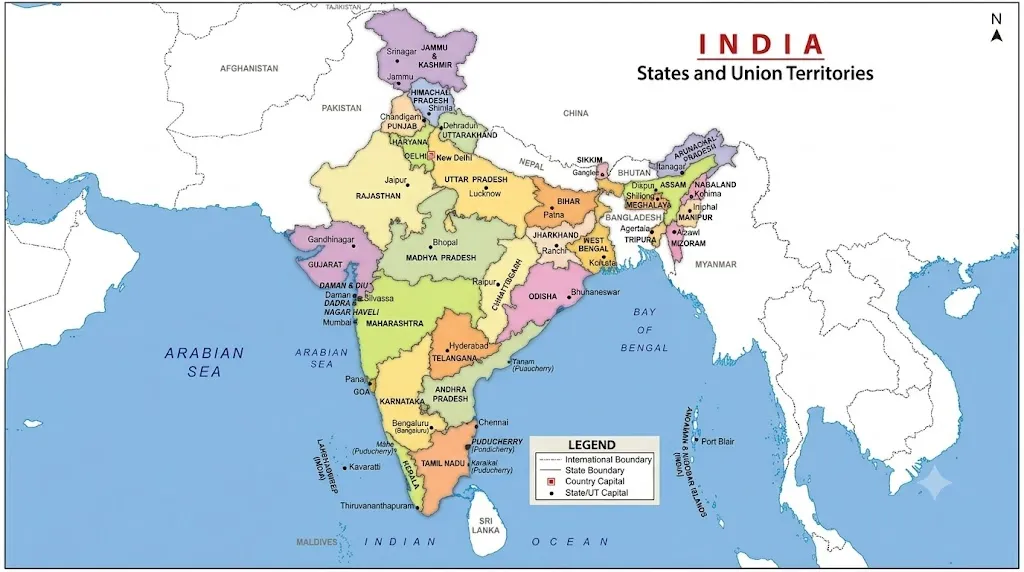
India is one of the world’s largest countries by area stretching from the western edge of Gujarat to Arunachal Pradesh in the east. Despite this wide geographical span India officially follows one time zone. India uses Indian Standard Time (IST) which is UTC+5:30 across the country. Keep reading to know in detail.
How Many Time Zones Does India Have?
India has one official time zone. It is called Indian Standard Time (IST). IST is 5 hours and 30 minutes ahead of UTC. The same official time is followed across India’s states and Union Territories.
What Is the Difference Between IST and UTC?
UTC is the international reference time. IST is India’s standard time. IST is UTC+5:30. Therefore, when UTC is 12:00 noon, IST is 5:30 pm.
What Is India’s Time Zone?
India’s official time zone is Indian Standard Time. UTC+5:30 means Indian Standard Time is five hours and 30 minutes ahead of Coordinated Universal Time.
Why Does India Have Only One Time Zone?
India uses a single standard time to maintain a common time reference across the country. A single time helps coordinate government activities.
Which Meridian Is Used for Indian Standard Time?
Indian Standard Time is based on a reference meridian of 82°30′ east longitude. The reference meridian passes near Mirzapur in Uttar Pradesh. It provides the geographical basis for India’s standard time.
How Many Time Zones Does India Have?
India has one official time zone, Indian Standard Time (IST) which is UTC+5:30. Before the adoption of a common standard time different cities and railway systems in India used different local times. During the late 19th century Bombay Time and Calcutta Time became particularly important for official and commercial purposes, while Madras Time was widely used by the railways.
Did India Have Bombay, Calcutta and Madras Time at the Same Time?
These different time standards existed during the same broad historical period. However, it is more accurate to describe them as regional or institutional time standards, rather than saying that British India officially had three modern time zones. Bombay Time was important in western India. Calcutta Time was important in eastern India. Madras Time became important for railways.