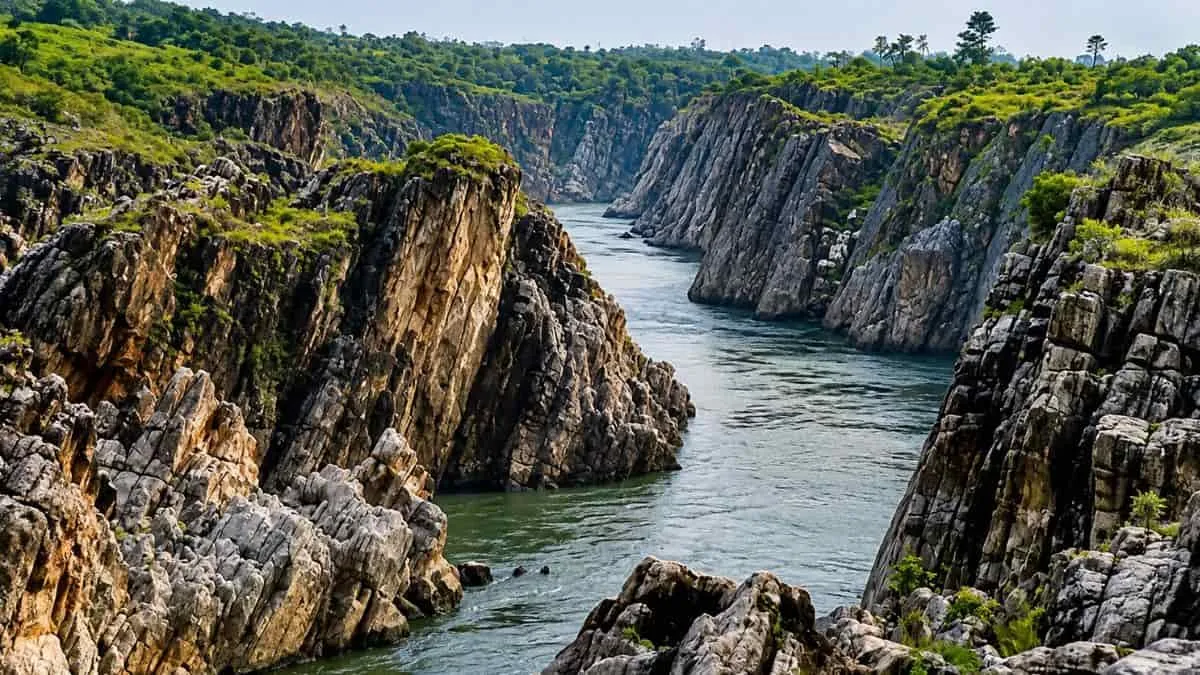
The Narmada River is one of the most important rivers of central India. It is also one of the few major rivers of Peninsular India that flows towards the west.
But there is something special about the way the Narmada flows. It does not simply flow across an ordinary valley. For a large part of its journey, the river flows through a rift valley.
So, why is the Narmada called a Rift Valley River? The Narmada flows through a long, low valley that was formed along a major fault and weak zone in the Earth's crust.
This valley lies between the Vindhya Range in the north and the Satpura Range in the south.
The Central Water Commission describes the Narmada as flowing through a rift valley between the Vindhya and Satpura ranges.
Narmada River: Quick Facts
|
Fact
|
Information
|
|
Name
|
Narmada River
|
|
Origin
|
Amarkantak, Madhya Pradesh
|
|
Main direction
|
West
|
|
Length
|
About 1,312 km
|
|
North of the river
|
Vindhya Range
|
|
South of the river
|
Satpura Range
|
|
Special feature
|
Rift valley river
|
|
Ends in
|
Arabian Sea
|
What Is a Rift Valley?
A rift valley is a long, narrow valley formed when large blocks of the Earth's crust move because of forces inside the Earth.
This type of valley is called a rift valley. The Narmada flows through one such old geological valley.
Trick to Remember for GK
Narmada: Rift Valley River
North: Vindhya
South: Satpura
Flow: West
Ends: Arabian Sea
Why is Narmada called a Rift Valley River?
There are three main reasons.
1. The Narmada flows through a geological depression
The Narmada does not flow across an ordinary flat valley for most of its important course.
It flows through a long geological depression associated with the Narmada-Son tectonic zone.
The Directorate General of Hydrocarbons, Government of India, describes the Narmada-Son Tectonic Lineament as an important geological zone and a mid-continental rift system.
2. It flows between the Vindhya and Satpura ranges
The Narmada flows with the Vindhya Range on its northern side and the Satpura Range on its southern side.
The Central Water Commission specifically records that the river flows in a rift valley between the Vindhyan Range and Satpura.
So, we can remember it like this:
|
Direction
|
Landform
|
|
North of Narmada
|
Vindhya Range
|
|
Middle
|
Narmada Rift Valley
|
|
South of Narmada
|
Satpura Range
|
3. Its course is controlled by Earth's geological structure
The path of the Narmada is closely connected with the geological structure beneath the land.
The Narmada-Son zone is a major tectonic feature. In simple terms, tectonic means related to movements and structures of the Earth's crust.
The river follows this old geological zone. That is why the Narmada has a different course from many other major rivers of Peninsular India.
Did You Know?
Near Jabalpur in Madhya Pradesh, the Narmada flows through the famous Marble Rocks and forms the Dhuandhar Falls.
These beautiful landforms have been shaped by the river and the hard rocks found in the area.
Why Does the Narmada Flow Through This Valley?
The Narmada Valley is linked with an important geological feature called the Narmada-Son zone.
This is a long geological zone that runs across central India. Government geological information describes the Narmada-Son zone as an important tectonic feature and a mid-continental rift system.
Over a very long period, movements in the Earth's crust created faults and weak areas in this region.
The Narmada found a natural path through this lower and weaker area. The river has continued to flow along this path.
This is why the Narmada is known as a rift valley river.
Where Is the Narmada Rift Valley?
The Narmada flows between two important mountain ranges:
|
Side of the Narmada
|
Mountain Range
|
|
North
|
Vindhya Range
|
|
South
|
Satpura Range
|
This is an important fact for GK questions.
You can remember it as:
Vindhya → Narmada Valley → Satpura
The Central Water Commission also describes the Narmada as flowing in a rift valley between the Vindhya and Satpura ranges.
Why Does the Narmada Flow West?
The Narmada mainly flows from east to west. This is also linked to the shape and geological structure of its valley.
Many large rivers of Peninsular India, such as the Godavari, Krishna and Mahanadi, flow towards the east and finally enter the Bay of Bengal.
The Narmada takes a different route. It flows west and enters the Arabian Sea.
The Tapi River is another important west-flowing river that also passes through a rift valley.
What Is the Narmada-Son Zone?
The Narmada-Son zone is a major geological feature of India. The word tectonic is used for things related to movements and structures of the Earth's crust.
The Narmada-Son zone has been affected by such geological processes over a very long period. It is one of the reasons the Narmada Valley has its special shape.