What Are the Differences Between Prokaryotic and Eukaryotic Cells?
Learn the key differences between prokaryotic and eukaryotic cells in simple terms, including structure, size, and examples.
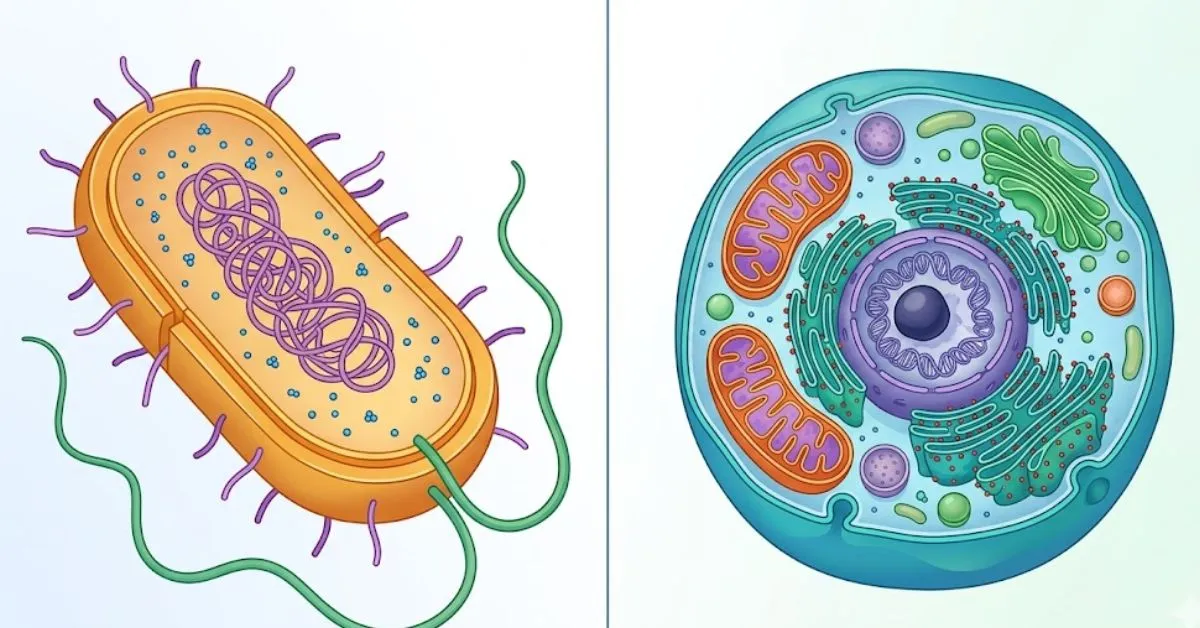
In biology you must have come across the two types of cells, the prokaryotic and eukaryotic cells. These two are the most fundamental forms of life on earth. Everything living from the bacteria on your skin to the trees outside is made out of one or both of these types of cells. Getting to know the difference between the two is the basis of knowing how all life functions.
What is a Prokaryotic Cell?
Prokaryotic was coined out of the Greek words pro (before) and karyon (nucleus). prokaryotic literally means before nucleus.
A cell which lacks a real nucleus is called a prokaryotic cell. It lacks a membrane around the genetic material which is a DNA and is freely floating in the cell in an area referred to as the nucleoid.
The oldest on the planet are prokaryotic cells which are estimated to have lived some 3.5 billion years ago. They do not occur in more than a single cell (they are multicellular) and in most cases are extremely small.
What is a Eukaryotic Cell?
Eukaryotic derives its name as eu (true), and karyon (nucleus). So eukaryotic means true nucleus.
A eukaryotic cell is characterized by a well-defined nucleus, and this is enclosed within a nuclear membrane (also referred to as nuclear envelope). Our DNA in a eukaryotic cell is packaged into chromosomes and is securely protected by this nucleus.
Eukaryotic cells are larger, more complicated and full of membrane-bound organelles - specialised structures that accomplish a particular task by the cell.
Prokaryotic vs Eukaryotic Cell: Key Differences
| Feature | Prokaryotic Cell | Eukaryotic Cell |
| Nucleus | Missing (no nuclear membrane) | True nucleus with membrane |
| Size | Small (1-10 µm) as per NCERT | Large ( 5-100 µm) |
| DNA shape | Circular, not membrane-bound | Linear, enclosed in nucleus |
| Membrane-bound organelles | Absent | Present (mitochondria, ER, Golgi body, etc.) |
| Ribosomes | Smaller (70S type) | Larger (80S type) |
| Examples | Bacteria, Archaea, Cyanobacteria | Plants, Animals, Fungi, Protists |
| Complexity | Simple | Complex |
1. The Most Important Difference: The Nucleus
Consider the nucleus as the control room of a cell. The walls of this control room are in a eukaryotic cell - a proper nuclear membrane, protecting the DNA.
In prokaryotic cells, no walls are present. The DNA just freely floats in the cytoplasm in a place called nucleoid. This is the biggest difference between the two.
2. The Workers Inside the Cell: Organelles
The eukaryote cells have lots of organelles which are enclosed in membranes and do some specific job. The energy generation is by the mitochondria. The synthesis of proteins occurs in the endoplasmic reticulum. Materials are packaged and shipped by the Golgi body. All these organelles are not attached to prokaryote cell membranes. They have a much simpler structure.
3. Size Difference: A Quick Way to Remember
Prokaryotic cells are smaller. Most of the bacteria are between 1 and 10 micrometres. The diameter of eukaryotic cells is usually 10 to 100 micrometres -10 times larger. It has only one rule: the more complicated its nucleus the bigger it is.
One of the most basic notions in biology is the difference between prokaryotic and eukaryotic cells. In other words, prokaryotic cells are older, smaller, simpler and have no definable nucleus and eukaryotic cells are newer, larger and more complex and contain a well-defined enclosed nucleus and specialised organelles. All life on Earth is made out of either one, or both of these types of cells, knowing them will provide you with a key to knowing life itself.

Nikhil is a dedicated digital journalist and communications professional with more than five years of experience, currently working within the General Knowledge section at Jagran Josh. He has established himself as a subject matter expert in Finance, Economy, History, Technology, and Trending News, consistently delivering accurate, engaging, and easy-to-read content for a wide global audience.
Over the course of his career, Nikhil has developed deep expertise in crafting informative listicles, viral trending stories. His editorial portfolio also spans finance, historical research, and technology reporting, making him a versatile and well-rounded content professional. Every piece he produces reflects a strong balance between factual accuracy and reader engagement.