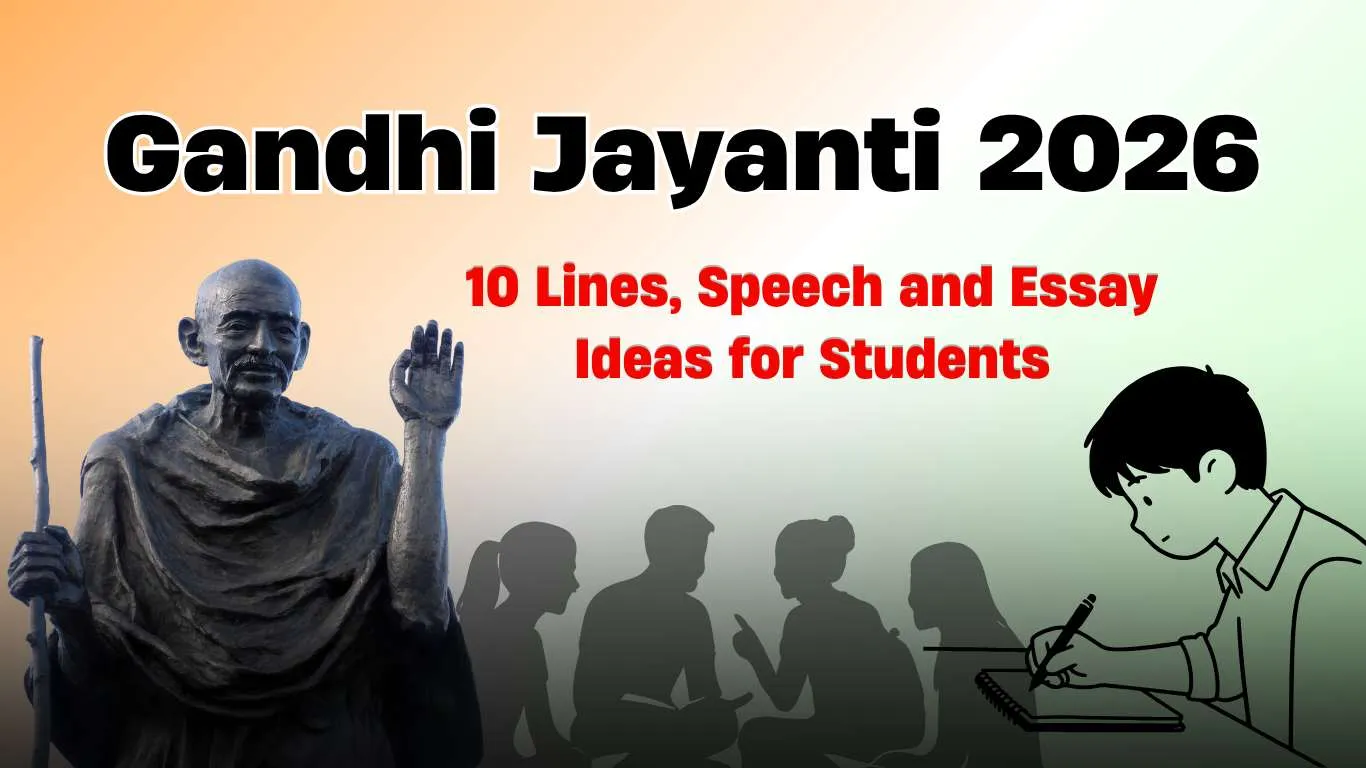
Gandhi Jayanti is a special day in India celebrated every year on October 2. It marks the birthday of Mahatma Gandhi, who is loved as the Father of the Nation. He helped India win freedom from foreign rule using truth and non-violence. On this day, people across the country remember his peaceful teachings and honor his great life. Explore 10 lines, short & long speeches, and essay ideas for Gandhi Jayanti 2026. Celebrate Mahatma Gandhi's 157th birth anniversary with inspiring insights on truth and non-violence. Check out the below article for speech and essays.
10 Lines on Gandhi Jayanti (2026)
- Gandhi Jayanti is observed every year on October 2 across India as a national holiday to mark the birth anniversary of Mahatma Gandhi.
- October 2, 2026, marks the 157th birth anniversary of Mohandas Karamchand Gandhi, born in Porbandar, Gujarat, in 1869.
- The day is also commemorated globally as the International Day of Non-Violence, as declared by the United Nations General Assembly in 2007.
- Affectionately called "Bapu" and honored as the Father of the Nation, Gandhi Ji led India's freedom movement against British colonial rule.
- His core philosophy was built upon the twin pillars of Satya (Truth) and Ahimsa (Non-violence).
- He spearheaded historic freedom movements including the Non-Cooperation Movement (1920), Salt Satyagraha (1930), and the Quit India Movement (1942).
- Mahatma Gandhi championed Swadeshi (self-reliance) and promoted Khadi and the Charkha as symbols of economic self-sufficiency.
- National observances take place at Raj Ghat in New Delhi, where the Prime Minister and national leaders pay floral tributes.
- Schools and colleges celebrate the occasion through prayer meetings, shramdaan (cleanliness drives), cultural performances, and speech competitions.
- Gandhi Ji's principles of simple living, social equality, and peaceful coexistence continue to inspire global civil rights movements.
Check: Gandhi Jayanti (2 October) Activities for School Students
Short Speech on Gandhi Jayanti
Respected Principal, teachers, and my dear fellow students,
Good morning to everyone present here today. We have gathered to celebrate Gandhi Jayanti, marking the birth anniversary of Mohandas Karamchand Gandhi—fondly remembered across the nation as Bapu and honored as the Father of the Nation. Born on October 2, 1869, in Porbandar, Gujarat, Mahatma Gandhi was not merely a political leader; he was a moral compass who transformed India’s fight for independence into a global symbol of moral resistance.
What made Bapu’s leadership unique was his reliance on weapons that required no gunpowder or physical force. He fought British colonial rule using the principles of Satya (Truth) and Ahimsa (Non-violence). Through historic mass movements like the Non-Cooperation Movement, the Salt March to Dandi, and the Quit India Movement, he demonstrated that firm, peaceful resistance could dismantle the mightiest empire of the modern era. Because of his profound impact on humanity, the United Nations officially observes October 2 as the International Day of Non-Violence.
However, Gandhi Ji’s vision extended far beyond political emancipation. He strongly believed that true national freedom, or Swaraj, begins with individual discipline, self-reliance, and social reform. He advocated for Swadeshi—supporting local industries and empowering rural communities—and championed social equality, the eradication of untouchability, and environmental sustainability. For Gandhi Ji, cleanliness was directly linked to godliness, a philosophy that continues to inspire our national cleanliness drives today.
As students living in an interconnected world, Gandhi Ji’s teachings offer vital guidance for our personal lives. In a society often filled with anger and hasty judgments, practicing Ahimsa means learning to resolve disagreements through dialogue, kindness, and empathy. Practicing Satya means standing by what is right, even when it is difficult.
Bapu famously said, "Be the change that you wish to see in the world." As we pay floral tributes to his memory today, let us pledge to adopt his principles in our daily conduct—by being honest in our studies, respectful toward others, and responsible citizens of our nation.
Thank you, and Jai Hind!
2. Long Speech on Gandhi Jayanti
Honorable Chief Guest, respected Principal, dedicated teachers, and my dear friends,
I stand before you today with deep reverence to celebrate Gandhi Jayanti, the birth anniversary of Mahatma Gandhi, the Father of our Nation. Every year on October 2, India pauses to reflect on the life, sacrifice, and timeless philosophy of a leader whose vision not only liberated a country of millions but also altered the course of modern world history.
Mohandas Karamchand Gandhi was born in 1869 in Porbandar, Gujarat. His journey from a quiet, young lawyer practicing in South Africa to becoming the supreme voice of India's freedom struggle is a story of personal transformation. It was in South Africa, while confronting systemic racial discrimination, that Gandhi Ji developed his revolutionary philosophy of Satyagraha—holding firm to truth through peaceful, non-violent resistance.
Upon returning to India, Gandhi Ji transformed what was previously an elite political discussion into a mass freedom movement. He brought farmers, weavers, women, and workers from every corner of the country into the national campaign. Through movements such as the Non-Cooperation Movement in 1920, the historic Dandi Salt March in 1930, and the decisive Quit India Movement in 1942, Bapu demonstrated that non-violent resistance is not a weapon of the weak, but the supreme virtue of the strong. Recognizing this universal legacy, the United Nations General Assembly declared October 2 as the International Day of Non-Violence.
Beyond securing political independence, Gandhi Ji’s primary goal was social and moral regeneration. He believed that political liberty was meaningless without social reform. He campaigned tirelessly against caste-based discrimination, worked to empower women, promoted communal harmony between religious groups, and emphasized basic education. His idea of Swaraj went beyond replacing foreign rulers with local ones; it meant individual self-mastery, moral responsibility, and community self-reliance.
Bapu was also an early proponent of sustainable living. Long before climate change became a global crisis, Gandhi Ji warned against the unchecked exploitation of natural resources, famously remarking, "Earth provides enough to satisfy every man's needs, but not every man's greed." He championed Swadeshi, encouraging self-sufficiency through local production, symbolized by the humble spinning wheel, or charkha. His commitment to sanitation and hygiene remains the foundation for national initiatives like the Swachh Bharat Abhiyan.
Today, as we navigate a world facing conflict, intolerance, and social divides, Gandhian values are more relevant than ever. The principle of Ahimsa reminds us that true progress cannot be achieved through hostility or destruction, but through mutual understanding, patience, and compassion.
As the youth of modern India, we inherit both Bapu's legacy and the responsibility to carry it forward. Celebrating Gandhi Jayanti should not be limited to an annual ceremony. It must be an active recommitment to his ideals. Let us strive to practice honesty in our thoughts, kindness in our actions, and integrity in our public life.
Let us remember his immortal words: "Your beliefs become your thoughts, your thoughts become your words, your words become your actions, your actions become your habits, your habits become your values, your values become your destiny." Let us build a nation that reflects the moral courage and peace that Mahatma Gandhi envisioned.
Thank you, and Jai Hind!
3. Short Essay on Mahatma Gandhi
Gandhi Jayanti is celebrated across India every year on October 2 to honor the birth anniversary of Mohandas Karamchand Gandhi, widely known as Mahatma Gandhi and the Father of the Nation. Born in 1869 in Porbandar, Gujarat, Gandhi Ji was a transformative leader whose political philosophy of truth and non-violence guided India to independence from British rule. Internationally, this day is recognized as the International Day of Non-Violence, underscoring his universal influence.
Role in the Freedom Struggle
Mahatma Gandhi’s greatest contribution to the Indian freedom movement was his ability to mobilize the masses through peaceful means. Rejecting violence, he introduced the concept of Satyagraha—a doctrine of non-violent resistance based on moral truth. Major national campaigns under his leadership, including the Non-Cooperation Movement (1920), the Salt March (1930), and the Quit India Movement (1942), united citizens across diverse economic, cultural, and religious backgrounds. His leadership proved that persistent, non-violent mass action could overcome colonial rule.
Social Philosophy and Constructive Work
For Gandhi Ji, political freedom was incomplete without social upliftment and self-reliance. He worked extensively to eliminate untouchability, advocate for women’s rights, and foster communal harmony. He introduced the concept of Swadeshi, encouraging people to use locally produced goods and adopt the charkha (spinning wheel) as a symbol of economic dignity. Additionally, his deep emphasis on sanitation and personal cleanliness laid the moral groundwork for modern national cleanliness drives, such as the Swachh Bharat Mission.
Relevance in the Modern World
In today's fast-paced and often polarized world, Mahatma Gandhi’s core message remains deeply relevant. His famous principle—"An eye for an eye only ends up making the whole world blind"—serves as a vital reminder for resolving conflicts peacefully. Modern challenges, including environmental degradation, social inequality, and digital hostility, can be meaningfully addressed through Gandhian principles of minimal consumption, mutual respect, and ethical living.
Mahatma Gandhi was not just a historic figure who won freedom for India; he was a moral guide for humanity. Observing Gandhi Jayanti is an opportunity for individuals, especially the youth, to reflect on his ideals of truth, peace, and selflessness. By incorporating these values into daily life, society can work toward building a more just, harmonious, and compassionate world.
4. Long Essay on Mahatma Gandhi
Mahatma Gandhi: Moral Vision, Freedom Movement, and Global Relevance
On October 2, 1869, in the coastal town of Porbandar, Gujarat, Mohandas Karamchand Gandhi was born. Few could have predicted that this quiet individual would grow up to lead one-fifth of the world’s population to freedom and become one of the most influential moral leaders in human history. Celebrated nationally as Gandhi Jayanti and globally as the International Day of Non-Violence, October 2 marks an annual occasion to honor Bapu’s legacy and re-examine his philosophy of truth, peace, and human dignity.
Formative Years and the Birth of Satyagraha
Gandhi’s intellectual and moral foundation was formed during his higher education in London and his subsequent work as a lawyer in South Africa. It was in South Africa that he personally experienced racial oppression, prompting him to organize civil rights movements for the Indian community. During these crucial years, he developed Satyagraha—a philosophy of non-violent resistance grounded in moral courage and the unwavering pursuit of truth (Satya). Gandhi Ji maintained that non-violence (Ahimsa) was not a sign of weakness or passive submission, but a active ethical force capable of converting an adversary through patience and moral conviction.
Transforming the Indian National Movement
Upon returning to India in 1915 at the request of Gopal Krishna Gokhale, Gandhi Ji traveled extensively across the Indian countryside to understand the lived reality of ordinary citizens. He transformed the Indian National Congress from an urban elite assembly into a genuine mass movement. Through key initiatives—such as the Champaran and Kheda Satyagrahas, the Non-Cooperation Movement (1920), the historic 240-mile Salt March to Dandi (1930), and the Quit India Movement (1942)—he demonstrated how peaceful civil disobedience could dismantle the administrative framework of foreign rule. His approach inspired millions of ordinary Indians, including women and rural workers, to actively participate in the national struggle.
Social Vision: Swaraj, Swadeshi, and Sarvodaya
Gandhi Ji’s vision for India extended beyond political independence. He argued that political freedom without social equality was hollow. He formulated three interconnected concepts:
- Swaraj (Self-Rule): Political independence combined with strict individual moral self-discipline and responsibility.
- Swadeshi (Self-Reliance): Economic self-sufficiency achieved by supporting local village industries, famously represented by the hand-spun cloth, Khadi.
- Sarvodaya (Welfare of All): An inclusive economic and social model ensuring that progress reaches the most vulnerable members of society.
Furthermore, Gandhi Ji dedicated a significant portion of his life to eradicating social evils such as untouchability, fostering inter-faith unity, advocating for women's empowerment, and promoting basic rural sanitation—ideals that directly inform modern initiatives like the Swachh Bharat Abhiyan.
Global Impact and Contemporary Relevance
The universality of Gandhi Ji's philosophy is evidenced by its profound influence on global civil rights leaders, including Martin Luther King Jr. in the United States, Nelson Mandela in South Africa, and the Dalai Lama. In an era marked by geopolitical tensions, climate change, and growing social polarization, Gandhian principles offer practical guidance. His warnings against over-consumption reinforce modern environmental sustainability goals, while his commitment to non-violent dialogue provides a framework for resolving modern conflicts.
Mahatma Gandhi’s life was, as he described it, a series of "experiments with truth." His enduring legacy proves that moral principles, when combined with collective action, can overcome physical power. Celebrating Gandhi Jayanti is not merely an act of historical remembrance, but a call to active citizenship. By practicing honesty, simplicity, and non-violence in our daily lives, we honor Bapu’s memory and contribute to a peaceful and equitable world.