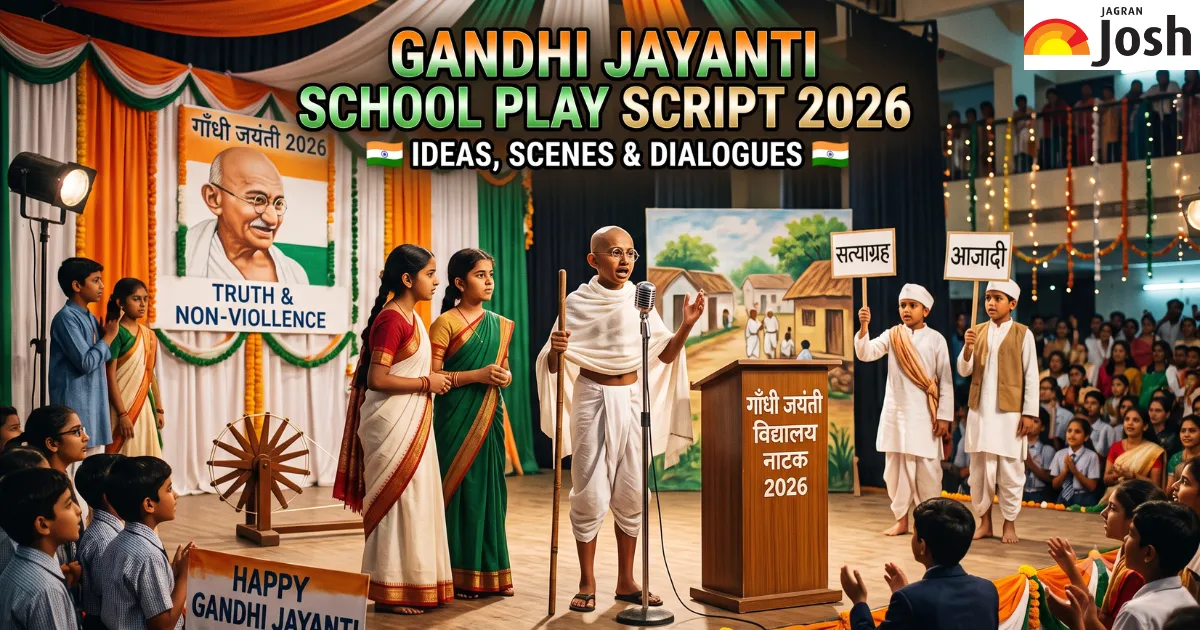
Gandhi Jayanti is celebrated every year on 2 October to mark the birthday of Mohandas Karamchand Gandhi, who was born on this day in 1869 in Porbandar, Gujarat. In 2026 the date falls on a Friday, so schools can plan a full morning assembly or a short cultural programme. It is a national holiday across India, and 2026 marks Bapu’s 157th birth anniversary. The day is also observed as the International Day of Non-Violence by the United Nations, because Gandhi’s idea of fighting with truth and peace inspired people all over the world. In Delhi, leaders and school groups gather at Raj Ghat to offer flowers and join prayer meetings. Across the country people sing bhajans like Raghupati Raghav Raja Ram and Vaishnav Jan To, and many students take part in cleanliness drives. For children, the best way to understand Bapu is not a long lecture but a small play where they act out his life themselves.
Gandhi Jayanti School Play Script 2026
A Gandhi Jayanti play does not need a big stage or expensive costumes. Ten to fifteen minutes is enough. You need about eight to ten students, a narrator who ties the scenes together, and a few simple props such as a white dhoti, a shawl, a wooden charkha, a walking stick and round spectacles. The script walks through Bapu’s life, from the cold night at the Pietermaritzburg station in South Africa to the Salt March of 1930 and the Quit India movement of 1942. Each scene carries one idea: truth, courage, self-reliance, unity or cleanliness. Keep the language the way students speak every day. Short lines spoken clearly are far better than long speeches nobody remembers. Teachers can adjust the number of scenes based on how much time the assembly allows, and juniors can simply join the opening and closing pledge.
Best Gandhi Jayanti Play Ideas for School Students
- The Train at Pietermaritzburg: young Gandhi is pushed off a train because of his skin colour, and he decides to fight unfairness with truth, not anger.
- The Salt March: Gandhi walks to Dandi and picks up a handful of salt to protest against an unfair British tax.
- The Charkha and Swadeshi: a simple scene about spinning thread, wearing khadi and supporting local weavers.
- Cleanliness and Self-Reliance: a short scene linking Bapu’s message to the Swachh Bharat idea in schools and homes.
- Gandhi and Kasturba: a quiet scene showing how Kasturba stood beside him in every struggle.
- Quit India 1942: students raise the call for freedom with courage and discipline.
- A Classroom Meets Bapu: modern students ask questions and Gandhi answers them in simple words.
- Tableau or Mime: for the youngest classes, silent scenes with a narrator reading the story aloud.
Gandhi Jayanti School Play Script With Dialogues
- Scene 1: The Pietermaritzburg Station, South Africa, 1893.
- Narrator: A young lawyer is travelling with a first-class ticket. But the colour of his skin decides how he is treated.
- Officer: You cannot sit here. Go to the back of the train.
- Gandhi: I have a valid ticket. Why must I move?
- Officer: Because you are not allowed in this coach.
- Gandhi (to himself): I will not answer this with anger. I will answer it with truth.
- Scene 2: The Salt March, 1930.
- Narrator: Thousands of people begin walking with Bapu towards the sea.
- Villager: Bapu, why do we walk so far for a little salt?
- Gandhi: Because even the smallest thing can carry the biggest truth. Salt belongs to everyone.
- Narrator: At Dandi, Gandhi bends down, lifts a handful of salt, and the whole crowd cheers.
- Scene 3: The Charkha.
- Kasturba: Why do you spin cloth every single day?
- Gandhi: Because work done with our own hands makes us free and strong.
- Scene 4: A Classroom Meets Bapu.
- Student: Bapu, what should we do today?
- Gandhi: Speak the truth, keep your school and your street clean, and help one person every day.
- Narrator: Students stand together and take a pledge to follow the path of truth, peace and service.
How to Perform a Gandhi Jayanti Play in School
- Choose a script of ten to fifteen minutes and finalise the cast within a week.
- Give the narrator the most important job, because the narrator keeps the story moving.
- Reuse costumes from the drama room: white kurta, dhoti, shawl, Gandhi cap, spectacles and a wooden staff.
- Add simple sound effects such as a train whistle, footsteps and sea waves.
- Practise voice volume, pauses and eye contact during assembly rehearsals.
- Use one bhajan or live song instead of long recorded music.
- Hold one full dress rehearsal on the actual stage before the final day.
- Keep a prompt copy behind the curtain in case someone forgets a line.
Tips to Make a Gandhi Jayanti School Play Engaging
- Keep every dialogue under two lines so students remember them easily.
- Let the play end with a pledge the whole audience repeats out loud.
- Show Bapu’s gentle humour in one light moment; children remember a laughing Gandhi better than a serious one.
- Give each actor one final line on what they learnt, in their own words.
- Let juniors hold placards or do a tableau while seniors perform the scenes.
- Finish with a cleanliness drive or a small sapling plantation so the message becomes action.
Also Read:
Gandhi Jayanti 2026 Drawing and Poster Ideas with Images
Gandhi Jayanti 2026 Activities for School Students: Creative Ideas to Celebrate October 2