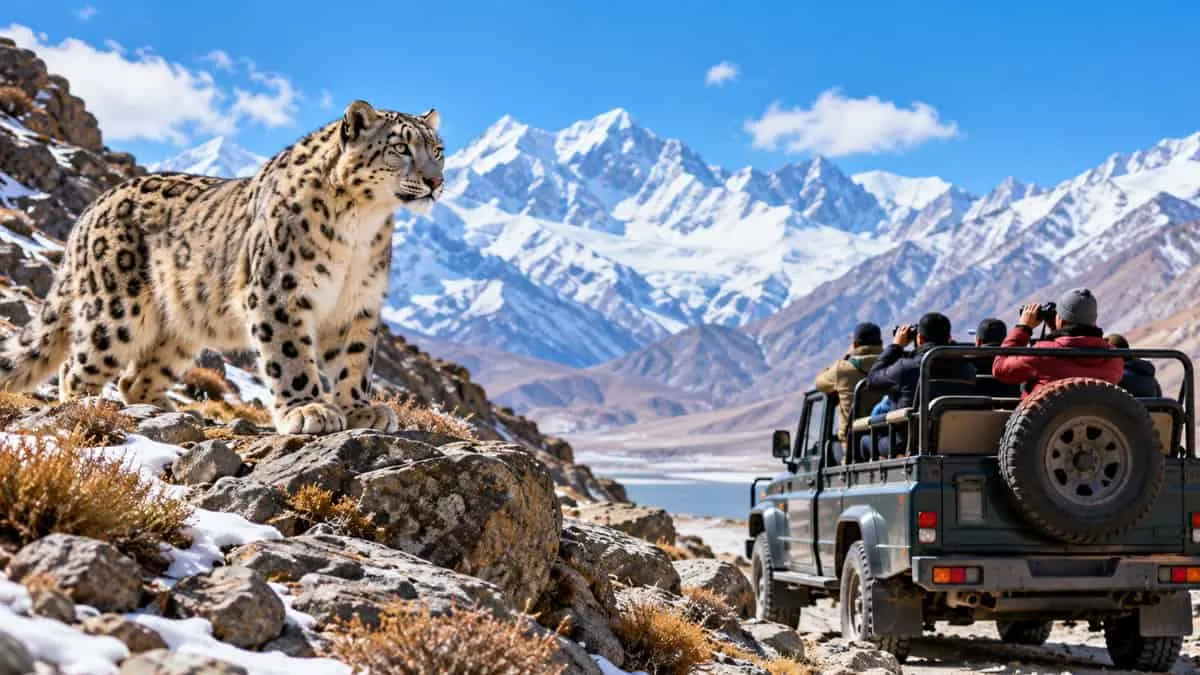
India’s First Snow Leopard Safari: India's first high-altitude Snow Leopard Wildlife Safari has been launched in Ladakh to promote responsible wildlife tourism and preserve the fragile habitat of this rare animal as well as to provide jobs to the local people. Lieutenant Governor Vinai Kumar Saxena inaugurated the programme during the Wildlife Week 2026. Initially, six specially designed vehicles will be used in snow leopard hotspots like Rumbak, Shang and Uley.
Snow Leopard and High-Altitude Nature Conservation (SHAN) Society is organizing the safari in cooperation with Department of Forest, Ecology and Environment, Union Territory of Ladakh. The program will help to develop more organized and sustainable wildlife tourism, while also promoting the sustainable utilization of the region's natural resources for the benefit of local communities.
Key Facts About India’s First Snow Leopard Safari
|
Facts
|
Details
|
|
Name
|
Ladakh Snow Leopard Safari
|
|
Location
|
Union Territory of Ladakh
|
|
Significance
|
India’s first high-altitude wildlife safari
|
|
Launched by
|
Lieutenant Governor Vinai Kumar Saxena
|
|
Vehicles flagged off
|
Six
|
|
Initial locations
|
Rumbak, Shang and Uley
|
|
Implementing organisation
|
Snow Leopard and High-Altitude Nature Conservation (SHAN) Society
|
|
Government partner
|
Department of Forest, Ecology and Environment, Ladakh
|
|
Main objective
|
Responsible tourism, wildlife conservation and local livelihoods
|
|
Snow leopards estimated in India
|
718
|
|
Snow leopards estimated in Ladakh
|
477
|
Source: Administration of the Union Territory of Ladakh and the Ministry of Environment, Forest and Climate Change.
What Is India’s First High-Altitude Snow Leopard Safari?
The Ladakh Snow Leopard Safari is a guided safari that aims to let tourists explore the highlands and to watch the wildlife in a responsible manner.
This safari will be conducted with specially made vehicles with open backs, local drivers and wildlife guides. Use of approved routes and restriction of visitor numbers is designed to minimise disturbance to animals and animal habitats.
The project also aims to stop off-road activities like illegal off-road driving, which can harm the delicate mountain ecosystems and disrupt wildlife. The administration is not going to allow tourism activities to add further stress on nature, but will rather associate tourism with conservation and economic development.
The launch of the guided Wildlife safari was announced on August 5, 2026 and subsequently launched at Wildlife Week 2026.
Where Will the Snow Leopard Safari Operate?
The safari will initially operate in selected locations where snow leopards are frequently sighted. The administration has also identified several protected areas and wider landscapes for suitable safari routes.
|
Location
|
Significance
|
|
Rumbak
|
An area known for snow leopard sightings
|
|
Shang
|
An identified location for the initial safari operations
|
|
Uley
|
An area where snow leopards are frequently sighted
|
|
A protected high-altitude landscape
|
|
|
Changthang Wildlife Sanctuary
|
A cold-desert ecosystem supporting distinctive wildlife
|
|
Karakoram Wildlife Sanctuary
|
A protected landscape in the Nubra–Shayok region
|
|
Nubra, Zanskar and Sham
|
Areas being considered for suitable wildlife tourism routes
|
|
Kargil and Drass
|
Regions included in the wider route-planning exercise
|
The administration has identified these landscapes for exploring suitable routes. This does not mean that every location will immediately have an operational safari. Routes must be selected and managed according to wildlife protection requirements and local conditions.
The Department of Forest, Ecology and Environment is responsible for wildlife protection and the management of protected areas in Ladakh.
Why Is Ladakh Important for Snow Leopard Conservation?
Ladakh is considered one of the most critical areas in India for conserving the snow leopard. This elusive animal is found in the rocky mountains, steep slopes and high altitude valleys of its cold deserts.
The estimated number of snow leopards in India is 718 according to the first Snow Leopard Population Assessment in India (SPAI) carried out in the years 2019-2023. Ladakh had the highest number with an estimated of 477.
The assessment had a focus area of about 120,000 square kilometres, which is over 70% of the potential range of the species in India. It was the first scientific assessment of snow leopard population on the scientific systematic basis in the country.It was the first ever systematic scientific survey of snow leopard in the country.
Snow Leopard Population in India
|
Region
|
Estimated population
|
|
Ladakh
|
477
|
|
Uttarakhand
|
124
|
|
Himachal Pradesh
|
51
|
|
Arunachal Pradesh
|
36
|
|
Sikkim
|
21
|
|
Jammu and Kashmir
|
9
|
|
Total
|
718
|
Source: Snow Leopard Population Assessment in India, 2019–2023, released by the Ministry of Environment, Forest and Climate Change.
These figures are estimates from the first nationwide assessment, not a count of every individual animal. They highlight Ladakh's importance in protecting the species and its habitat.
How Will the Safari Help Wildlife Conservation?
The main purpose of the safari is to make wildlife tourism compatible with conservation. Its success will depend on how carefully visitors, vehicles and tourism activities are managed.
The initiative is expected to support conservation in several ways:
-
Controlled vehicle movement: Approved routes can help prevent vehicles from entering sensitive habitats.
-
Reduced wildlife disturbance: Trained drivers and guides can help visitors maintain suitable distances from animals.
-
Better visitor management: Regulating visitor numbers can reduce pressure on fragile ecosystems.
-
Greater conservation awareness: Guided trips can help visitors understand the importance of protecting snow leopards and their habitats.
-
Community participation: Local residents can become active partners in protecting wildlife rather than remaining outside the tourism economy.
These measures are particularly important in high-altitude regions, where ecosystems can be sensitive to human disturbance.
How Will Local Communities Benefit?
The importance of the initiative is that it is based on community-based conservation. The government's goal is to provide local people with direct economic benefits from the protection of wildlife.
The safari can provide jobs for local drivers, wildlife guides, birding guides and nature guides and nature interpreters. It can also stimulate the small tourism enterprises.
The Wildlife Week programme also highlighted other livelihood initiatives.
Training for local youth: Twenty young people are being trained in bird identification, birdwatching and spotting. They will receive binoculars, while birdwatching hides are planned at major hotspots. These measures aim to create opportunities in birdwatching and nature-based tourism.
Conservation-linked work for women: The Wild Animal Felting Programme involves 50 women from Turtuk, Photoksar, Sangrah, Chushul and Shargole. It connects traditional skills and local wool with conservation-linked enterprises.
Conservation education: The administration also announced support for conservation education through Eco Clubs in 50 schools in Leh and Kargil, with support from SHAN Society.
Together, these activities show how tourism, education and local enterprise can contribute to wildlife conservation.
What Is the Role of SHAN Society?
The safari is being organized by the Snow Leopard and High-altitude Nature Conservation (SHAN) Society in partnership with the Department of Forest, Ecology and Environment of the state of Ladakh.
It is important to its role in the initiative that links wildlife tourism to wildlife protection, public awareness and local livelihoods. The wider programme also features birding and community initiatives related to conservation.
The model is designed to instill an appreciation of the importance of wildlife and natural resource protection amongst residents of the region and foster shared responsibility for protecting the region's wildlife and natural resources.
Other Wildlife Conservation Initiatives Highlighted in Ladakh
The safari launch formed part of Wildlife Week 2026 celebrations at Choglamsar Protected Forest in Leh. The event was observed under the theme “Connecting Habitats, Thriving Wildlife.”
Other initiatives highlighted during the programme included:
-
Human-wildlife conflict mitigation: An AI-based device developed by the Wildlife Division, Kargil, in technical collaboration with the University of Ladakh, Kargil Campus, was inaugurated.
-
Himalayan brown bear awareness: A documentary on the Himalayan brown bear was released.
-
Wildlife tourism promotion: A brochure covering wildlife tourism packages offered by SHAN Society was released.
-
Black-necked crane conservation: The second edition of the Ladakh Black-necked Crane Festival was announced.
-
School conservation education: Support was provided for conservation activities through Eco Clubs in Leh and Kargil.
These initiatives reflect a wider effort to connect environmental protection with education, community participation and sustainable tourism.
Conclusion
This is the first time India will host a high-altitude Snow Leopard Wildlife Safari that will help establish a link between wildlife conservation and sustainable tourism in Ladakh. The administration plans to phase in guided safari vehicles, local staff to help with the tour, and approved routes to minimize disturbance of wildlife and provide an economic benefit to local people.
In the region of Ladakh, with an estimated 477 of India's 718 snow leopards inhabiting its area, it is particularly important to protect its habitat. Strict controls on visitors, responsible tourism, and active involvement of local residents will be essential for safari's long-term success.
The initiative provides a conservation model that can also help support local livelihoods, environmental education and that of sustainable development of Ladakh.