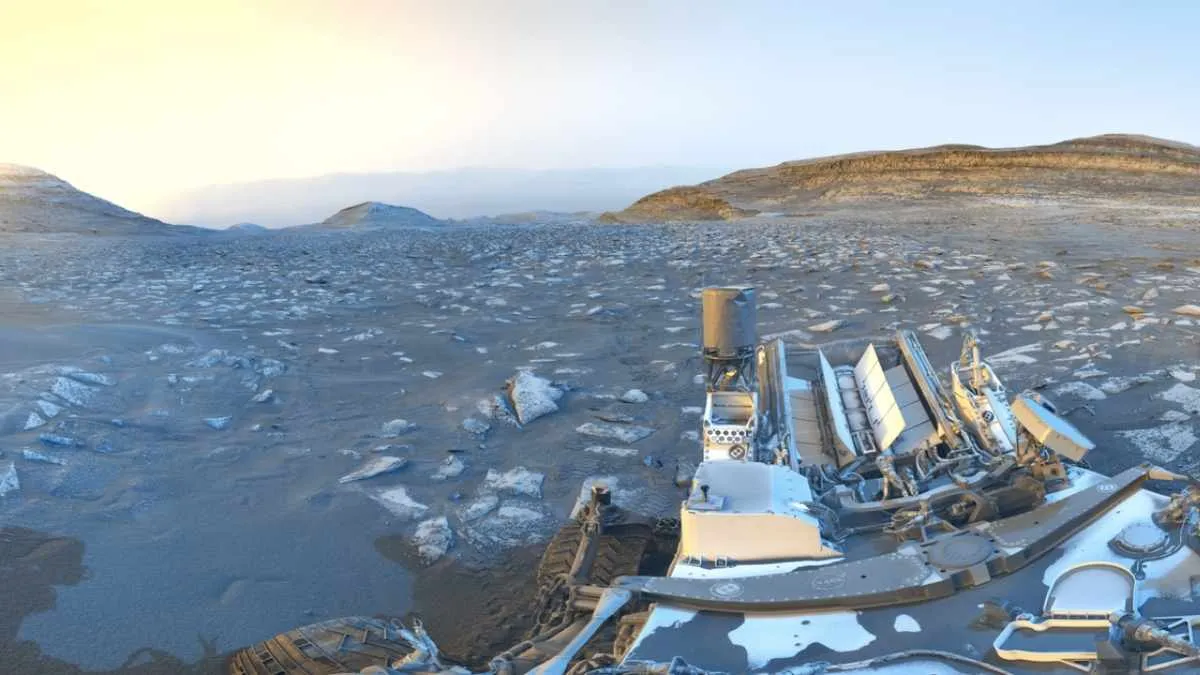
NASA’s Mars Curiosity rover just achieved a huge milestone. Curiosity completed 5,000 Martian days (called sols) of working on the Red Planet of Solar System. It was taking morning and evening pictures of Gale Crater to celebrate its 5000th day on Mars when NASA’s Curiosity stumbled upon one of its biggest surprises yet.
The heavy wheels of Curiosity crushed a small rock beneath while driving the Gediz Vallis channel. When engineers looked at the camera feedback, they saw the broken stone contained bright yellow crystals made of pure elemental sulfur on Mars.
This article highlights the important facts about both the 5000 day celebration and the latest discovery of NASA’s Curiosity rover on Mars to enrich your General Knowledge.
Key Facts about NASA’S Curiosity Rover 5000 Days on Mars
|
Discovery Details
|
NASA Mars Mission Facts
|
|
Milestone
|
Over 5000 Martian days (sols) active
|
|
Location
|
Gediz Vallis channel on Mount Sharp
|
|
Main Discovery
|
Pure yellow sulfur crystals inside a crushed rock
|
|
How It Happened
|
Accidental rock crush during a routine drive
|
Why Pure Yellow Sulfur Surprise Scientists Studying Life on Mars
For years scientists have found sulfate salts on Mars which are minerals formed when ancient water dried up. But pure unmixed sulfur is completely different. Pure sulfur on Earth usually forms around hot springs or active volcanoes.
Mount Sharp on Mars shows no signs of recent volcanic activity. So finding a whole field of these sulfur filled rocks was unexpected.
NASA project scientist Ashwin Vasavada noted that finding these crystals was like finding an oasis in the middle of a desert because current theories about Martian geology simply cannot explain why they are there.
How Ancient Water Shaped the Gediz Vallis Channel on Mars
The discovery took place in the Gediz Vallis channel, which is a big gully that stretches along the slope of Mount Sharp.
The scientists hypothesised that millions of years ago, due to intense flow of water and mud slides, boulders were pushed down the slopes of the mountain. As a result, the accumulation of boulders in the valley took place.
-
The fast flowing water created the Gediz Vallis channel many years ago.
Boulders and gravels slid down the slopes and accumulated in piles.
Water evaporation left peculiar mineral deposits.
Curiosity rover unintentionally broke a stone, thus revealing yellow crystals inside.
Curiosity climbs up the mountain and the scientists investigate the surrounding rocks to find out whether water underground or chemical reactions produced this pure sulfur formation.
What is NASA’s Curiosity Legacy on the Red Planet
With its arrival on Mars in 2012, the Mars Curiosity rover has discovered that Mars at one point was home to freshwater lakes which were able to support basic forms of life. Today, through the continued space exploration by NASA, the rover continues to provide us with vital information from Mount Sharp.