Which Countries are Separated by the Durand Line?
Established in 1893, the Durand Line is an important international boundary line. In this article, we will learn which two countries the Durand Line separates and why was the Durand Line established.
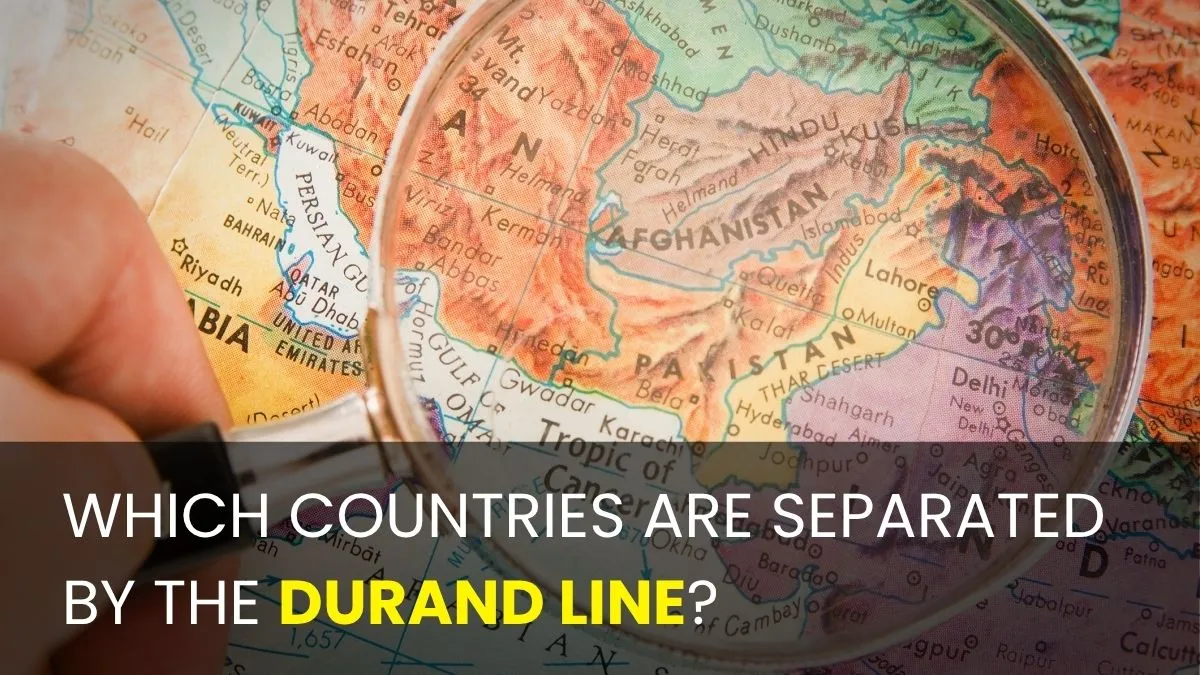
The Durand Line is a 2,640-kilometre international boundary between Pakistan and Afghanistan. It was established in 1893 through an agreement between Sir Mortimer Durand, a British colonial administrator, and Abdur Rahman Khan, the then Emir of Afghanistan. Though Afghanistan does not accept the Durand Line, it is internationally recognised as the western border of Pakistan.
India also has a small claim to the borderline, about 105 km of the easternmost section of the Durand Line, through Pakistan-occupied Kashmir (specifically Gilgit-Baltistan). India argues that Kashmir is an integral part of India, the section bordering Afghanistan's Wakhan Corridor currently under illegal Pakistani control.
In this article, we will learn which two countries the Durand Line separates and why was the Durand Line established.
Which countries are separated by the Durand Line?
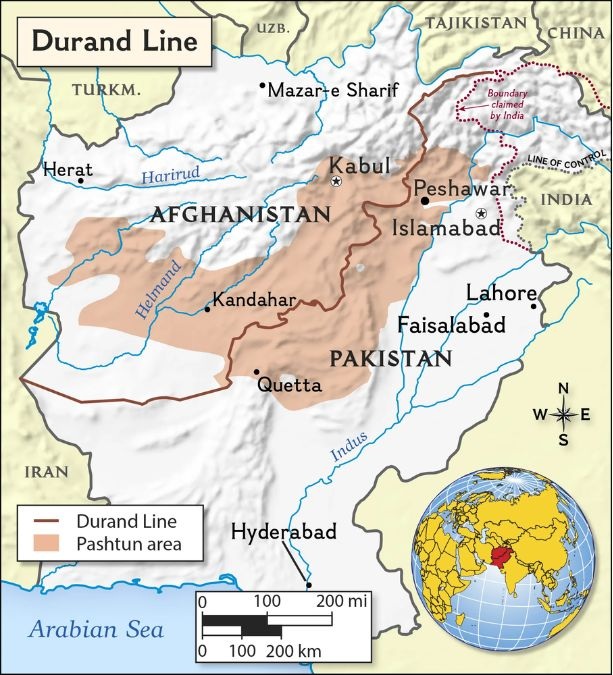
The Durand Line separates Afghanistan and Pakistan. The Durand Line, which was established on 12 November 1893, was drawn by the then Foreign Secretary of British India Sir Henry Mortimer Durand and the then Afghan Emir Abdur Rahman Khan by signing the Durand Line Agreement at the end of the first phase of the Second Anglo-Afghan War.
The 2,640 km international boundary begins at the Hindu Kush mountains in the north and stretches southward to the Balochistan plateau, ending near the Iranian border in the west and China in the east. The western end lies near the Afghanistan-Iran border while the eastern end approaches the border with China (via the Wakhan Corridor).
The Durand Line passes through key geographic and strategic passes, including the Khyber Pass, the Karakoram Range, and the Spīn Ghar (White Mountains), and various Pashtun tribal areas.
The Durand line divides the traditional homelands of the Pashtun and Baloch ethnic groups, with tribal areas located on both sides of the border.
Why was the Durand Line established?
The line was intended to establish the respective spheres of influence of British India and Afghanistan in the region, but it has remained one of the most contentious and politically sensitive boundaries in South Asia.
The origins of the Durand Line can be traced to the Great Game, the 19th century geopolitical rivalry between the British Empire and Tsarist Russia for international influence in Central Asia.
Britain sought to create a buffer zone between its Indian territories and Russian-controlled areas. Afghanistan, lying between these two empires, became a critical frontier state during the 1800s.
Origins of the Durand Line
The British invaded Afghanistan in 1839, but were defeated in the First Anglo-Afghan War. British invaded again in 1878-1880, and won the Second Anglo-Afghan War and secured the Treaty of Gandamark (1879), which granted them the control over Afghanistan's foreign policy.
In 1893, the then Foreign Secretary of British India Sir Henry Mortimer Durand and the then Afghan Emir Abdur Rahman Khan, signed an agreement to create the Durand Line which split the Pashtun tribal areas, placed Balochistan under British and established the Wakhan Corridor as a buffer between Russia and the Britain.
In 1919, following the Third Anglo-Afghan War, the Treaty of Rawalpindi was signed which helped Afghanistan restore control over its foreign affairs and reaffirmed the Durand Line.
When British India was partitioned in 1947, Pakistan inherited all previous treaties and borders established by the British. However, Afghanistan has never formally recognised the Durand Line as an international border with Pakistan. Afghanistan maintains that the Durand Agreement was a colonial imposition.
Also read: Which Country Ranks First in Military Power?

Roopashree Sharma is an experienced broadcast journalist with over 7 years of experience, specialising in beats including geopolitics, defence, and general awareness. She has worked in the roles of correspondent and producer for leading media houses, including Zee, WION, and Economic Times. Currently serving as Deputy Manager – Editorial at Jagran New Media, she produces explainer articles and videos for the General Knowledge (GK) section of the Jagran Josh (English) portal. For inquiries, contact her at roopashree.sharma@jagrannewmedia.com.