Who Founded Tughlakabad? Check History and Facts
Discover who the founder of Tughlakabad was, the story behind its rise and fall, its remarkable architecture, and key facts about the Tughlakabad fort near Delhi.

Tughlakhabad is known as one of the most popular ruined cities in India. Its ruins still cover hundreds of acres near present-day Delhi and its massive stone walls still rise up to 15 metres in some places. But who constructed this forgotten fortress city and why did it fall so quickly? This article addresses these questions about Tughlakhabad.
Quick Summary on Tughlakabad
1. Tughlakabad was founded by Ghiyasuddin Tughlaq, the first sultan of the Tughlaq dynasty.
2. Construction began around 1321 CE, after Ghiyasuddin seized the Delhi Sultanate.
3. It was the third city of Delhi, following Qila Rai Pithora and Siri.
4. The city was abandoned within a few decades of being built, possibly due to a water shortage.
5. The site is protected by the Archaeological Survey of India (ASI) and lies in South Delhi.
Who Founded Tughlakabad?
Ghiyasuddin Tughlaq was the founder of Tughlakabad, and also the Tughlaq Dynasty. He became the Sultan of Delhi in 1320 CE by overthrowing the last Sultan of the Khilji Empire. He was a powerful military commander who served the Khilji Dynasty before seizing the throne during the decline of Khilji dynasty.
Ghiyasuddin Tughlaq ordered the construction of a new fortified city almost immediately after taking power. The city takes its name from its founder Ghiyasuddin Tughlaq. "Tughlakabad" means "the city of the Tughlaqs."
Historical Background
The Rise of Ghiyasuddin Tughlaq
Ghazi Malik, later known as Ghiyasuddin Tughlaq, was a military commander under the rule of Alauddin Khalji, he served as the governor of Dipalpur and Lahore and defended the northwestern frontier against Mongol invasions.
After Alauddin Khalji died in 1316 CE, the Khilji dynasty fell into chaos. Ghazi Malik took advantage of the resulting instability. In 1320 CE, he deposed and killed the last Khilji ruler, Khusrau Khan, and declared himself sultan with the title Ghiyasuddin Tughlaq Shah.
Why Ghiyasuddin Tughlaq built a new city?
Ghiyasuddin Tughlaq wanted a city that matched his ambitions. The existing cities of Delhi, particularly Siri, were associated with his predecessors. Building a new capital was a way to project power and start fresh.
He also had practical reasons. Tughlakabad's hilltop location gave it strong natural defences. The plan was to create a city that could withstand Mongol raids, which was the painpoint of Delhi for long.
Key Facts About Tughlakabad
Founded by: Ghiyasuddin Tughlaq (Ghazi Malik)
Year of founding: Around 1321 CE
Dynasty: Tughlaq dynasty (Delhi Sultanate)
Location: South Delhi, near Mehrauli-Badarpur Road
Wall circumference: Approximately 6.5 kilometres
Number of bastions: Over 50
Architectural style: Tughlaq (battered walls, rough stone, pointed arches)
Managed by: Archaeological Survey of India (ASI)
Nearest landmark: Qutub Minar (approximately 8 km)
Description of Tughlakabad and its Fort
Location
Tughlakabad lies in South Delhi, near the Mehrauli-Badarpur Road. It is approximately 8 kilometres from Qutub Minar. The site covers an enormous area and is divided into three parts: the main fort, a fortified residential area, and the tomb of Ghiyasuddin Tughlaq himself.
The Fort
The fort walls are built from rough-cut quartzite stone, stacked in a style that differs sharply from the refined red sandstone used in later Mughal architecture. The walls are massive and utilitarian. At their peak, they stood about 10 to 15 metres high and stretched for approximately 6.5 kilometres in circumference.
The fort had around 50 bastions, and 13 gates. The fort had palaces, reservoirs, mosques and residential areas. The city was made to hold a large population along with army and other administratives.
The Tomb of Ghiyasuddin Tughlaq
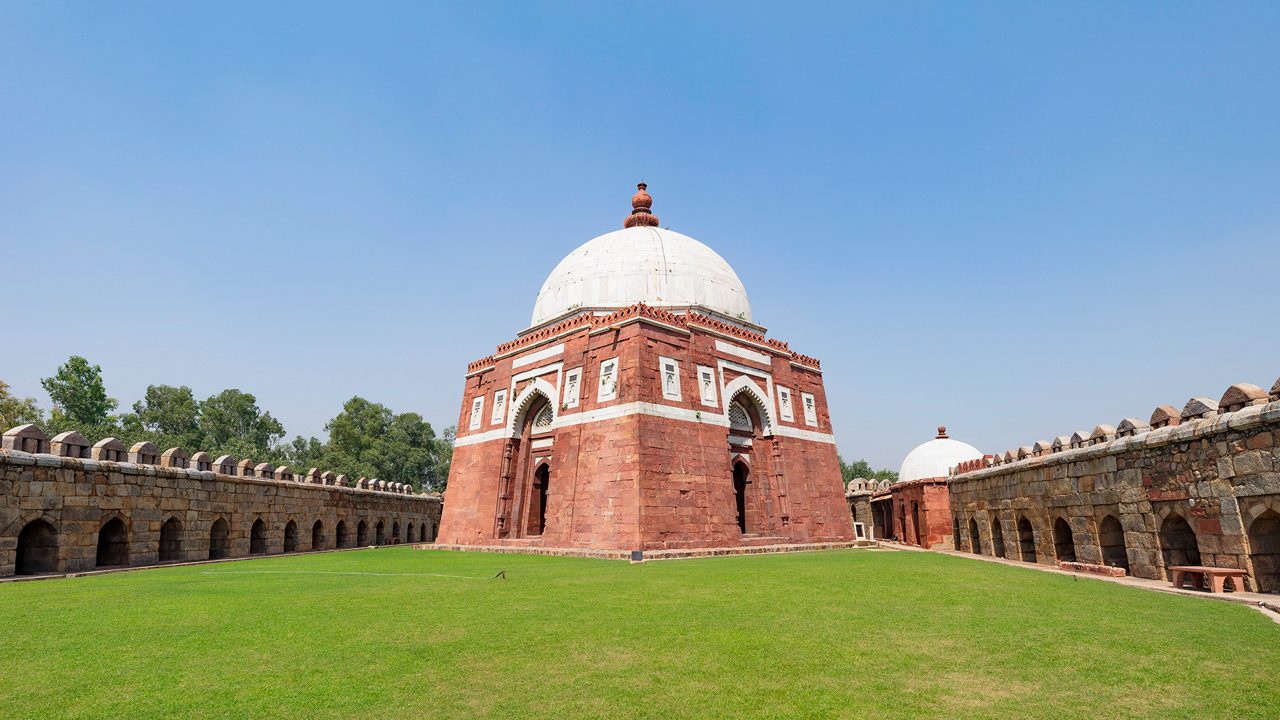
One of the best-preserved structures at the site is the tomb of Ghiyasuddin Tughlaq. It sits on a raised platform connected to the main fort by a causeway. The tomb is built of red sandstone and white marble in a style that mixes Central Asian and Indian influences. Its sloping walls, a design feature called battered walls, became a defining characteristic of Tughlaq-era architecture.
The tomb also contains the graves of Ghiyasuddin's wife and his son, Muhammad bin Tughlaq.
Engineering and Architecture of Tughlakabad Fort
Tughlaq Architectural Style
Tughlakabad introduced a new and distinct architectural style to the Delhi Sultanate. Key features of this architecture style included the following:
1. The sloping walls of the fort leaned inward as they rose in height, providing the fort with solidity.
2. Pointed arches were used in gates and doorways, which reflected Central Asian Islamic influence.
3. Large, uncut or minimally dressed stones were used, giving the fort structures a rugged appearance.
4. Unlike the ornate Khilji architecture, Tughlaq buildings were plain with focus on functionality. Historian Percy Brown, in his book "Indian Architecture (Islamic Period)," described Tughlaq architecture as expressing "strength, austerity, and military power" rather than decorative elegance.
Water Management
The builders created a large artificial reservoir near the fort. This lake, sometimes called the Tughlaqabad Lake, was formed by constructing a dam across a seasonal river. The reservoir supplied water to the city and also served as a defensive moat.
However, water shortage is often cited by historians as one reason the city was eventually abandoned. The reservoir may not have been sufficient for a large permanent population.
What caused the fall of Tughlakabad?
Tughlakabad was one of the shortest-lived capitals in Indian history. Ghiyasuddin Tughlaq died in 1325 CE, just a few years after the city was completed. His son and successor, Muhammad bin Tughlaq, shifted the capital away from Tughlakabad. He briefly moved the court to Daulatabad in the Deccan and later to other sites.
By the mid-14th century, Tughlakabad was largely deserted.
The Curse of Nizamuddin
A famous legend surrounds the city's abandonment. According to historical accounts recorded by Ibn Battuta and others, Ghiyasuddin Tughlaq had a dispute with the Sufi saint Hazrat Nizamuddin Auliya. The sultan reportedly diverted labourers away from the saint's shrine to work on his fort.
In response, Nizamuddin is said to have declared: "Dilli dur ast" (Delhi is far away), meaning the sultan would never enjoy his city. When Ghiyasuddin died in 1325 CE under a collapsing pavilion, many saw this as a fulfillment of the saint's words.
Historians treat this as legend rather than fact, but it remains one of Delhi's most retold stories.
Actual Reasons for Abandonment
Scholars point to more practical causes that resulted in the fall of Tughlakabad:
1. The area around Tughlakabad had limited groundwater and rainfall which led to water scarcity.
2. Muhammad bin Tughlaq's policies were unstable.He moved the capital multiple times during his rule, thereby not allowing one area to develop fully.
3. As Mongol threat to Delhi relaxed, the hilltop fort's defensive advantage declined in value.
Key Facts for Competitive Exams
The following facts are helpful for students who are taking different competitive exams such as SSC, Bank PO's, UPSC etc.
1. The Tughlaqabad was established by Ghiyasuddin Tughlaq (Ghazi Malik) about 1321 CE.
2. Ghiyasuddin Tughlaq was the first Sultan of the Tughlaq dynasty.
3. In the historical context, Tughlakabad is regarded as the third city of Delhi.
4.Tughlakabad fort walls had more than 50 bastions and were about 6.5 kilometres in circumference.
5.Battered (sloping) walls and rough quartzite stone masonry are the features of Tughlaq architectural style.
6.In 1325 CE, Ghiyasuddin Tughlaq died and the city was abandoned by his successor Muhammad Bin Tughlaq.
MCQs for Competitive Exams
Q1. Tughlakabad was founded by?
A) Alauddin Khalji
B) Alauddin Muhammad
C) Ghiyasuddin Tughlaq
D) Firoz Shah Tughlaq
Answer: C) Ghiyasuddin Tughlaq
Q2. What is the most characteristic feature of the Tughlaq style of Tughlakabad?
A) Plain red sandstone carvings
B) Battered (sloping) walls and rough stone masonry
C) Inlay work in white marble
D) Pagoda-shaped temples with lotus designs
Answer: B) Battered (sloping) walls and rough stone masonry
Check out some more interesting articles from the general knowledge section to boost your knowledge of national and international topics. Stay connected with Jagran Josh for more topics like this.

Mriganka Chakraborty is a seasoned digital journalist and communications professional who is currently working as Deputy Manager at Jagran Josh, where he leads the General Knowledge Section. As a subject matter expert with 8+ years of editorial experience, he has created authoritative content that is trusted by millions of readers around the world in Science, History, Geography, Polity, Economy, Sports, and Technology. His extensive expertise in these subjects enables him to present complex topics in an engaging, accurate, and reader-friendly manner to a global audience, making learning addictive and fun.
His background in a wide range of content areas and his ability to move between them make him a trusted voice to readers who want reliable, well-researched content across a variety of disciplines.
In his leisure time, Mriganka enjoys reading fiction novels and watching action and thriller movies, and cricket, which not only hone his storytelling skills but also keep his editorial vision fresh and dynamic.