What Is the Nifty 50? Decoding Indian Stock Market for young investors

The Nifty 50 is among the primary stock exchange indices in India. It represents the performance of 50 large and actively traded companies listed on the National Stock Exchange (NSE). Since it includes companies from three diverse sectors such as banking, information technology, energy, consumer goods etc., the index is regarded as a symbol of the market performance of the Indian economy as a whole.
It is called the ‘heartbeat’ of the stock market as it represents the overall health of the market economy. As the Nifty 50 moves up or down, it easily portrays the overall mood of the investor and the general atmosphere of the economy.
How Does the Nifty 50 Work?
The Nifty 50 is calculated by using a simple but scientific method. It does not sum up simple stock prices. It uses market value and free-float shares to represent a true market activity.
- The index is calculated using free-float market capitalisation, that is, market cap of publicly available shares only.
- Shares held by promoters, governments and locked-in investors are not used for the index calculation.
- Each company has a weight in the index, based on its free-float market value.
- It is not an equal weightage for all the companies.
- Big companies like IT firms, banks have a higher effect on the index compared to small firms.
- A price change in heavyweights has more effect on index movement.
- The index represents actual market activity, not total ownership structure.
- It was launched with base date 3 November 1995, and base value 1000 points.
- The current index level indicates growth of these 50 companies since the base year.
Key features of the Nifty 50
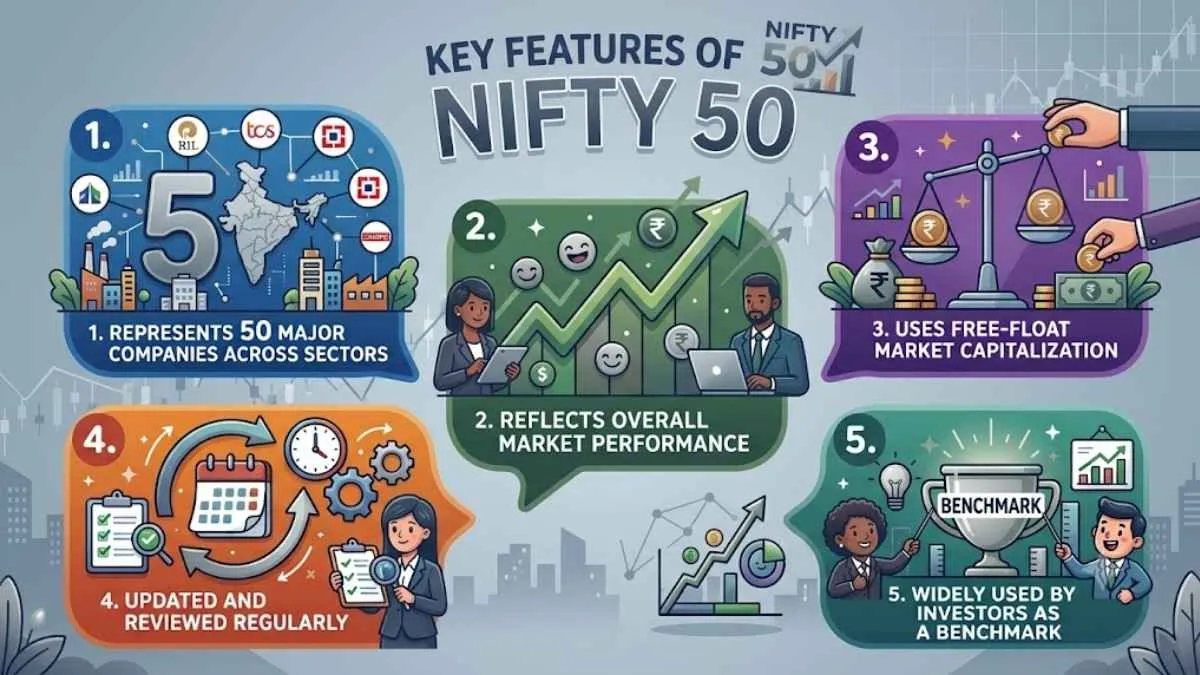
Rebalancing of the stock market index Nifty 50
The Nifty 50 is not static; it changes over time. It is rebalanced twice a year, usually in March and September. During rebalancing, companies that are losing weightage or importance might get removed from the index. They are replaced by strong companies. Rebalancing is done to ensure that the Nifty 50 always reflects the current scenario of the stock market. In short, it ensures that the Nifty has the right companies in the mix.
Why the Nifty 50 matters?
All the investors know, the Nifty 50 is all-important, because it is not just a number but a strong barometer of the stock market. It helps investors, mutual funds, portfolio managers compare and better estimate their performances and make better investment choices. Even a small investor can use it to understand the market trends in a simplified mode. It also has an important part in products such as ETFs and derivatives trading.
In my view, if any one want a quick bird’s eye view of Indian stock market performances, Nifty 50 is one of the simplest and most trustworthy indicators to look at.
Disclaimer: This Jagran Josh article is for educational purposes only and not financial advice. Investments involve risks; students should research independently and consult qualified professionals before investing.

Aishwarya Samant is a journalist with over 4 years of experience navigating the fast-paced corporate media landscape. She specializes in decoding business news, world economy, personal finance, and stock market trends, often adding a subtle touch of political perspective to keep things interesting.
Having worked with reputed organizations like ZEE, TV9, News24, and NewsX, she is no stranger to the newsroom hustle and the demands of real-time storytelling. Her writing style is fast-paced, engaging, and crafted to connect seamlessly with diverse audiences across platforms. She approaches every story from the reader’s point of view, breaking down complex topics into clear, relatable narratives backed by solid facts and credible sources. While she’s confident in expressing strong viewpoints, she ensures balance with insights. Sharp, fact-driven content that informs, engages, and keeps readers coming back for more.


-1791255808594_t.webp)
-1791253022402_t.webp)
-1791214652060_t.webp)