50+ Most Important One Liner GK Questions on Indian Polity
Learn key facts about the Constitution and government with 50+ one liner GK questions on Indian Polity. Boost your knowledge now!
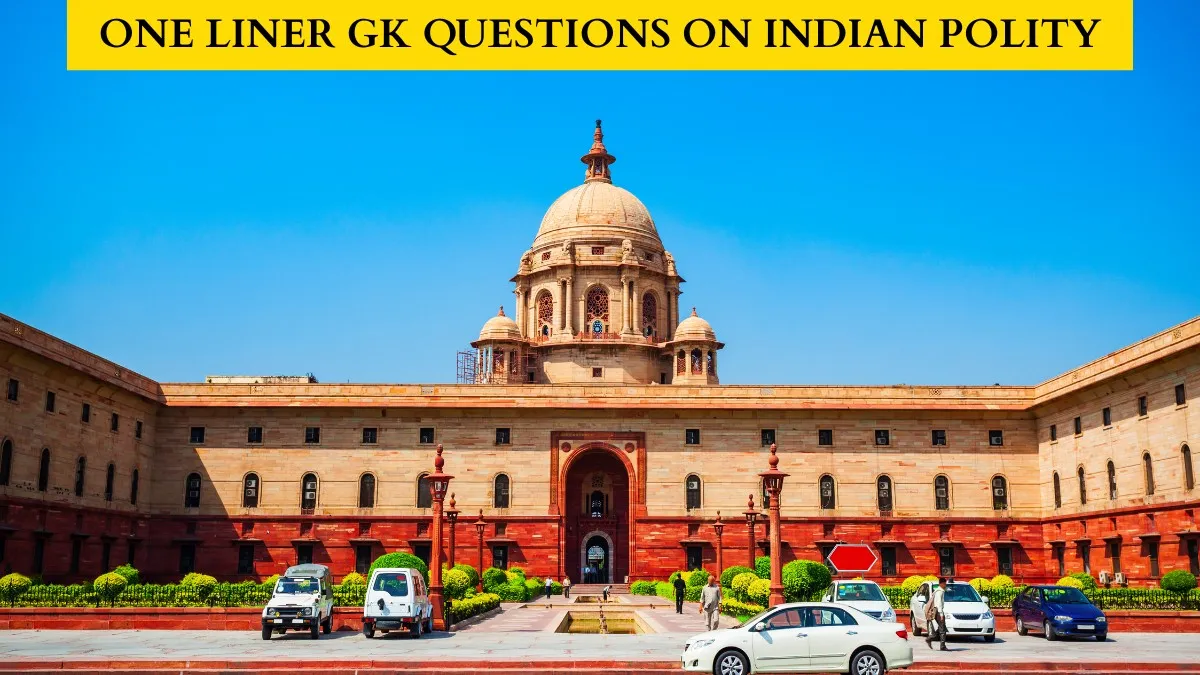
Indian polity is one of the most searched topics for students who are preparing for various competitive exams, and having a solid foundation of Indian polity is necessary to get better outcomes in exams. This article contains 50+ one liner GK questions on Indian Polity that will test your knowledge on Indian Polity and also provide you with a quick reference for general studies.
GK Questions with Answers on Indian Polity
Question 1
Who is known as the Father of the Indian Constitution?
Answer: Dr. B.R. Ambedkar
Question 2
When was the Constitution of India adopted by the Constituent Assembly?
Answer: November 26, 1949
Question 3
When did the Constitution of India officially come into force?
Answer: January 26, 1950
Question 4:
Who was the permanent President of the Constituent Assembly?
Answer: Dr. Rajendra Prasad
Question 5
Who served as the constitutional advisor to the Constituent Assembly?
Answer: B.N. Rau
Question 6
How much time did it take to completely frame the Constitution of India?
Answer: 2 years, 11 months, and 18 days
Question 7
From which country did India borrow the concept of Fundamental Rights?
Answer: United States of America
Question 8
The concept of Directive Principles of State Policy (DPSP) was borrowed from which country?
Answer: Ireland
Question 9
The idea of "Concurrent List" in the Indian Constitution was borrowed from which country?
Answer: Australia
Question 10
How many schedules does the Indian Constitution currently have?
Answer: 12
Question 11
Which part of the Constitution deals exclusively with Fundamental Rights?
Answer: Part III
Question 12
Which Article of the Indian Constitution did Dr. Ambedkar call the "Heart and Soul of the Constitution"?
Answer: Article 32 (Right to Constitutional Remedies)
Question 13
Which Schedule of the Constitution contains the Anti-Defection Law?
Answer: Tenth Schedule
Question 14
Which Article explicitly abolishes the practice of Untouchability?
Answer: Article 17
Question 15
Which Part of the Constitution contains the Fundamental Duties?
Answer: Part IV-A or Article 51A
Question 16
How many Fundamental Duties are currently listed in the Indian Constitution?
Answer: 11
Question 17
Which Article directs the State to secure a Uniform Civil Code?
Answer: Article 44
Question 18
Which schedule deals with the allocation of seats in the Rajya Sabha?
Answer: Fourth Schedule
Question 19
What is the minimum age required to become the President of India?
Answer: 35 years
Question 20
Who administers the oath of office to the President of India?
Answer: The Chief Justice of India
Question 21
Article 61 of the Constitution deals with which procedure?
Answer: Impeachment of the President
Question 22
Who is the ex officio Chairman of the Rajya Sabha?
Answer: The Vice President of India
Question 23
How many members can the President nominate to the Rajya Sabha?
Answer: 12 members (from fields of art, literature, science, and social service)
Question 24
Who holds the ultimate constitutional power to pardon a death sentence in India?
Answer: The President
Question 25
What is the maximum permissible gap between two sessions of Parliament?
Answer: 6 months
Question 26
Who appoints the Prime Minister of India?
Answer: The President
Question 27
Which house of Parliament is known as the Upper House or the Council of States?
Answer: Rajya Sabha
Question 28
What is the maximum constitutional strength of the Lok Sabha?
Answer: 550 members
Question 29
What is the standard tenure of a member of the Rajya Sabha?
Answer: 6 years
Question 30
Who presides over a joint sitting of the two houses of Parliament?
Answer: The Speaker of the Lok Sabha
Question 31
A Money Bill can only be introduced in which house of Parliament?
Answer: Lok Sabha
Question 32
What is the quorum required to hold a meeting of the Lok Sabha?
Answer: One-tenth (1/10th) of the total membership
Question 33
Who decides whether a bill is a Money Bill or not?
Answer: The Speaker of the Lok Sabha
Question 34
Who appoints the Chief Justice of India?
Answer: The President
Question 35
What is the retirement age for a judge of the Supreme Court?
Answer: 65 years
Question 36
Which Article grants the Supreme Court the power to issue writs for the enforcement of Fundamental Rights?
Answer: Article 32
Question 37
Which Article grants High Courts the power to issue writs?
Answer: Article 226
Question 38
How many High Courts are currently operating in India?
Answer: 25
Question 39
Who appoints the judges of the State High Courts?
Answer: The President appoints but the appointment is done with the consultation with the CJI and the state's Governor.
Question 40
Who appoints the Governor of a state?
Answer: The President
Question 41
What is the minimum age required to become the Chief Minister of a state?
Answer: 25 years
Question 42
Which Indian state has the maximum number of seats in the Lok Sabha?
Answer: Uttar Pradesh has 80 seats.
Question 43
Which constitutional amendment gave formal constitutional status to Panchayati Raj institutions?
Answer: 73rd Amendment Act, 1992
Question 44
Which committee recommended the three-tier Panchayati Raj system?
Answer: Balwant Rai Mehta Committee
Question 45
What is the minimum age to contest Panchayati Raj or municipal elections?
Answer: 21 years
Question 46
Which constitutional amendment is popularly known as the "Mini Constitution"?
Answer: 42nd Amendment Act, 1976
Question 47
Which amendment lowered the voting age in India from 21 to 18 years?
Answer: 61st Amendment Act, 1988
Question 48
The Right to Property was removed from the list of Fundamental Rights by which amendment?
Answer: 44th Amendment Act, 1978
Question 49
The words "Socialist," "Secular," and "Integrity" were added to the Preamble through which amendment?
Answer: 42nd Amendment Act, 1976
Question 50
Which constitutional amendment introduced the Goods and Services Tax (GST)?
Answer: 101st Amendment Act, 2016
Question 51
Which Article provides for the establishment of the Finance Commission?
Answer: Article 280
Question 52
Who is the highest law officer in the country?
Answer: The Attorney General of India
Question 53
Which Article establishes the Election Commission of India?
Answer: Article 324
Question 54
Which article governs the appointment of the Comptroller and Auditor General (CAG) of India?
Answer: Article 148
If you want to explore more such general knowledge articles and quizzes on polity, check out Jagran Josh.
Read Further
GK Questions With Answers on Hindu Mythology

Mriganka Chakraborty is a seasoned digital journalist and communications professional who is currently working as Deputy Manager at Jagran Josh, where he leads the General Knowledge Section. As a subject matter expert with 8+ years of editorial experience, he has created authoritative content that is trusted by millions of readers around the world in Science, History, Geography, Polity, Economy, Sports, and Technology. His extensive expertise in these subjects enables him to present complex topics in an engaging, accurate, and reader-friendly manner to a global audience, making learning addictive and fun.
His background in a wide range of content areas and his ability to move between them make him a trusted voice to readers who want reliable, well-researched content across a variety of disciplines.
In his leisure time, Mriganka enjoys reading fiction novels and watching action and thriller movies, and cricket, which not only hone his storytelling skills but also keep his editorial vision fresh and dynamic.