National Family Health Survey (NFHS-6): Key Findings on Health Indicators, Fertility Rate, Child Health, and State-Wise Trends
The Ministry of Health and Family Welfare has released the National Family Health Survey (NFHS-6) for 2023-24. Discover key takeaways, including child stunting dropping to 29.3%, institutional births reaching 90.6%, doubling of internet users, and rising financial inclusion. Explore key insights into fertility trends, maternal nutrition, and public health indicators.
-1780122468555.webp)
The Ministry of Health and Family Welfare (MoHFW) has released the National Family Health Survey (NFHS-6) for 2023-24. It was conducted with the International Institute for Population Sciences (IIPS), Mumbai as nodal agency. The survey covers an extensive sample of nearly 6.79 lakh households across 715 districts. NFHS-6 stands as one of India's most critical socio-demographic and healthcare scorecards which offeres an empirical look at the country's grass-roots transformation.
The NFHS-6 latest data highlights remarkable accelerations in maternal and child healthcare, financial protection, digital penetration, and nutritional outcomes. However, it simultaneously flashes early warning signs regarding lifestyle-related conditions and non-communicable diseases (NCDs) and increasing cases of obesity in adults.
What is the National Family Health Survey (NFHS-6)?
The National Family Health Survey is a large-scale, multi-round survey conducted in a representative sample of households throughout India. Its objective is to provide high-quality, reliable data on population dynamics, family planning, maternal and child health, nutrition, anemia, and healthcare utilisation.
NFHS-6 adopted a completely digital data collection ecosystem using Computer-Assisted Personal Interviewing (CAPI) with real-time multi-level data scrutiny.
NFHS-6 introduces crucial modern socioeconomic markers, tracking Direct Benefit Transfers (DBTs), Self-Help Group (SHG) coverage, digital literacy, and expanded clinical, anthropometric, and biochemical (CAB) assessments, including expanded HIV testing.
Key Highlights and Findings of NFHS-6
The core takeaways from the NFHS-6, 2023-24 survey signal an India transitioning rapidly toward digital inclusion, structured financial backup, improved nutrition conditions in the child and standardized healthcare access. Here are the key highlights:
Digital Literacy and Financial Inclusion
-
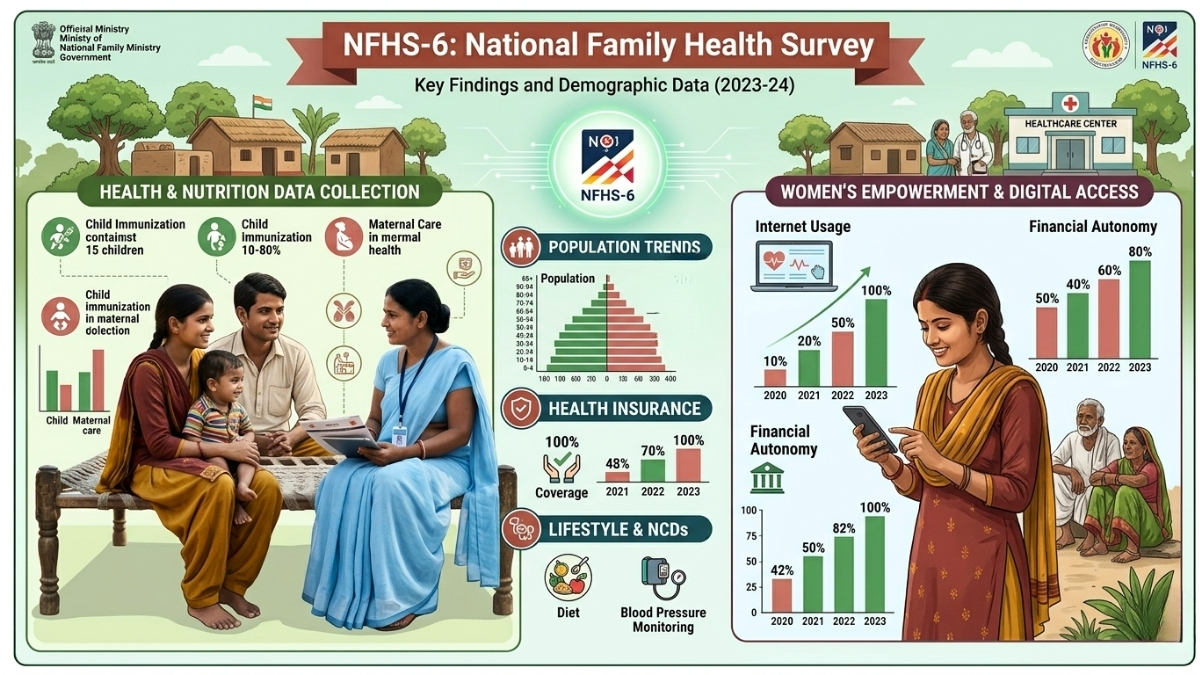
The percentage of women who have ever used the internet has nearly doubled, surging from 33.3% in NFHS-5 to 64.3% in NFHS-6.
-
Bank account ownership has increased especially women holding and actively operating their own bank or savings accounts rose to 89.0% (up from 78.6%).
-
Independent mobile phone usage among women climbed to 63.6% (up from 53.9%).
Universal Health Protection
Driven heavily by flagship schemes like Ayushman Bharat (PM-JAY), household health insurance/financing scheme coverage expanded significantly from 41.0% to 60.2%, easing out-of-pocket healthcare expenses.
Population and Fertility Trends
-
India's Total Fertility Rate (TFR) holds steady at 2.0, remaining comfortably below the replacement level of 2.1.
-
The Contraceptive Prevalence Rate (CPR) grew from 66.7% to 69.1%, indicating improved agency and access regarding family planning.
Maternal and Child Health Indicators in NFHS-6
National Family Health Survey (NFHS-6) highlights maternal care infrastructure has experienced notable strengthening, manifesting in safer deliveries and robust prenatal tracking such as
| Indicator | NFHS-5 (2019-21) | NFHS-6 (2023-24) |
| Antenatal Care (ANC) Coverage | 92.6% | 95.9% |
| First Trimester ANC Registration | 70.0% | 76.2% |
| At least 4 ANC Visits | 58.5% | 65.2% |
| Institutional Deliveries | 88.6% | 90.6% |
| Births Attended by Skilled Personnel | 89.4% | 91.3% |
| Postnatal Care for Newborns (within 2 days) | 79.1% | 85.3% |

The C-Section Surge Emerging as Modern Structural Challenge Child Deliveries
In India institutional deliveries have hit a historic high of 90.6%. The survey highlights a sharp escalation in Caesarean section (C-section) births, which is 27.2% increaed from 21.5% in NFHS-5. This trend is heavily pronounced in urban areas (40.5%) and critically visible in private healthcare facilities, where C-sections reached a high of 54.1%, compared to 16.9% in public hospitals.
Nutrition, Anaemia, and Public Health Trends
Long-term investments in grass-roots nutritional safety nets have yielded clear positive outcomes for child growth indicators, though adult health patterns present new concerns.
Child Nutrition and Immunization
-
Stunting (Low height-for-age) dropped substantially from 35.5% to 29.3%, signaling a positive long-term nutritional shift.
-
Severe Wasting (Low weight-for-height) witnessed a sharp 32% decline, dropping from 7.7% to 5.2%.
-
Underweight minors marked reduction from 32.1% to 31.8%.
-
Early breastfeeding children breastfed within one hour of birth rose from 41.8% to 50.1%.
-
Full Immunization coverage has been increased to 87.1% (up from 83.8%). Notably, 95.6% of these children received their immunizations via public health installations. Rotavirus vaccine penetration experienced a massive leap from 36.4% to 85.4%.

The Looming NCD Crisis Adult Overweight and Obesity
NFHS-6 reports a rising dual burden of malnutrition, characterized by an uptick in overweight and obesity percentages alongside elevated blood sugar trends and lifestyle challenges such as:
-
Overweight/Obese Women has spiked to 30.7% from 24.0% (climbing to 42.8% in urban spaces).
-
Overweight/Obese Men rose to 27.3% from 22.9%.
-
Elevated Blood Sugar in adults (15+ years) falling into the ‘very high’ blood sugar bracket grew from 6.3% to 9.1%.
State-Wise Performance and Regional Disparities
Although in the survey highlights the aggregate national figures show steady progress but regional variations persist:
-
Southern and Western States continue to lead the mandate on financial inclusion, maternal health KPIs, and digital penetration, while simultaneously bearing the highest percentages of adult obesity and C-section deliveries.
-
Empowered Action Group (EAG) States such as Bihar, Madhya Pradesh, and Uttar Pradesh registered the most significant percentage-point drops in child stunting and severe wasting, reflecting the impact of localized interventions, though they continue to face challenges regarding early antenatal registrations and adolescent maternal age trends.
How NFHS-6 Impacts Government Policies and Welfare Schemes
The data indicates that future public health policy will likely need to pivot toward preventive healthcare systems to address adult obesity, sedentary lifestyle choices, and rising blood sugar levels. However NFHS-6 also highlights a direct impact of several active government initiatives and policies incudes:
-
POSHAN Abhiyaan and Saksham Anganwadi: The structural drop in child stunting validates the converging layout of Poshan 2.0 and the Integrated Child Development Services (ICDS).
-
Janani Suraksha Yojana (JSY) and PMSMA: Elevated ANC turnouts and the 90.6% institutional delivery rate point to the success of direct benefit transfers and tracked maternal health pathways.
-
Digital India and PM Jan Dhan Yojana: The doubling of female internet access and high independent banking ratios indicate success in rural digital financial integration.
Frequently Asked Questions (FAQs) on National Family Health Survey for Competitive Exams
Q1. With reference to National Family Health Survey (NFHS), consider the following statements:
-
The survey collects data related to fertility, mortality, nutrition, and child health.
-
Questions on disability were included for the first time in NFHS-5.
-
Population Research Centres (PRCs) are the nodal agencies for conducting NFHS.
Which of the statements given above are correct?
(a) 1 and 2 only
(b) 2 and 3 only
(c) 1 and 3 only
(d) 1, 2 and 3
Answer: (a) 1 and 2 only
Q2. National Family Health Survey (NFHS)-5 does NOT include:
(a) High Blood Pressure
(b) Diabetes
(c) HIV Test
(d) Registration of Death
Answer: (c) HIV Test
Q3. Which survey uses probability sampling to collect demographic and health data in India?
(a) Census of India
(b) Sample Registration System
(c) National Family Health Survey
(d) Civil Registration System
Answer: (c) National Family Health Survey
Q4. According to NFHS-5 (2019–21), what was the Sex Ratio at Birth (SRB) in India?
(a) 935
(b) 931
(c) 940
(d) 927
Answer: (b) 931 (as per the exam key)
Q5. As per NFHS-5 (2019–21), what proportion of households in Bihar live in a pucca house?
(a) Two-thirds
(b) One-third
(c) One-half
(d) One-fourth
Answer: (b) One-third
Q6. According to NFHS-5, what percentage of children under five years are underweight in India?
(a) 32.1%
(b) 28.5%
(c) 26.7%
(d) 19.3%
Answer: (a) 32.1%
Q7. The National Family Health Survey (NFHS) is conducted under the stewardship of:
(a) NITI Aayog
(b) Ministry of Statistics and Programme Implementation
(c) Ministry of Health and Family Welfare
(d) Registrar General of India
Answer: (c) Ministry of Health and Family Welfare
Q. Which institution serves as the nodal agency for conducting NFHS in India?
(a) NITI Aayog
(b) ICMR
(c) International Institute for Population Sciences (IIPS), Mumbai
(d) Census Commissioner of India
Answer: (c) International Institute for Population Sciences (IIPS), Mumbai under the Ministry of Health and Family Welfare.
Q. Which indicator is commonly used in NFHS to measure population growth trends?
Answer: Total Fertility Rate (TFR) is one of the most important indicators used in NFHS.
Q. What is the replacement-level fertility often discussed in NFHS reports?
Answer: Replacement-level fertility is 2.1 children per woman, which is considered necessary to maintain a stable population.
Q. When was the first National Family Health Survey conducted in India?
Answer: The first NFHS (NFHS-1) was conducted in 1992–93.
Q. How many rounds of NFHS have been conducted in India so far?
Answer: Five rounds have been completed (NFHS-1 to NFHS-5), while NFHS-6 is the latest round being conducted.

Manisha Waldia is a distinguished content strategist with 5 years of experience crafting premium educational content for UPSC and State PCS, with a focus on deep conceptual analysis across Polity, Geography, History, and Environment. She currently brings this expertise to Jagran Josh, where she covers major national and international events, current affairs, and static general knowledge. Over her career, Manisha's specialized insights have led her to curate high-impact materials and serve as a UPSC Mains answer-evaluator for India’s top institutes—including Drishti IAS, Shubhra Ranjan IAS, Study IQ, GS Score, and PWonlyIAS. She has also worked alongside leading NGOs like Oxfam India and Avani Kumaon.
Contact: manisha.waldia@jagrannewmedia.com


-1791182162808_t.webp)