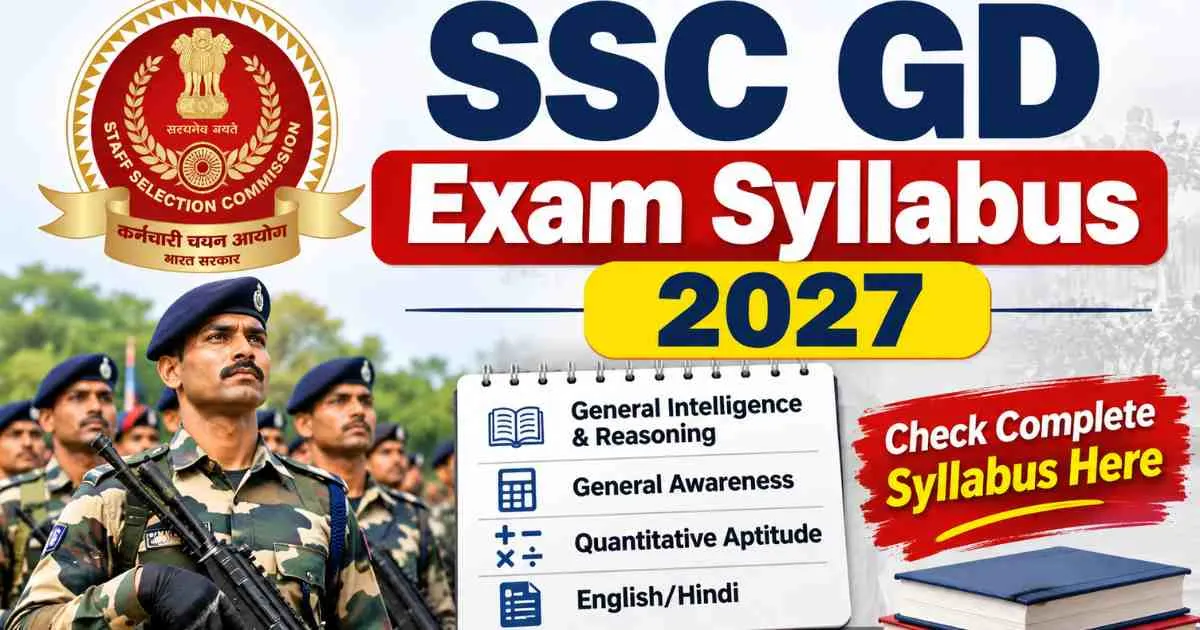
The SSC GD Syllabus 2027 includes four subjects i.e, General Intelligence and Reasoning, General Knowledge and General Awareness, Elementary Mathematics, and English/Hindi. Candidates preparing for the Constable (GD) examination should understand the topics covered in each section, the number of questions, the marking scheme and the overall selection process.
As of November 20, 2026, the Staff Selection Commission (SSC) has not released the official SSC GD 2027 notification. Candidates can refer to the latest available SSC GD 2026 notification to understand the syllabus and examination structure. The Computer-Based Examination (CBE) pattern consists of 80 questions carrying 160 marks, with a total duration of 60 minutes. Any changes introduced for the 2027 recruitment cycle will be confirmed through the new notification. Scroll for more details.
SSC GD Syllabus 2027: Highlights
The SSC GD examination is conducted to recruit Constables (General Duty) in various Central Armed Police Forces (CAPFs), the Secretariat Security Force (SSF) and Rifleman (GD) in Assam Rifles. The written examination tests candidates on basic reasoning, general awareness, mathematics and language skills.
Related Stories
|
Particulars
|
Details
|
|
Examination Name
|
SSC GD Constable Examination 2027
|
|
Conducting Authority
|
Staff Selection Commission
|
|
Post Name
|
Constable (GD) and Rifleman (GD)
|
|
Examination Mode
|
Computer-Based Examination
|
|
Subjects
|
4
|
|
Total Questions
|
80
|
|
Maximum Marks
|
160
|
|
Exam Duration
|
60 minutes
|
|
Question Format
|
Multiple Choice Questions
|
|
Correct Answer
|
2 marks
|
|
Negative Marking
|
0.25 marks
|
|
Question Level
|
Matriculation (Class 10)
|
|
Selection Process
|
CBE, PET, PST, Medical Examination and Document Verification
|
SSC GD Syllabus 2027 PDF Download
Candidates looking for the SSC GD Syllabus 2027 PDF can refer to the previous recruitment notification until the Commission publishes the updated document. The official notification contains the examination pattern, indicative syllabus, recruitment stages and other important instructions.
Download: SSC GD Syllabus 2027 PDF (Link Active Soon)
Subject Wise Topics for SSC GD Syllabus 2027
The syllabus is designed to assess candidates' basic academic knowledge, reasoning ability and awareness of their surroundings. The questions are based on the Class 10 level, so candidates should focus on strengthening fundamental concepts rather than studying advanced topics.
1. General Intelligence and Reasoning Syllabus
The General Intelligence and Reasoning section tests logical thinking, observation, pattern recognition and problem-solving abilities. Questions are mainly based on non-verbal reasoning and analytical aptitude. The important topics covered in this section include:
- Analogies
- Similarities and Differences
- Spatial Visualisation
- Spatial Orientation
- Visual Memory
- Discrimination
- Observation
- Relationship Concepts
- Arithmetical Reasoning
- Figural Classification
- Arithmetic Number Series
- Non-Verbal Series
- Coding and Decoding
Candidates should practise reasoning questions regularly to improve their ability to identify patterns and solve problems within the given time.
2. General Knowledge and General Awareness Syllabus
This section checks candidates' knowledge of India, neighbouring countries, current events and general developments. Questions are designed to assess awareness of everyday events and basic scientific knowledge. The important areas of preparation include:
- Current Affairs
- Indian History
- Indian Geography
- Indian Culture
- Sports
- Economic Developments
- General Polity
- Indian Constitution
- Scientific Research
- Important National Events
- Important International Events
- General Awareness
Candidates should follow current affairs regularly and revise static general knowledge topics. Special attention should be given to important events, sports competitions, government developments and basic science.
3. Elementary Mathematics Syllabus
The Elementary Mathematics section evaluates numerical ability and understanding of basic arithmetic concepts. Candidates should be comfortable with calculations, mathematical operations and commonly used formulas. The important topics include:
- Number Systems
- Computation of Whole Numbers
- Decimals and Fractions
- Relationship Between Numbers
- Fundamental Arithmetical Operations
- Percentages
- Ratio and Proportion
- Averages
- Interest
- Profit and Loss
- Discount
- Mensuration
- Time and Distance
- Ratio and Time
- Time and Work
Regular practice is essential for this section. Candidates should focus on calculation speed, accuracy and understanding the methods used to solve different types of mathematical problems.
4. English/Hindi Syllabus
The English/Hindi section evaluates candidates' ability to understand basic language concepts and interpret written information. The examination tests fundamental language skills and reading comprehension. Candidates should prepare the following areas:
- Basic English or Hindi understanding
- Reading Comprehension
- Vocabulary
- Basic Language Usage
- Understanding of Written Passages
How to Download SSC GD Syllabus 2027?
Candidates can follow these steps to access the latest available syllabus online.
- Visit the official SSC website at ssc.gov.in.
- Point the cursor to “for candidates” option
- Then a drop down list will appear
- Click on the syllabus option
- Find and click on the SSC GD Syllabus 2027 link
- Download and take printout of the SSC GD 2027 Syllabus for future reference
SSC GD Exam Pattern 2027
The SSC GD Computer-Based Examination is divided into four sections, with each subject carrying equal weightage. Candidates have to answer 80 objective-type questions within 60 minutes.Check the table below to know SSC GD Subject Wise Exam Pattern.
|
Subject
|
Number of Questions
|
Maximum Marks
|
|
General Intelligence and Reasoning
|
20
|
40
|
|
General Knowledge and General Awareness
|
20
|
40
|
|
Elementary Mathematics
|
20
|
40
|
|
English/Hindi
|
20
|
40
|
|
Total
|
80
|
160
|
Each section contains 20 questions worth 40 marks. Candidates should manage their time carefully because they have only one hour to complete all four sections. The examination is conducted online, and questions are presented in multiple-choice format.
SSC GD Marking Scheme 2027
Understanding the marking scheme is important because the examination includes negative marking. Candidates receive marks for correct responses, while incorrect answers result in a deduction. The marking scheme in the latest available notification is given below:
|
Response Type
|
Marks Awarded
|
|
Correct Answer
|
+2
|
|
Incorrect Answer
|
-0.25
|
|
Unattempted Question
|
0
|
|
Total Marks
|
160
|
How Is the SSC GD Score Calculated?
The marks are calculated by adding the marks obtained for correct answers and deducting the penalty for incorrect responses. For example, if a candidate answers 60 questions correctly, gives 10 incorrect answers and leaves 10 questions unanswered, the score will be:
|
Particulars
|
Calculation
|
Marks
|
|
Correct Answers
|
60 × 2
|
120
|
|
Incorrect Answers
|
10 × 0.25
|
-2.5
|
|
Unattempted Questions
|
10 × 0
|
0
|
|
Final Score
|
120 - 2.5
|
117.5
|
Thus, the candidate will score 117.5 marks out of 160 before any applicable normalization or other notified adjustments.
Preparation Tips for SSC GD 2027
A planned study routine can help candidates complete the syllabus without leaving important topics for the final stage. Since the examination covers four different subjects, candidates should divide their preparation time according to their strengths and weaknesses.
- Start by reviewing all four subjects and making a list of topics that need more attention. This will help you organise your preparation.
- Solve questions on analogies, coding-decoding, series and classification. Regular practice can improve speed and logical thinking.
- Read daily news and revise important national and international developments. Also prepare static GK topics such as history, geography, polity and sports.
- Begin with basic arithmetic and gradually practise questions involving percentages, averages, ratio, profit and loss, time and work, and mensuration.
- Read short passages, practise vocabulary and work on understanding written information in English or Hindi.
- Previous-year papers help candidates understand the question format, difficulty level and types of questions asked in the examination.
- Attempt full-length mock tests within the prescribed 60-minute duration. Analyse incorrect answers and work on improving accuracy.
- Do not wait until the CBE result to begin physical preparation. Include running and basic fitness exercises in your routine.