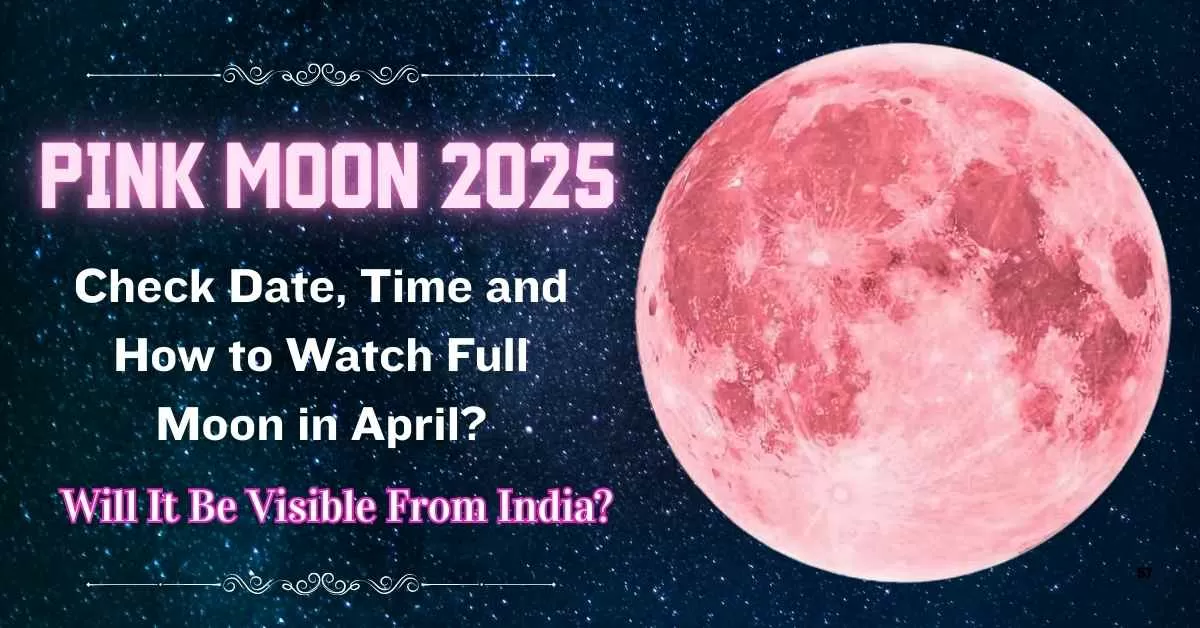
Pink Moon 2025: Why is April’s Full Moon Called a Pink Moon? Check Date, Time & Where to Watch This “Micromoon” From India?
April Full Moon 2025: The Pink Moon on April 12, 2025, is the year's smallest full moon because it appears at its farthest point from Earth, called apogee. Despite the name, it won’t look pink—it’s named after springtime phlox flowers. This moon is also called the Paschal Moon, as it helps set the date for Easter, which will be on April 20, 2025.
Key Points
- The Pink Moon occurs on April 12, 2025, at 8:22 PM EDT.
- It's named after spring wildflowers, not its color.
- The Pink Moon will be a micromoon, appearing smaller than usual.
Pink Moon 2025: You may have heard of the light spectrum, which consists of seven colours: red, orange, yellow, green, blue, indigo and violet.
And that’s why sometimes the colour of the moon appears to be red and blue—because the air around the Earth can change the way we see its colour by blocking or scattering certain colours of light.
But what if we tell you that there is another version of the moon that may entice your curiosity? The pink moon.
The April full moon is known as the pink moon due to the blooming of a wildflower called Phlox subulata, also known as moss pink, which is one of the earliest spring flowers in North America.
Despite its name, the moon doesn’t actually turn pink. The term 'Pink Moon' comes from traditional Native American and colonial-era naming systems that marked the seasons by the natural environmental changes.
Check Out| From New Moon to Full Moon: Understanding the 8 Moon Phases
What Is the April Pink Moon 2025? Meaning and Origin of the Name
The April Pink Moon 2025 is a full moon that occurs on Saturday, April 12, 2025, at 8:22 p.m. EDT in the United States.
Despite its name, the moon itself does not appear pink; instead, it is named after the early spring wildflowers, such as the moss pink or creeping phlox, which bloom around this time.
Meaning and Origin of the Name
Origin: The name "Pink Moon" originates from Native American traditions, specifically from the early spring blooms of wildflowers like the moss pink or creeping phlox.
Meaning: The Pink Moon marks the first full moon of spring in the Northern Hemisphere and is associated with renewal and transformation. It is also known as the Paschal Full Moon, which plays a role in determining the date of Easter Sunday.
Types of Moon
The full moon in April 2025, called the Pink Moon, will be a micromoon. This means the Moon will be at its farthest point from Earth—a spot called apogee. Because of this, the Moon will look a little smaller and dimmer than usual in the night sky.
While supermoons tend to steal the spotlight by appearing larger and brighter when the Moon is closest to Earth (perigee), micromoons have their quiet charm.
April Pink Moon 2025 Date and Time: When to Watch the Full Moon
The April Pink Moon 2025 will occur on Saturday, April 12, 2025, at 8:22 PM EDT (or 05:00 AM IST on April 13) in the United States.
This full moon is best viewed as it rises in the east shortly after sunset, when it appears larger due to the "moon illusion" and may take on a gentle orange hue due to atmospheric conditions.
Pink Moon 2025: Will It Be Visible From India?
Yes, the April Pink Moon 2025 will be visible from India. It will occur on Saturday, April 12, 2025, at 8:22 PM EDT, which corresponds to Sunday, April 13, 2025, at 5:00 AM IST. The moon can be seen from all over India, and the best viewing locations are those remote from light pollution, such as open fields, hilltops, or rural areas.
How to Watch the April Pink Moon 2025: Best Viewing Tips and Locations
The April Pink Moon 2025 will rise on Saturday, April 12, 2025, at 8:22 PM EDT (or Sunday, April 13, 2025, at 5:52 AM IST). Here are the best tips and locations for viewing this celestial event:
#1. Timing:
- The moonrise will occur shortly after sunset, making dusk the ideal time to watch it.
- The moon will appear full for about a day before and after its peak phase.
#2. Location:
- Choose a location with a clear view of the eastern horizon, such as open fields, hilltops, or beaches.
- Areas with minimal light pollution will enhance visibility.
#3. Equipment:
- Use binoculars or telescopes to observe details like craters and shadows.
- For photography, use a camera with a tripod and include foreground elements for dramatic shots.
#4. Accompanying Star:
- Look for Spica, the brightest star in the Virgo constellation, located near the Pink Moon.
#5. Best Locations
- Urban Areas: Rooftops or high-rise buildings with an unobstructed eastern view.
- Rural Areas: Dark-sky parks or countryside locations far from city lights.
- Coastal Regions: Beaches or cliffs with open horizons.
April Pink Moon 2025: 10 Amazing Fun Facts
- Name Origin: The name "Pink Moon" comes from Native American traditions, specifically from the early spring blooms of wildflowers like moss pink or creeping phlox, not because the moon itself appears pink.
- Date and Time: The Pink Moon will occur on Saturday, April 12, 2025, at 8:22 PM EDT (or Sunday, April 13, 2025, at 5:00 AM IST).
- Supermoon vs Micromoon Debate: There is a discrepancy in whether the April Pink Moon is a supermoon (appearing larger due to being closer to Earth) or a micromoon (appearing smaller due to being farther away). Some sources incorrectly identify it as a supermoon, while others correctly state it is a micromoon.
- Moon Illusion: The moon appears larger when it is low on the horizon due to the moon illusion, which can make it seem more impressive.
- Colour Appearance: Although not pink, the moon can take on an orange hue at sunrise or sunset due to atmospheric conditions.
- Paschal Moon: The Pink Moon is also known as the Paschal Moon, playing a role in determining the date of Easter Sunday.
- Cultural Significance: It marks the first full moon of spring, symbolising renewal and transformation. It's an auspicious time for spiritual growth and new beginnings.
- Accompanying Star: The Pink Moon will be visible near Spica, one of the brightest stars in the night sky.
- Visibility: The Pink Moon will be visible from most parts of the world, including India, making it a global event.
- Scientific Classification: The Pink Moon is a full moon that occurs when the moon is on the opposite side of the Earth from the Sun, making it fully illuminated by sunlight.

Kriti Barua is a skilled digital journalist and communications professional with 4+ years of experience, currently writing for the General Knowledge section at Jagran New Media. She has established herself as a subject matter expert in History, Geography, Trending National and International News, Sports, Science, and Defence, producing clear, reliable, and search-optimised content that connects with readers worldwide.
Kriti holds a BA degree from Delhi University and a one-year diploma in TV Production and Journalism, an academic background that adds research depth and strong storytelling instincts to her writing. Her experience spans brand writing, content marketing, and digital media, giving her a sharp understanding of what makes content both helpful to readers and visible in search.
At Jagran New Media, she applies this expertise to national and international news coverage, query-based articles, and in-depth pieces across her specialist subject areas. Her content is defined by easy language, factual accuracy, strong keyword strategy, and reader-friendly storytelling.


-1791182162808_t.webp)