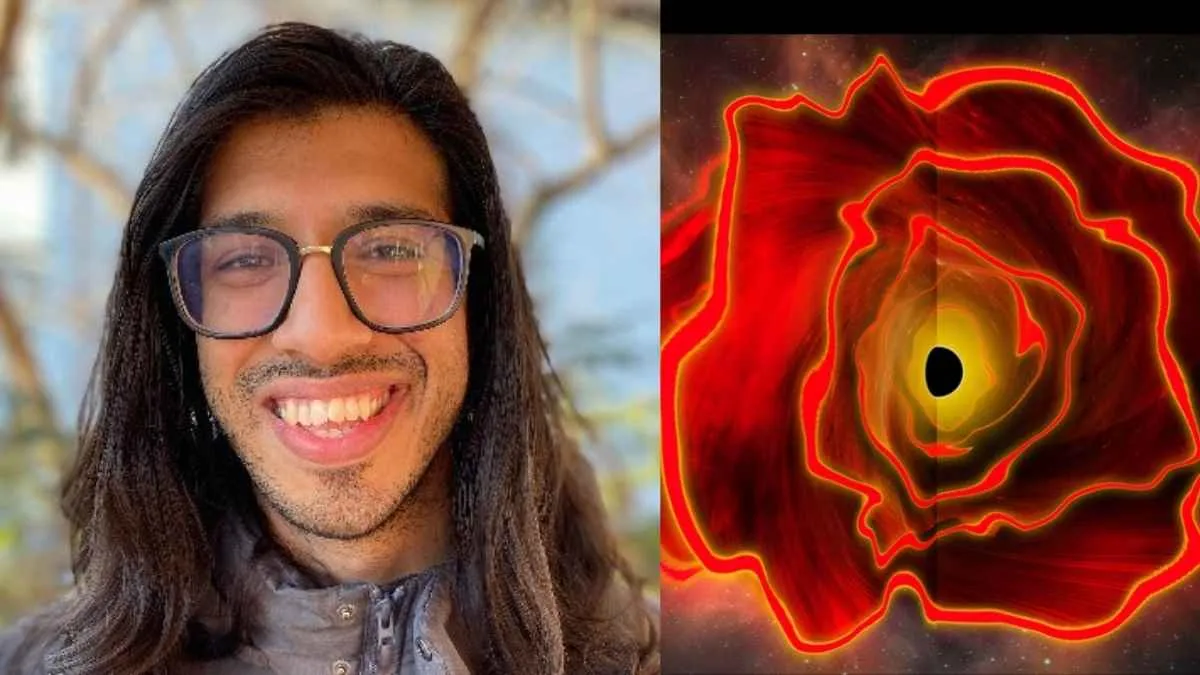
The find of a new type of cosmic phenomena, the ‘Black Hole Star,’ has thrust a recently naturalised Indian born astrophysicist, Dr Rohan Naidu, into the global limelight. The fresh study, which was published in Nature in August 2026, has opened a new window onto the early universe.
Many of the online chatter refer to Naidu as the engineering student who made the find, a description that understates his journey. At 18, the student of physics walked out of an engineering college in India, opting instead to follow his passion for the universe.
That choice took the him out of Hyderabad, through Singapore, Harvard, MIT and the University of Hawaii. The scientist who once gave up a conventional academic path has become a key part of one of the most significant discoveries in astronomy, showing that curiosity can rewrite the map of our careers, as well as that of the universe.
Who Is Rohan Naidu? Man Behind The New Star Discovery
Before his name became associated with one of the biggest discoveries in astronomy, Dr. Naidu was an 18 year old in Hyderabad, with a penchant for space.
He dropped out of engineering college in India, bought his first plane ticket and moved to Singapore to enroll in the inaugural cohort of Yale NUS College.
His higher education took him to Harvard University where he earned a PhD in astronomy, studying ancient galaxies hidden in the Milky Way. He has held positions like the NASA Hubble Fellowship and the Pappalardo Fellowship at MIT. Now, as an Assistant Professor at the University of Hawaii, Dr. Naidu is demonstrating that sometimes, astronomy starts with a leap of faith.
What's the New Star black hole discovery? Facts
- Dr. Rohan Naidu and his team used data from the James Webb Space Telescope (JWST) to make the discovery.
- The object which has been discovered has now been officially named MoM BH 1.
- Initially, scientists thought this was a giant red star because of how it looked in telescope pictures.
- The size of the object is huge. Scientists say its outer layer could be as big as our whole solar system.
- it SITS to be not a typical star.
- Normal stars, like our Sun, produce energy through a process known as nuclear fusion.
- MoM BH 1 operates in a different way. It is powered by a huge black hole that's suspected to be located at its core.
- Scientists estimate that the black hole is almost 100,000 times the mass of the Sun.
- A thick cloud of hydrogen gas surrounds the black hole, making the object appear like a massive star.
- The object emits a tremendous amount of power, almost 100 billion times the energy produced by the Sun.
- The new finding may offer insights into how some of the biggest and earliest black holes in the universe formed.
A Tiny Red Dot That's Been Chaptering The Story of The Universe
Astronomers have been trying to crack the code of the universe's so called 'little red dots' for years. These oddball objects discovered by the James Webb Space Telescope were a lot brighter and bigger than scientists thought.
The discovery of Dr. Rohan Naidu's Black Hole Star may be the final piece of the puzzle. Scientists think these strange objects may help reveal how supermassive black holes grew so rapidly after the Big Bang. In plain English, folks may have found an important step in the early days of the universe.
Labeled a ‘one in a billion’ discovery, the find resolves old mysteries only, but opens up a whole world of brand new ones.