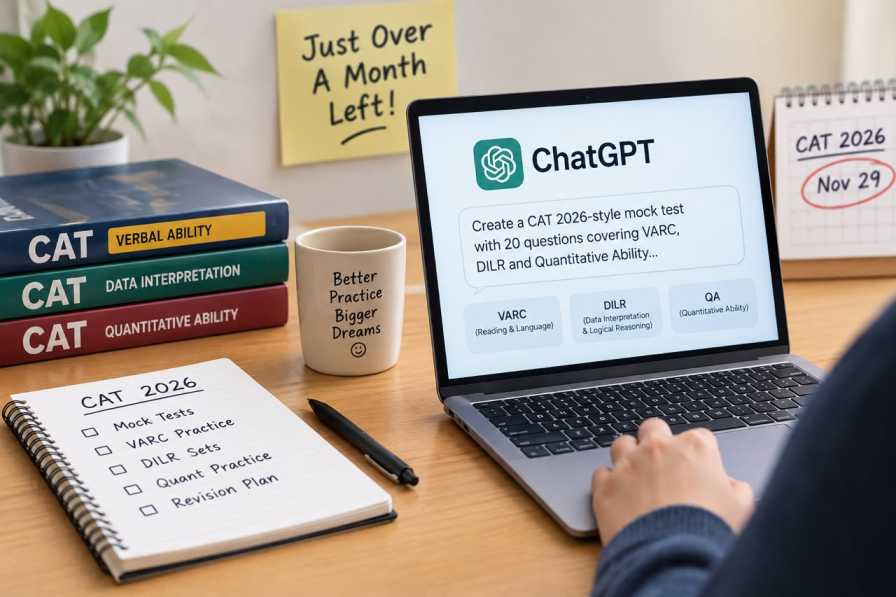
With just over a month left for the Common Admission Test (CAT) 2026, candidates can use the remaining time to practise questions, identify weak areas and improve their exam strategy. Along with previous years’ question papers and regular mock tests, tools such as ChatGPT can help students create additional practice questions based on the CAT exam pattern.
ChatGPT can generate questions for the three major sections of the exam: Verbal Ability and Reading Comprehension (VARC), Data Interpretation and Logical Reasoning (DILR), and Quantitative Ability (QA). Candidates can also use it to review their answers and understand the concepts behind incorrect responses.
5 ChatGPT Prompts To Practise Mock Tests For CAT 2026
Candidates can copy and paste the following prompts into ChatGPT to create practice material for their preparation.
1. Generate a CAT-style mock test
Prompt:
“Create a CAT 2026-style mock test with 20 questions covering VARC, DILR and Quantitative Ability. Include a mix of easy, moderate and difficult questions. Follow the general CAT question formats, include multiple-choice and type-in-the-answer questions, and provide an answer key with detailed solutions separately. Do not reveal the answers until I finish attempting the questions.”
This prompt can help candidates practise questions from all three sections in one sitting. Students can also ask ChatGPT to generate separate tests for each section.
2. Practise VARC questions
Prompt:
“Act as a CAT VARC practice coach. Create a reading comprehension passage on a topic suitable for CAT-level practice, followed by five multiple-choice questions. Include questions on the main idea, inference, tone, author’s argument and paragraph interpretation. Provide four options for each question and explain the correct answers after I submit my responses.”
This prompt can help candidates practise reading comprehension and improve their ability to identify the central argument, understand inferences and eliminate incorrect options.
3. Create DILR sets with increasing difficulty
Prompt:
“Generate three CAT-style Data Interpretation and Logical Reasoning sets, starting with moderate difficulty and progressing to a challenging level. Use different formats, such as tables, arrangements, schedules, rankings or data-based puzzles. Include four to five questions per set. Let me solve each set before showing the answers and explain the logic step by step.”
DILR practice requires candidates to interpret information, identify relationships and select an efficient approach. Solving different types of sets can help students become more comfortable with unfamiliar problems.
4. Practise Quantitative Ability
Prompt:
“Create 15 CAT-level Quantitative Ability questions covering arithmetic, algebra, geometry, number systems and modern mathematics. Include a range of difficulty levels and a mix of multiple-choice and type-in-the-answer questions. Ask me one question at a time, check my response and explain the solution using the simplest valid method.”
Candidates can use this prompt to revise important topics and practise calculations. They can also request additional questions from topics in which they need more practice.
5. Analyse mistakes and prepare a revision plan
Prompt:
“I have completed a CAT mock test. My section-wise scores are VARC: [enter score], DILR: [enter score], and QA: [enter score]. My main mistakes were [describe mistakes]. Analyse my performance, identify the areas I should prioritise and create a seven-day revision plan. Include daily practice targets, timed question-solving sessions and revision slots. Do not promise a particular score improvement.”
This prompt can help candidates turn their mock-test results into a practical revision plan. Students should enter their actual scores and mistakes to receive more relevant suggestions.
How To Use ChatGPT Effectively For CAT 2026 Preparation?
Candidates should avoid spending too much time generating questions without attempting full-length mock tests. A balanced preparation strategy should include timed practice, analysis of incorrect answers, revision of concepts and regular sectional tests.
After every mock test, students should review questions they answered incorrectly, questions they could not attempt and questions that took too long to solve. They can then use ChatGPT to understand the underlying concepts or generate similar practice questions.
Candidates should also verify solutions, particularly for complex Quantitative Ability and DILR questions, as AI tools can sometimes produce incorrect answers or explanations.
With limited time remaining, the priority should be to improve accuracy, manage time effectively and become familiar with the exam format rather than attempting to cover every topic from scratch.
ALSO READ| How to Score 99 Percentile in CAT 2026? Tips, Strategy and Study Plan
ALSO READ| CAT 2026 Registrations See 3.7% Dip: 2.84 Lakh Candidates Apply for November 29 Exam