Look up at a stormy sky, and you see life-giving water droplets. However, if you travel beyond our atmosphere, the concept of weather shifts into something out of a science fiction movie.
Space agency research from NASA and deep planetary climate modeling reveals that while the physics of cloud formation remains stable, the actual rain on different planets varies drastically based on atmospheric pressure and chemistry.
For anyone asking, "Does it rain on other planets?" the short answer is yes, but you will not find a single drop of water raining beyond Earth. Instead, alien skies host everything from boiling chemicals to showers of precious gemstones, offering a fascinating look into the raw mechanics of rains on other planets in our universe.
Does it Rain on Other Planets of the Solar System?
When exploring rain on other planets, scientists look at how atmospheric elements interact with temperature. Earth sits perfectly within the Goldilocks Zone, making it the unique home of the water cycle.
On other celestial bodies, the structural mechanics of raindrops, their round shape, terminal velocity, and millimeter sizing, remain remarkably similar due to universal physics, but the chemical ingredients completely change.
A landmark study on planetary atmospheres published in JGR Planets notes that raindrops are physically limited in size. If a droplet grows too large, air resistance breaks it apart; if it is too small, it evaporates before reaching the ground.
What Rains on Different Planets and Moons
Each planet is known for its own distinct cosmic fingerprint, turning regular storms into extreme environmental events. Here is what happens when clouds break across the solar system:
|
Planet / Moon
|
Atmospheric Makeup
|
Type of Rain
|
Surface Impact
|
|
Venus
|
Thick Carbon Dioxide, Nitrogen
|
Sulfuric Acid
|
Evaporates 15 miles before hitting the ground due to intense heat.
|
|
Saturn and Jupiter
|
Hydrogen, Helium, Methane
|
Diamond Rain
|
Carbon turns to graphite, then hardens into diamonds under extreme pressure.
|
|
Titan (Saturn's Moon)
|
Nitrogen, Dense Methane
|
Liquid Methane and Ethane
|
Carves out physical rivers and fills vast hydrocarbon lakes.
|
|
Mars
|
Thin Carbon Dioxide, Traces of Vapor
|
Dry Ice Snow
|
Carbon dioxide freezes into a fine snow at the poles rather than liquid rain.
|
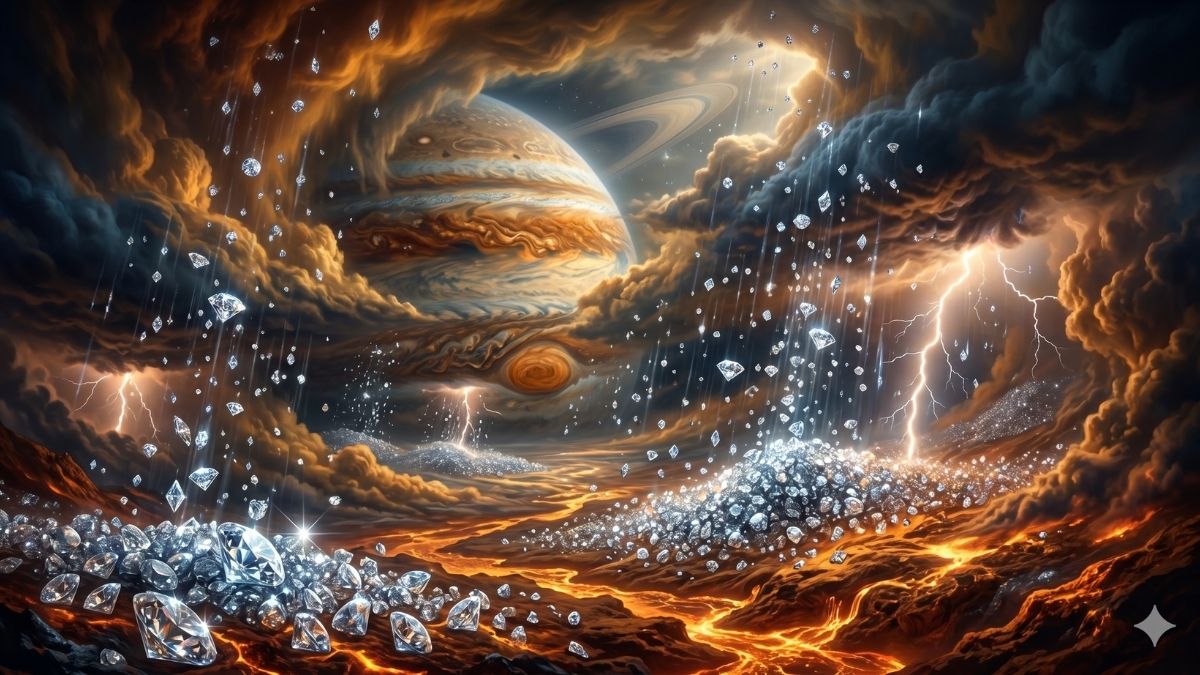
How does Diamond Rain Form on Saturn and Jupiter?
According to data analyzed by planetary scientists at the NASA Jet Propulsion Laboratory, certain deep atmospheric conditions result in diamond rains on Saturn and Jupiter annually:
-
Lightning Strikes: Powerful, non-stop lightning storms rip methane molecules apart in the upper atmosphere.
Graphite Formation: The liberated carbon atoms bond together, forming soot-like clouds of floating graphite.
Gemstone Transition: As the graphite falls through thousands of miles of crushing atmospheric pressure and immense heat, it compresses directly into solid diamond chunks.
The Hidden Internal Rain of Deep Space
Recent computer experiments by astrophysics teams at UCLA and Princeton University have completely altered our view of planetary interiors. Their research showcases that inside icy planets like Uranus and Neptune, water and hydrogen gas, initially mixed together during a planet's hot youth, begin to separate as the core cools down.
This creates a deep internal rainout effect where heavy water droplets sink inward while lighter hydrogen rises. This hidden weather cycle releases unexpected heat reservoirs, finally explaining why Neptune radiates significantly more heat than its structural twin, Uranus.
Looking at how rain behaves on other worlds tells us that the laws of physics hold the universe together, even when it's made of strange and alien stuff. The discovery of alien weather cycles, as space telescopes continue their study of distant exoplanets, moves humanity one step closer to understanding habitable environments beyond our own solar system.