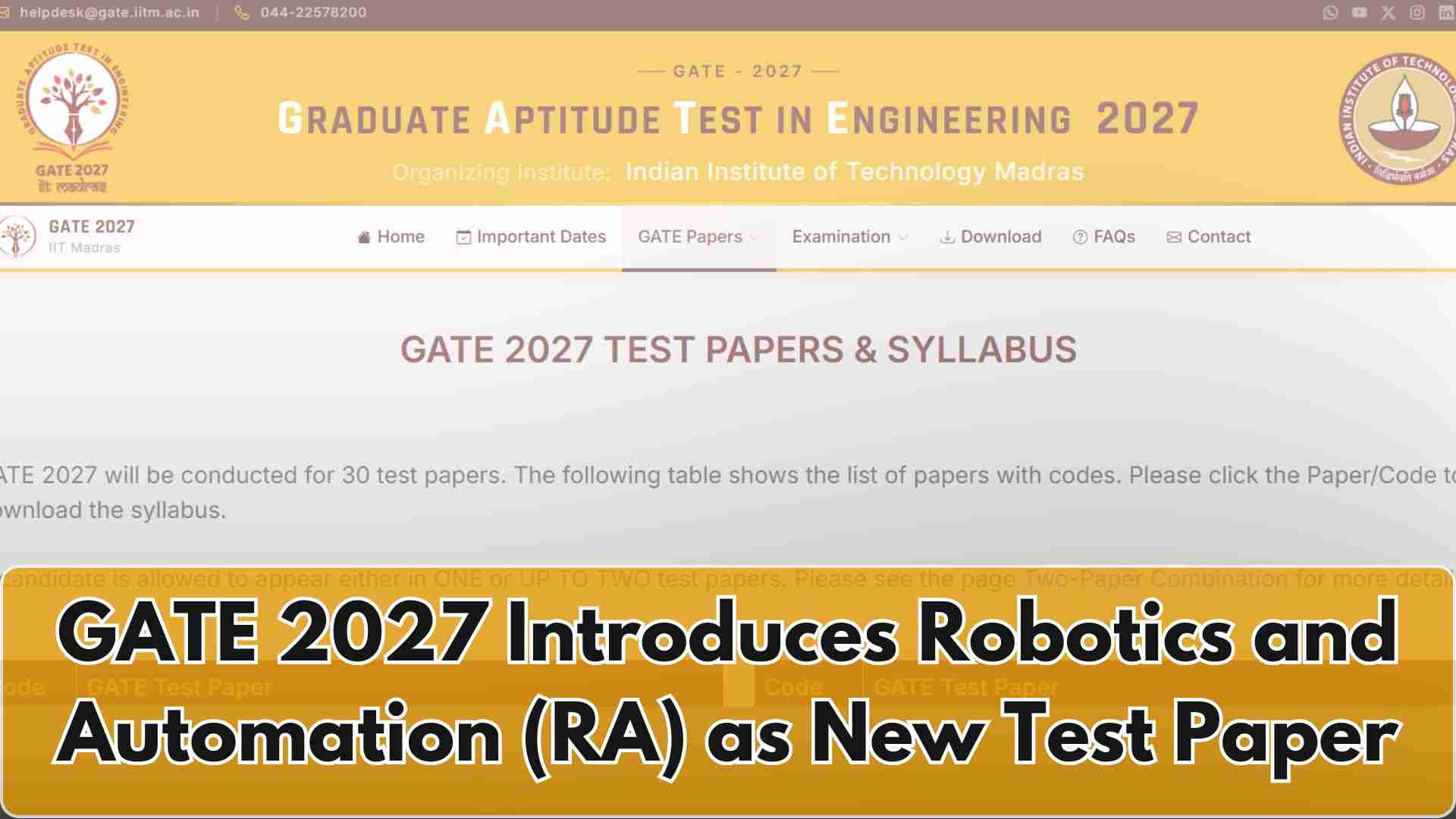
The Indian Institute of Technology (IIT) Madras, the organising institute for the Graduate Aptitude Test in Engineering (GATE) 2027, has introduced Robotics and Automation (RA) as a brand-new test paper. The addition has increased total number of GATE papers from 29 to 30, growing demand for skilled professionals in robotics, automation, mechatronics, smart manufacturing and Industry 4.0. The new paper has been introduced along with a comprehensive syllabus revision across GATE papers after five years.
Candidates interested in pursuing M.Tech programmes or PSU recruitment in robotics and automation-related fields can now opt for the dedicated RA paper in GATE 2027.
GATE 2027 Robotics and Automation (RA) Paper Introduced
The newly introduced Robotics and Automation (RA) paper has been designed to test candidates on multidisciplinary concepts combining mechanical engineering, electrical engineering, electronics, control systems and automation technologies.The paper is of 85 marks of questions, while 15 marks are given to General Aptitude, which is similar to other GATE papers.
GATE 2027 RA Exam Pattern
|
Particular |
Details |
|
Paper Code |
RA |
|
Paper Name |
Robotics and Automation |
|
Total Marks |
100 |
|
General Aptitude |
15 Marks |
|
Subject Questions |
85 Marks |
|
Exam Mode |
Computer-Based Test (CBT) |
|
Duration |
3 Hours |
GATE 2027 Robotics and Automation Syllabus
The syllabus is divided into common topics and two specialised sections.
Part A (Common Section): Engineering Mathematics
Part B: Choose One Specialisation
Candidates will have to attempt one of the following sections:
- Part B1: Electrical Engineering OR
- Part B2: Mechanical Engineering
GATE 2027 Robotics and Automation Syllabus: Download PDF
Why the New RA Paper Matters ?
The introduction of the Robotics and Automation paper goes with the rapid growth of automation technologies, artificial intelligence, robotics, smart factories and autonomous systems all over industries. It provides engineering graduates with a dedicated exam course for higher studies and recruitment in growing technology sectors.
It is also expected to help students from disciplines such as Mechanical Engineering, Electrical Engineering, Electronics, Mechatronics, Instrumentation and Automation Engineering who wish to specialise in robotics-related fields.