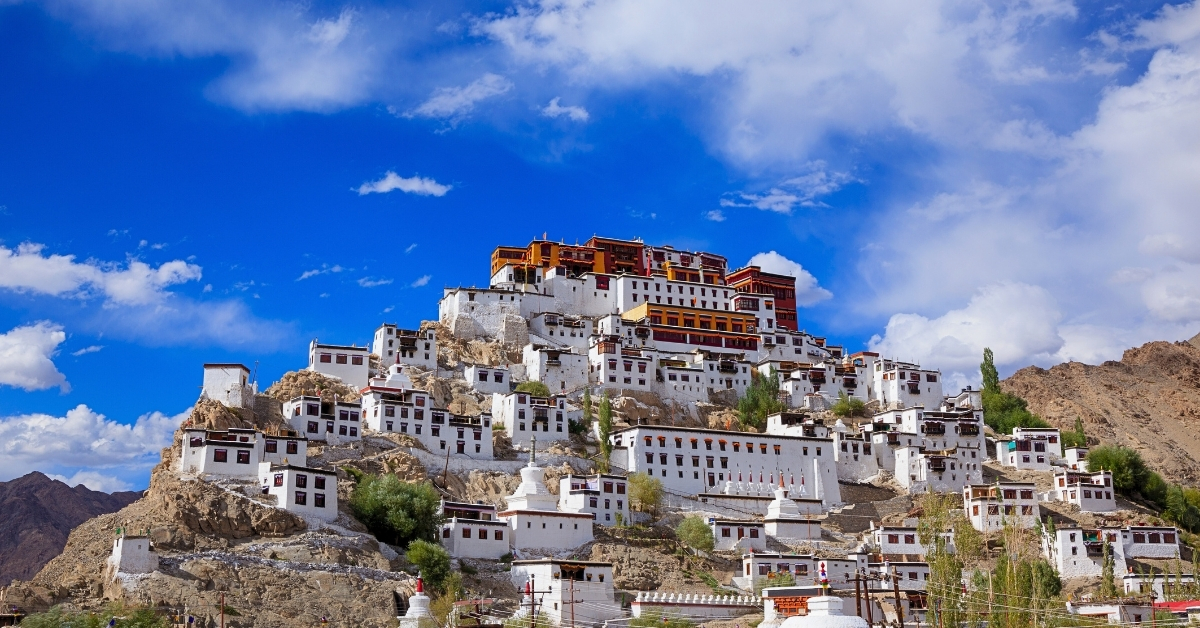
The Union Territory of Ladakh is famous for its scenic beauty, snow-capped mountains, dark sky reserve and high-altitude passes. But it is also famous for its civilisational history. The Ladakh Lieutenant Governor Vinai Kumar Saxena has declared 23 historical and archaeological locations as "Protected Monuments".
The decision is aimed at preserving Ladakh’s rich cultural and historical legacy. To promote the scientific conservation and documentation of these protected monuments and protecting them from climate change.
Full List of Ladakh 23 Heritage Sites
Ladakh designates 23 heritage sites as protected monuments under the Jammu and Kashmir ancient monuments preservation act.
Here is the complete list of all 23 protected sites along with their districts and historical and cultural significance
|
Heritage Site
|
District
|
Historical & Cultural Significance
|
|
Petroglyph Site
|
Leh
|
ancient prehistoric rock engravings and petroglyphs, early human settlement patterns.
|
|
Maitreya Buddha rock carving
|
Leh
|
monolithic rock carving of the future Buddha (Maitreya).
|
|
Tingmosgang fort
|
Leh
|
historical strategic fortress witnessed political events and royal treaties in Ladakh’s history.
|
|
Ancient caves
|
Leh
|
complex of ancient rock-cut meditation and dwelling caves and early religious art and historical inscriptions.
|
|
Petroglyph site
|
Leh
|
renowned for prehistoric rock art panels depicting wild animals, hunting scenes and symbolic motifs.
|
|
Petroglyph site
|
Leh
|
serves as an important archaeological marker housing ancient prehistoric engravings of early nomadic and trading groups.
|
|
Petroglyph site
|
Leh
|
located near a monastic village, featuring ancient rock art predating or co-existing with early monastic expansion.
|
|
Petroglyph site
|
Leh
|
houses Murgi Tokpo; one of Ladakh's largest prehistoric rock art sites
|
|
Stongday Gonpa
|
Leh
|
ancient Buddhist monastery known for monastic traditions in Trans-Himalayas.
|
|
Meditation cave
|
Leh
|
historical cave utilized by ascetic monks and scholars for meditation and spiritual retreat.
|
|
Hunder cave
|
Leh
|
ancient natural and rock-cut cavern linked to early human habitation and monastic refuge in Nubra valley region.
|
|
Dechen Tsomo Khar
|
Leh
|
a vintage hill fortress displaying traditional defensive architecture and royal oversight of trade routes.
|
|
Stampuk cave
|
Leh
|
archaeological cave site preserving traces of ancient habitation, rock markers and historical human activity.
|
|
Chamba Rock carving
|
Leh
|
An intricate historical sculpture carved directly into cliff faces, showing Buddhist devotion.
|
|
Zong Chamba
|
Leh
|
a large rock-cut representation of Maitreya Buddha, illustrating spread of Buddhist sculpture art across high-altitude paths.
|
|
Rock-Carved Buddha statue
|
Leh
|
monolithic Buddha statue, historical masonry and faith traditions in Nubra.
|
|
Rigsum Gonbo rock carvings
|
Leh
|
depicts a triad of protective deities like Rigsum Gonbo or Manjushri, Avalokiteshvara and Vajrapani carved into mountain rock.
|
|
Chamba Karpo
|
Leh
|
white-painted or light-toned rock carving of the Maitreya Buddha.
|
|
Chamba rock carving
|
Leh
|
localised stream-side rock art panel highlighting historical religious propagation along ancient foot tracks.
|
|
Folong Singey
|
Leh
|
natural geological formation resembling a lion's head that holds cultural and mythological significance.
|
|
Sumoor fort
|
Leh
|
historic fortification structure designed to protect local settlements
|
|
Rock Inscriptions
|
Kargil
|
are ancient epigraphs and script carvings, linguistic and historical clues about Kargil's past cross cultural exchanges.
|
|
Petroglyph Site at Mangmore
|
Kargil
|
prehistoric communities and ancient abstract rock etchings.
|
What are Protected Monuments?
Protected Monuments are cultural, historical and archaeological sites recognised by the government as structures or areas of national or regional importance.
The site will be protected from illegal encroachment, damage and alteration of site without strict government permission.
Promote the scientific conservation of sites through restoration, documentation and scientific research.
It also promotes tourism and encourages researchers, historians and travellers to appreciate Ladakh's history and culture.