For many of us, if we ever heard the word “rodent”, it would bring to mind only the thought of a mouse darting around the floor of our kitchen. It’s important, however, to be aware that close to 40 per cent of the mammals here on Earth are rodents!
We use animals such as the squirrel, the rat, porcupines and even beavers as examples of some of the many rodent species roaming this planet. Rodents are identifiable by the characteristic presence of two continuously growing incisors. Rodents can be as small as rats and as big as a fully grown adult. Ever heard of the largest rodents? Have a peek down below.
List Of 10 Largest Rodents in the World
Rodents come in different sizes and are found on almost all continents. While some types of rodents can range in weight from a few grams, some of the biggest rodents can weigh up to more than 50 kg. Here is a detailed list of the top ten heaviest rodents in the wildlife record of the IUCN.
Related Stories
| Rodent Name | Scientific Name | Maximum Weight | Body Length | Found In | Description |
| Capybara | Hydrochoerus hydrochaeris | 66–91 kg (145–200 lbs) | 1.0–1.3 m (3.3–4.3 ft) | South America | Semi-aquatic mammal that lives in groups of 10 to 40 near lakes and rivers. |
| North American Beaver | Castor canadensis | 32–50 kg (70–110 lbs) | 0.9–1.2 m (3.0–4.0 ft) | North America | Famous nature engineers with paddle tails that build wooden dams and lodges. |
| Eurasian Beaver | Castor fiber | 30 kg (66 lbs) | 0.8–1.0 m (2.6–3.3 ft) | Europe & Asia | Nearly extinct in the 1900s, but successfully reintroduced across European rivers. |
| Cape Porcupine | Hystrix africaeaustralis | 30 kg (66 lbs) | 0.6–0.9 m (2.0–3.0 ft) | Southern Africa | The largest rodent in Africa, covered in sharp, protective quills. |
| Lesser Capybara | Hydrochoerus isthmius | 28 kg (62 lbs) | 0.8–1.0 m (2.6–3.3 ft) | Panama & Colombia | A smaller relative of the main capybara that lives in smaller family units. |
| Crested Porcupine | Hystrix cristata | 27 kg (60 lbs) | 0.6–0.8 m (2.0–2.6 ft) | North Africa & Italy | Nocturnal animal that uses its thick quills to defend against big predators. |
| North American Porcupine | Erethizon dorsatum | 18 kg (40 lbs) | 0.6–0.9 m (2.0–3.0 ft) | North America | Excellent tree climbers with nearly 30,000 sharp quills on their body. |
| Coypu (Nutria) | Myocastor coypus | 17 kg (37 lbs) | 0.4–0.6 m (1.3–2.0 ft) | South America | River dweller with bright orange teeth; now found across North America too. |
| Patagonian Mara | Dolichotis patagonum | 16 kg (35 lbs) | 0.7–0.8 m (2.3–2.6 ft) | Argentina | Looks like a cross between a rabbit and a deer with long, fast legs. |
| Pacarana | Dinomys branickii | 15 kg (33 lbs) | 0.7–0.8 m (2.3–2.6 ft) | South America (Andes) | A slow-moving, rare forest species that uses its front paws to eat food. |
1. Capybara (Hydrochoerus hydrochaeris)
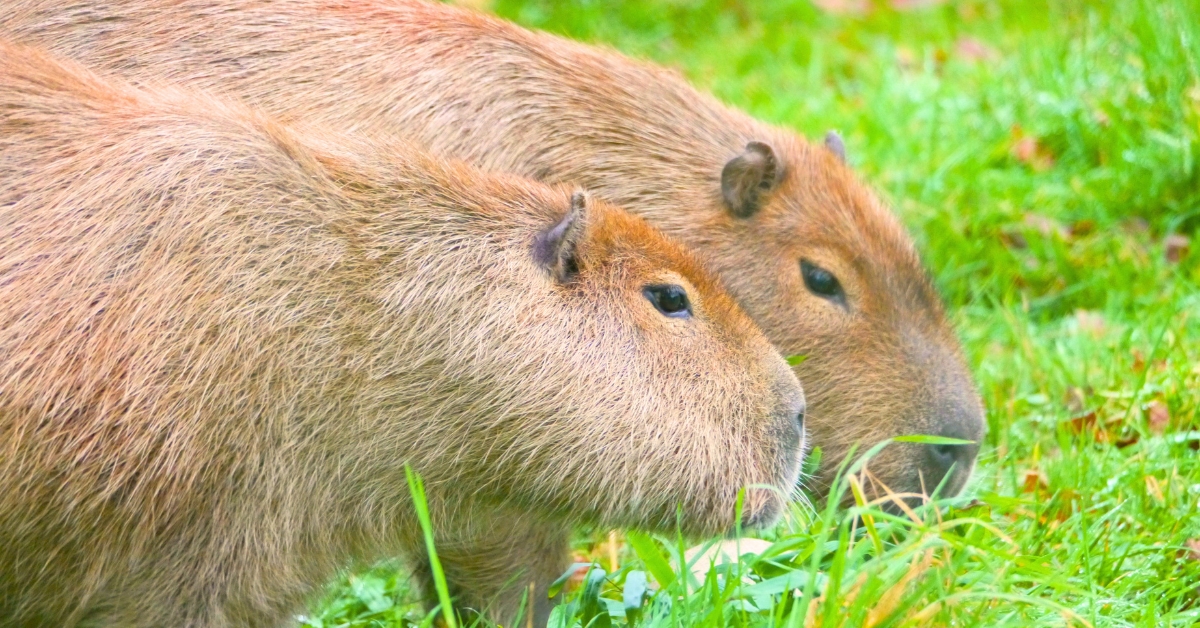
It is 100% sure that capybaras are the biggest rodents in the world. This giant creature is found in South America. In adulthood, the capybara’s size is at least 1.3 meters long.
They usually weigh more than 65 kg, and they can even sleep with their heads out of the water! What is also cool about this interesting animal is that it mostly lives in lakes and rivers since it’s semi-aquatic and has webs between its paws.
The world of rodents extends beyond simply the small house mouse and backyard squirrels. The European beaver can weigh in at as much as 30kg, even building dams across rivers, whilst their South American cousins, the capybara, can reach up to 66kg, helping greatly in maintaining their ecosystems.