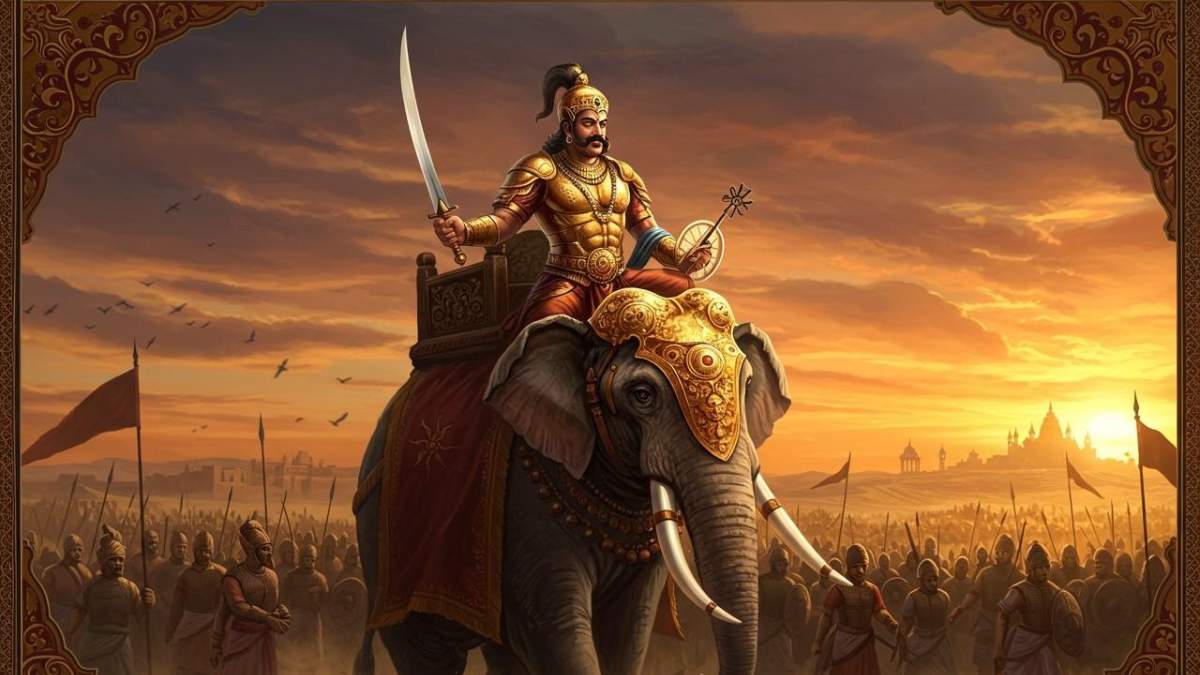
The Mauryan Empire was a large and powerful empire that existed within the ancient Indian World. The empire was set up by Chandragupta Maurya in the 4th century BCE, and gradually expanded across most of the Indian subcontinent by the rulers Bindusara and Ashoka.
The Mauryan Empire was known for its strong administrative structure, creating trade networks, and spreading Buddhism during Ashoka's time. The Mauryan Empire extended across a large, diverse, and multicultural area, therefore, different groups of people spoke multiple languages within the empire.
However, the administrative language for the Mauryan Empire and on many inscriptions was Prakrit while there was also some use of Sanskrit for religious and scholarly purposes by certain sections of society during the Mauryan period.
What Language Was Spoken by the Mauryan Empire?
Ashoka's Inscription
The Mauryan Empire was an old large Indian empire that existed from around 322 BCE - 185 BCE. The empire was so large that there were many languages that were used throughout the empire's territories. The two most significant languages in terms of use for official documentation and communication with the government were Prakrit as the primary language, especially in the edicts of Emperor Ashoka along with Sanskrit.
The use of Sanskrit was also common but typically used more by scholars or religious groups. Another part of the reason that these three languages were so common was due to foreign influence or trade connections. There were not only three languages, however Prakrit was by far the most dominant language in the empire for both government and communication.
Related Stories
Prakrit: Common Speech and Administration
Prakrit was the primary language used for day-to-day business and routine activities within the Mauryan Empire and was a common language spoken by people from all walks of life in every part of the empire.
Emperor Ashoka utilized Prakrit in all of his rock and pillar edicts so that he could communicate effectively with the average citizen, therefore, Prakrit was the common language used by the emperor to deliver moral instruction, establish legal standards, and promote the ethical teachings of Buddhism.
There were several regional varieties of Prakrit that allowed it to accommodate local people in each part of the empire. Because Prakrit is a simpler dialect when compared to Sanskrit it became a language that connected the rulers to the masses, thus allowing for effective communication throughout the large Mauryan Empire.
Sanskrit: Elite and Scholarly Texts
The primary speakers of Sanskrit were the well-educated elite class of northern India which included teachers, priests, scholars, royals, and philosophers. Some examples of its use included religious ceremonies, intentions or desires, and the creation of written works based on philosophy, religion, and literature.
However, it was not spoken as often by the masses or peasant class, but rather prestigious, respected elites, and known as the language of the educated individual. The preservation of many of India's earliest Hindu religious texts and literary works would have occurred through the use of Sanskrit as well as due to the development and evolution of its grammar and syntax.
Although Prakrit continued to be the major spoken and written language within the government of the period, the influence of Sanskrit continued to grow among the elite during this time and would ultimately provide a foundation for developing classical Indian literary and educational traditions.
Interesting Facts About the Mauryan Empire
Here are top 5 Interesting Facts About the Mauryan Empire:
1. Unification of the Mauryan Empire
The Mauryan Empire, founded by Chandragupta Maurya in 322 BC, was Connecticut's first great empire and was formed by the conquest of the Nanda Empire, leading to the establishment of the first large unified area on the Indian subcontinent.
The Mauryan Empire's government was very efficient, and practical adaptations were made to govern such a large and populous region effectively.
2. Ashoka’s Conversion and Buddhist Influence
After the Kalinga War, Ashoka converted to Buddhism, establishing himself as the leader of many people, he also set out to propagate dharma or ethical living throughout Asia by inscribing his edicts on stone known as edicts.
These edicts are some of the earliest written evidence of an Indian ruler's commitment to governing with justice and ethical behavior.
3. Strong and Organized Bureaucracy
The Mauryan Empire had a highly organized bureaucracy and supported the Emperor in leading the government by providing many ministers, supervisors, and governors.
By using an organised administration in the Mauryan Empire, trade routes could be tracked closely, businesses could be conducted in a secure environment, and as a result, the Mauryan Empire experienced stable and consistent economic growth.
4. Pataliputra as a Trade and Cultural Hub
Pataliputra served as a significant marketplace in addition to being an influential cultural center within the Maurya empire. Located at the intersection of major regional trade routes leading to the Mediterranean, with Greece, Persia and Southeast Asia founding nations.
The popularity of Pataliputra and many other merchant cities made them critical components within the Mauryan economy and helped to develop the Maurya empire as one of history's great empires, both economically and culturally.
5. Influence of Chanakya and the Arthashastra
The Mauryan administration, and its code of conduct, were significantly influenced by the philosophical teachings of Chanakya also known as Kautilya reflected within the Arthashastra, written by Chanakya.
Mauryan Empire Language Questions in Competitive Exams
Competitive examinations regarding the Mauryan Empire, particularly language questions typically consist of items that focus on the following areas:
-
The language that was used by Emperor Ashoka in his edicts like Sanskrit.
-
The use of Prakrit as the official language and for the general public.
-
The use of different scripts, like Brahmi and Kharosthi.
-
The use of Sanskrit as a scholarly language.
-
The multilingual aspect of the empire.
Examinations will also frequently assess these types of questions through the use of multiple-choice questions (MCQs), statements, and identification.
Conclusion
Language was central to the Mauryan Empire not only as a means of governing but also for ways to connect with people. Prakrit was used as a primary language of administration and communication with the public, scholars and elite members utilized Sanskrit. These two languages facilitated successful communication between various areas throughout the empire.