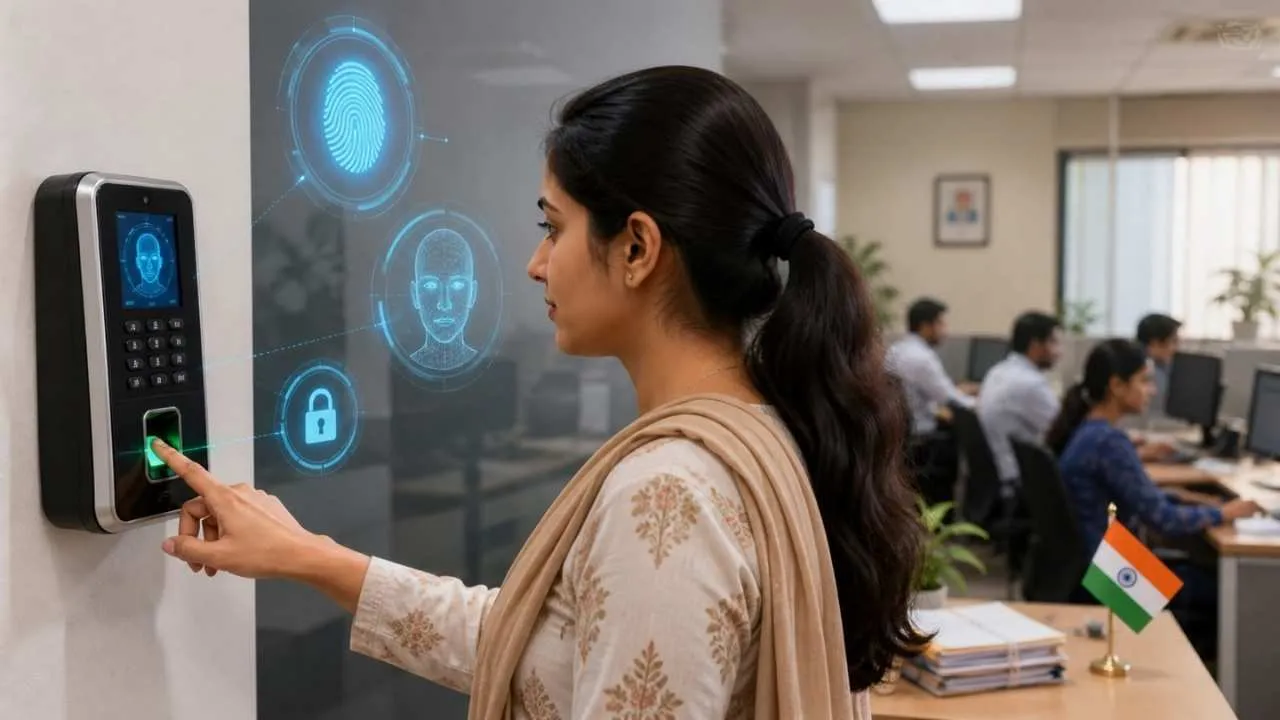
The Aadhaar Enabled Biometric Attendance System was introduced in Central Government offices to modernise the attendance method. It is a new system in the Central Government based on the Digital India initiative.
The system facilitates Aadhaar enabled biometric attendance of the central government employees at the workplace, which replaces paper-based attendance registers and ensures accuracy in attendance.
Employees no longer need to sign the register manually by using their Aadhaar identification and instead mark their attendance biomedically through fingerprint, iris or facial biometrics. This ensures transparency and eliminates proxy attendance. It serves as a system that works in Real time. Thus, the attendance can now be digitalized where there is no room for error. The main objective of the Aadhaar Enabled Biometric Attendance System to maintain discipline at the workplace.
Why AEBAS Was Introduced
Before AEBAS, attendance in many government offices was recorded manually, which often led to errors, delays, and misuse. To address these challenges, the Department of Personnel and Training (DoPT) introduced AEBAS as a centralized, technology-driven solution.
The key objective was to create a system that is:
- Transparent and tamper-proof
- Real-time and easily accessible
- Efficient in tracking employee working hours
- Free from fake or duplicate attendance entries
Key Features of AEBAS
AEBAS comes with several features that make it a reliable attendance system:
|
Feature
|
Description
|
|
Real-Time Authentication
|
Attendance is recorded instantly after biometric verification.
|
|
No Proxy Attendance
|
Ensures that only the actual employee can mark attendance.
|
|
Paperless System
|
Completely eliminates the need for manual registers.
|
|
Multi-Platform Support
|
Works across different devices and operating systems.
|
|
Working Hours Tracking
|
Employees can easily monitor their daily attendance and working hours.
|
How is Aadhaar Enabled Biometric Attendance System Important for Governance?
AEBAS (Aadhaar Enabled Biometric Attendance System) is contributing towards better governance in India. The system has inculcated better discipline at the workplace, particularly in government offices. It has helped to eliminate absentees and promotes regularity and punctuality at the workplace. The necessity of keeping manual records and filing attendance sheets is now minimised and administrative load is reduced.
Having accurate attendance records in real time certainly helps authorities in making better and informed decisions. AEBAS is a smart move towards digital governance and it demonstrates how digital systems are being used to bring better transparency, accountability and efficiency at the frontlines.