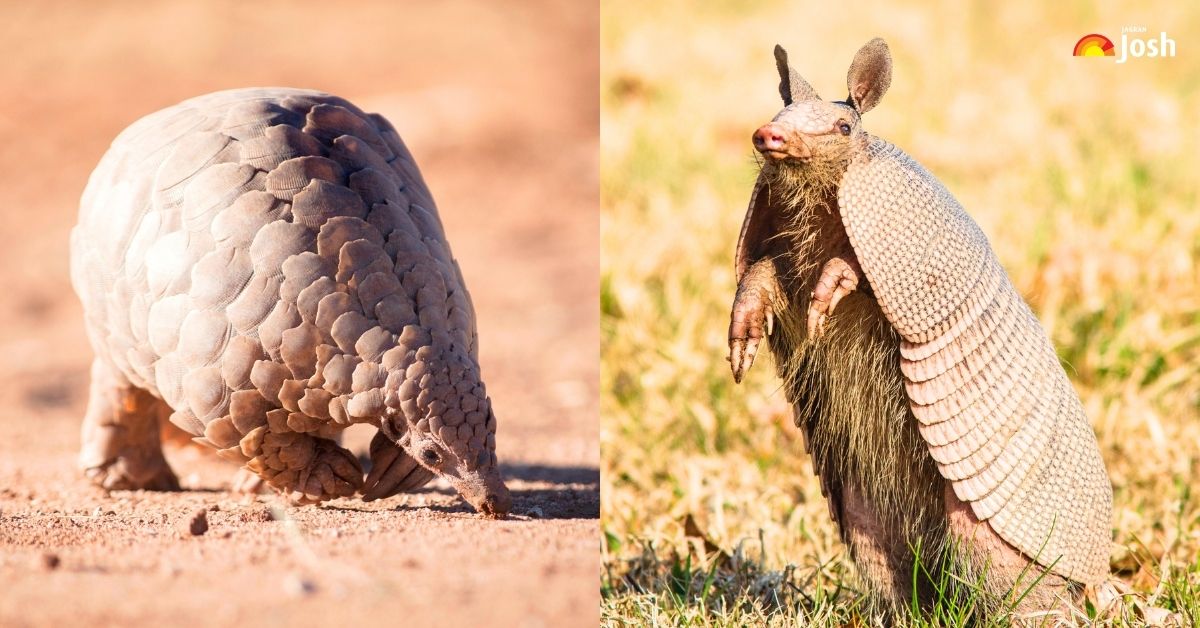
Last summer, while on a safari tour, Alex and Robin saw an unusual-looking animal running through the bush. After a couple of hours during their safari tour, they saw another small animal with its thick armour.
“Robin, look! Another pangolin!” Alex pointed to it. But Robin just nodded his head and told him it was not a pangolin but an armadillo. Those two animals looked alike, and Alex and Robin could not find out who was correct.
Such confusion can happen to many people like Alex and Robin due to such unique armoured animals like armadillos and pangolins.
Now, in this article, we will discuss all the differences between armadillos and pangolins in detail, taking into consideration such aspects as habitat, type of armour, and others.
Pangolin vs Armadillo: What’s the difference?
Though these creatures look alike as both appear to be like little tanks walking on their legs, they belong to two distinct species altogether. Also, they are found in two distinct geographical regions.
Related Stories
| Feature | Pangolin | Armadillo |
| Armor Material | Keratin scales | Bony plates (Osteoderms) covered in leather |
| Native Habitat | Asia and Africa | North, Central, and South America |
| Total Species | 8 species (4 in Asia, 4 in Africa) | 21 living species |
| Scientific Order | Pholidota | Cingulata |
| Teeth | No teeth at all | Small peg-like teeth (up to 100 teeth in giant armadillos) |
| Main Diet | Ants and termites (Insectivore) | Ants, beetles, worms, small plants, and eggs |
| Ability to Roll | All 8 species can roll into a ball | Only 2 species (three-banded armadillos) can roll completely |
| Conservation Status | Critically Endangered to Vulnerable (100% of species threatened) | Mostly Least Concern (except a few species) |
What is a Pangolin?
The pangolin is a solitary animal that is said to be the only mammal that has scales all over its body. There are eight species of pangolins, which vary from Asia to Africa. The pangolin's scales make up about 20 per cent of the mammal’s body weight.
The pangolins lack teeth; instead, the tongue is sticky to trap insects. The tongue length of the pangolin is longer than its body length.
Within a year, one pangolin can consume up to 70 million insects. When threatened by predators, the pangolin makes a ball that even lions cannot break.
What is an Armadillo?
Armadillos are mammals with a tough shell composed of bony plates. The term "armadillo" is derived from Spanish, which literally translates to "little armoured one". There are twenty-one varieties of armadillos, and the majority of them live in the Americas.
What makes an armadillo different from a pangolin is the fact that the latter has tiny teeth in its mouth. The nine-banded armadillo is one variety of armadillo which is widely known in North America.
It weighs between 8 and 17 pounds (3.6 and 7.7 kg). It should not be assumed that all armadillos can curl into a ball since only two varieties of three-banded armadillos possess that ability.
Where do Pangolins and Armadillos live?
Pangolins inhabit only the Eastern Hemisphere, where they can be found in Sub-Saharan Africa and in Southeast Asia, in a tropical environment. Certain nations where you may take pleasure in pangolins consist of India, Malaysia, Uganda and China.
Armadillos are peculiar creatures and can be found in parts of the globe from Argentina southwards into parts of Mexico as well as in central sections of the USA.
Really feeling scared should you see an armadillo ambling around in Florida or Texas would undoubtedly not be called for. It would simply be an armadillo, as these creatures have been living in the Americas.
Why do people confuse Pangolins and Armadillos?
People commonly mistake a pangolin for an armadillo simply because they have many physical characteristics resembling each other closely. This striking similarity in physical forms is due to a phenomenon known as convergence.
Convergence is a theory whereby two geographically separated and entirely different species evolved analogous physical features because of similarities in their physical environments and diet.
As they consumed termites, like other insectivores, they developed extremely elongated snouts; hooked claws capable of penetrating insect and termite colonies underground; and scales serving the purpose of armour; they protected the animal’s body from stinging insects as well as its predators.
After diverging from each other in evolution 60 to 70 million years ago, both these creatures came to develop bodies with very similar features.