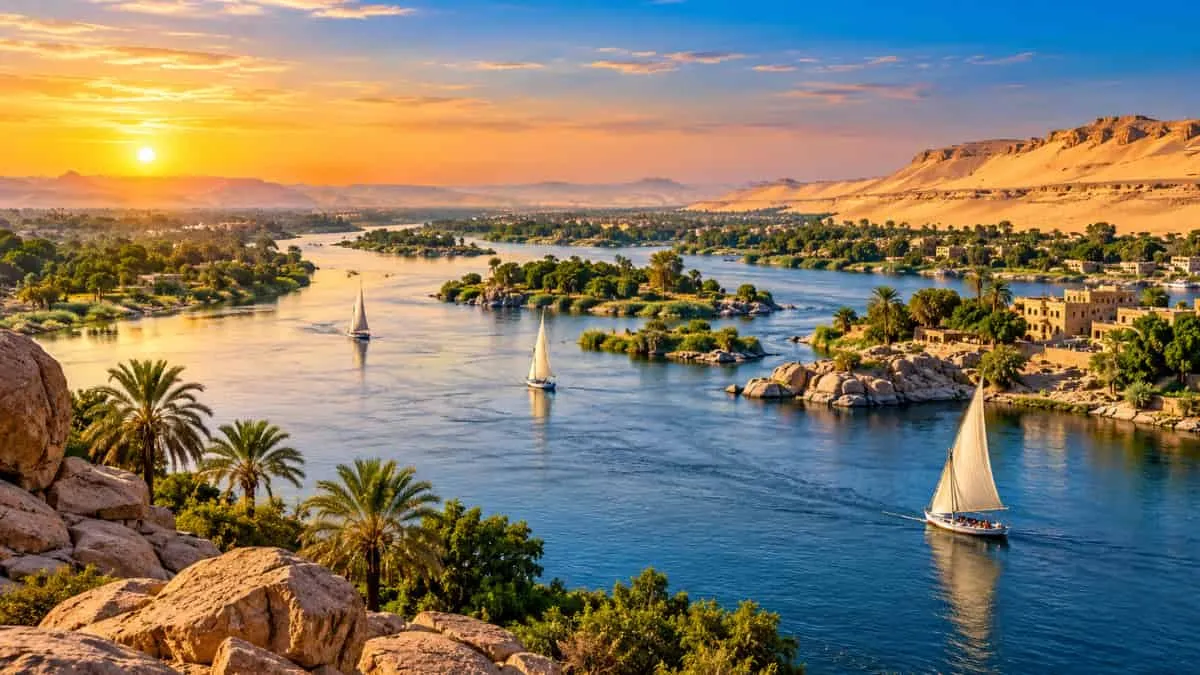
The Nile is the largest river in Africa in terms of length, with its length estimated at 6,650 kilometers to 6,695 kilometers. It runs through northeastern Africa and drains into the Mediterranean in northern Egypt. As reported by National Geographic, the river is about 6,800 kilometers long if the entire drainage system of the river is taken into consideration.
The Nile River is widely recognized for its links with ancient Egypt, but its significance reaches far beyond this historical aspect. Millions of people rely on it for their water needs, agricultural and industrial use among other things.
What Is the Length of the Nile River?
The Nile is generally measured at approximately 6,650 to 6,695 kilometres long. This makes it the longest river in Africa and one of the longest rivers in the world.
Related Stories
|
Nile River Facts
|
Details
|
|
River name
|
Nile River
|
|
Length
|
Approximately 6,650–6,695 km
|
|
Continent
|
Africa
|
|
Region
|
Northeastern Africa
|
|
Main direction of flow
|
South to north
|
|
Source
|
River system associated with the East African Great Lakes region
|
|
Mouth
|
Mediterranean Sea
|
|
Major tributaries
|
White Nile and Blue Nile
|
|
Famous country associated with the river
|
Egypt
|
Where Does the Nile River Start and End?
The source of the Nile River is quite difficult to determine. The river originates from several rivers and streams that form a vast drainage network in East Africa.
Lake Victoria is a lake in East Africa that borders the countries of Uganda, Tanzania and Kenya, and is regarded as an important origin point for the Nile River.
From Lake Victoria, the river system takes a northerly route to pass through Uganda and South Sudan. The White Nile joins the Blue Nile at Khartoum in Sudan. Thereafter, the Nile flows to the Mediterranean Sea passing through Sudan and Egypt.
This geographical path has earned it a unique position as one of the most significant natural wonders in Africa.
Which Countries Does the Nile River Flow Through?
The Nile Basin Initiative identifies 11 countries within the Nile Basin. These countries share the wider river system, although the main river channel does not flow through every one of them.
The 11 countries are:
-
Burundi
Democratic Republic of the Congo
Egypt
Eritrea
Ethiopia
Kenya
Rwanda
South Sudan
Sudan
Tanzania
Uganda
These countries are connected through the Nile Basin, which includes the main river, tributaries, lakes and other waterways.
What Are the White Nile and Blue Nile?
The White Nile and Blue Nile are the two major tributaries that join to create the main Nile River.
White Nile: The White Nile is linked to the Great Lakes area in East Africa. It flows north from Uganda to South Sudan and then further north to reach Khartoum, Sudan.
Blue Nile: The Blue Nile starts in Lake Tana, which is found in Ethiopia. This river has plenty of water and silt, especially during the rains, and joins the White Nile in Khartoum.
When the two rivers combine, their waters flow north into Egypt and the Mediterranean Sea.
Why Is the Nile River Important?
The Nile has supported communities for thousands of years. Its importance can be understood in several ways.
1. Agriculture: Water from the Nile helps farmers grow crops in areas where rainfall is limited. The river has been especially important to agriculture in Egypt.
2. Drinking water: Millions of people across the Nile Basin depend on the river system for their water needs.
3. Electricity: Dams built along the Nile and its tributaries generate hydroelectric power.
4. History and civilisation: Ancient Egyptian civilisation developed along the Nile. The river provided water, fertile soil and a route for transportation.
5. Wildlife and ecosystems: The river supports wetlands, fish, birds and other wildlife. The Sudd wetland in South Sudan is one of the major wetland areas associated with the Nile system.
Is the Nile the Longest River in the World?
The Nile is commonly acknowledged as the longest river in the world; however, there are instances where it is questioned due to the Amazon River in South America.
The calculation of a river's length is not easy. It involves choosing a distant stream as the river's source and calculating the length of its crooked route. This can be done through various ways.
In general information and geography classes, the Nile is commonly regarded as the longest river in Africa and in the world.