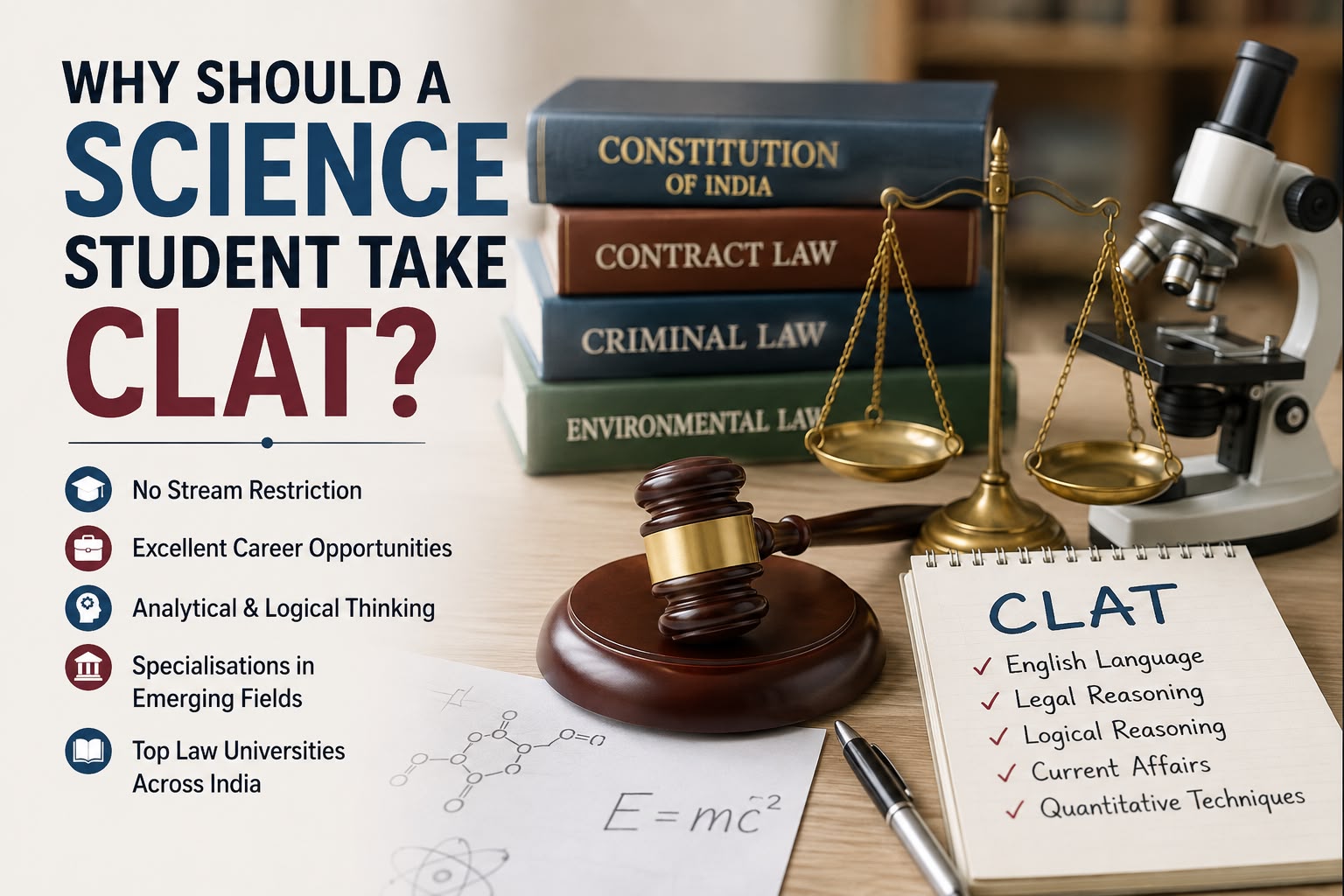
Many Science students think that law is only meant for Arts or Commerce students. However, that is not true. Students from the Science stream can also appear for the Common Law Admission Test (CLAT) after Class 12 and build successful careers in the legal field. CLAT opens the door to some of India’s top National Law Universities (NLUs), where students can pursue integrated law programmes such as B.Sc. LL.B. (offered by select universities) or the more common five-year LL.B. courses.
Why is CLAT a Good Option for Science Students?
Here are some reasons why Science students should consider taking CLAT:
- No stream restriction: Students from Science, Commerce and Arts can all appear for CLAT if they meet the eligibility criteria.
- A different career path: If you do not want to pursue engineering, medicine or pure science, law offers another respected and rewarding profession.
- Strong analytical skills: Science students are often good at logical thinking and problem-solving, which are useful in law entrance exams and legal studies.
- Diverse career opportunities: After completing a law degree, students can become lawyers, judges (after meeting eligibility requirements), legal advisors, corporate lawyers, policy researchers and more.
- Opportunities in growing fields: Science students can specialise in areas like intellectual property rights (IPR), technology law, cyber law, environmental law and healthcare law, where scientific knowledge can be an advantage.
Career Options And Their Average Salary After CLAT
A law degree through CLAT can lead to careers in different sectors, including:
|
Job Type |
Average Salary |
|
Corporate Lawyer |
Rs 6,16,736 per year |
|
In-House Counsel |
Rs 7 lakh per year |
|
Judges of High Court |
Rs 2,25,000 - Rs 2,50,000 per month |
|
Legal Counsel |
Rs 20.1 lakh per year (with two years of experience) |
|
Litigation Lawyer |
Rs 4.8 lakh per year |
|
Public Policy Specialist |
Rs 20 lakh per year (with two years of experience) |
Law education helps students build several valuable skills, such as:
- Critical thinking
- Logical reasoning
- Research skills
- Communication and public speaking
- Problem-solving
- Negotiation and drafting
- Time management
These skills are useful not only in legal careers but also in management, business and public administration.
Is CLAT Difficult for Science Students?
Not necessarily. CLAT mainly tests:
- Reading comprehension
- English language
- Current affairs and general knowledge
- Legal reasoning
- Logical reasoning
- Quantitative techniques (basic mathematics)
The exam does not ask questions from Physics, Chemistry or Biology. With regular reading, practice and mock tests, Science students can prepare well and perform competitively.
Science students should not feel limited to traditional career options like engineering or medicine. CLAT offers an opportunity to study law at some of India’s leading institutions and explore careers in corporate law, technology law, intellectual property, cyber law and many other fields. For students interested in analytical thinking, communication and solving real-world problems, law can be a promising career choice.