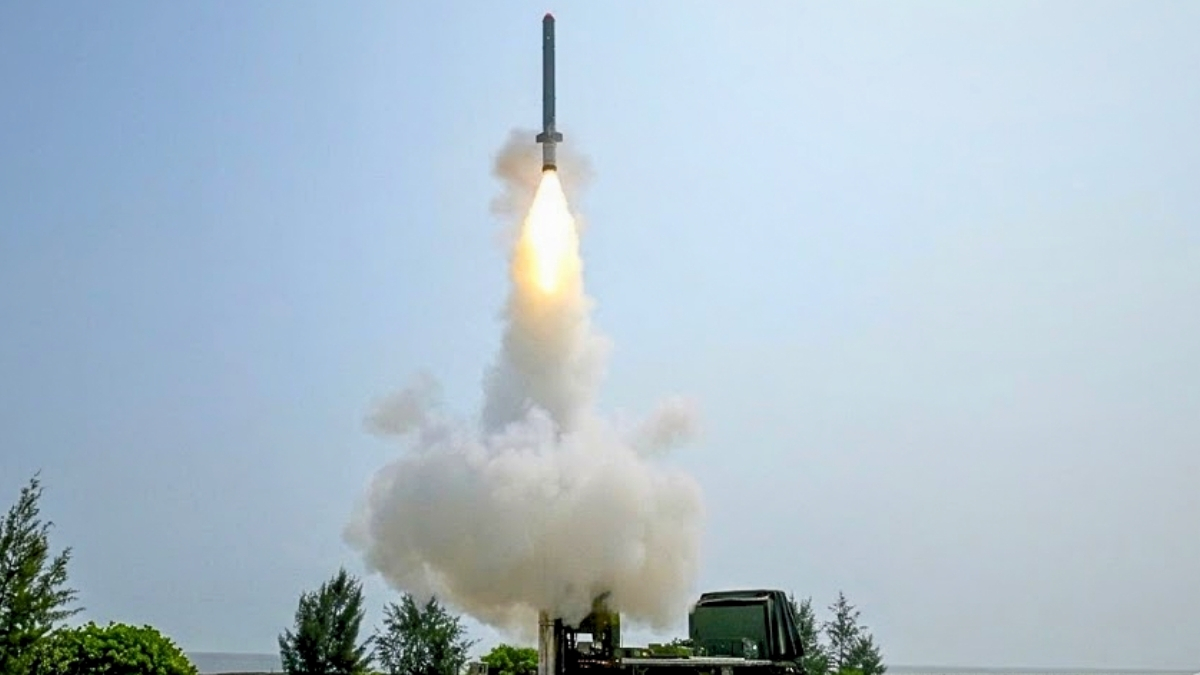
The Defence Research and Development Organisation (DRDO) successfully conducted a developmental flight test of the indigenously developed Long Range Land Attack Cruise Missile (LRLACM) from the Dr APJ Abdul Kalam Island off the coast of Odisha.
The mission's objectives were fully achieved by representing a huge technological breakthrough for India’s long-range precision strike capabilities under India's Aatmanirbhar Bharat mission.
Key Highlights of the Test
LRLACM is jointly developed by Aeronautical Development Establishment (ADE) Bengaluru and DRDO. ADE served as the nodal laboratory for the configuration, design and execution of the LRLACM program.
The entire trajectory of the cruise missile was monitored by a network of range tracking instruments and data captured by the Integrated Test Range (ITR) at Chandipur confirmed that the missile achieved its flight objectives with pinpoint operational performance.
The missile utilizes the highly efficient propulsion system indigenous "Manik" Small Turbofan Engine a matured under earlier technology programs along with a solid rocket booster to sustain fuel-efficient flight over extended ranges.
The trial validated the missile's low-altitude, terrain-following and sea-skimming capabilities which allow it to duck beneath enemy air-defense radar networks to evade modern interceptors.
Advanced Electro-Optical Tracking Systems (EOTS), radar networks and telemetry units deployed along the coast validated the missile's aerodynamic maneuvers and waypoint navigation accuracy.
What is the significance?
DRDO’s LRLACM is built as a highly versatile tactical platform, engineered for tri-service integration whioch means its modular structure can be configured for mobile ground stations, naval vertical launch system (UVLM) cells on warships and airborne frames.
The LRLACM is considered India's equivalent to the US Tomahawk or Russian Kalibr cruise missiles weapons designed to strike high-value and static infrastructure deep inside hostile territory without exposing the launch platforms to enemy lines by measuring roughly six meters long and weighing close to a metric tonne. The missile carries a conventional 450 kg warhead over an estimated range of 1,000 to 1,500 km.