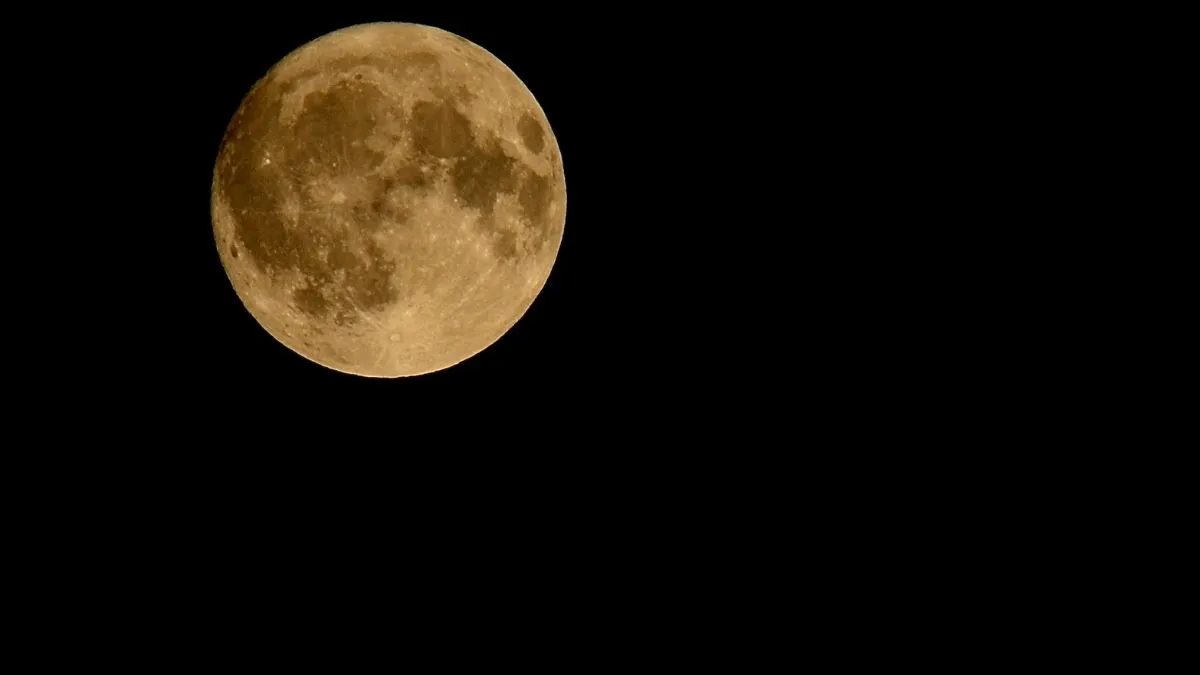
The Hunter's Moon lights up the global evening sky tonight. The full moon will reach peak illumination on October 26th 2026 at 12:12 am EDT (04:12 UTC).
Observers across both Northern and Southern hemispheres will see a full disc rising shortly after dusk for consecutive evenings. There is a widespread social media buzz that claims tonight is a supermoon. But astronomical measurements tell a different story.
Orbital records from NASA and the US Naval Observatory clarify that this seasonal spectacle is a standard full moon paired with striking optical illusions.
Why Astronomy Rules Out a Supermoon Tonight?
The term supermoon applies when a full lunar phase coincides closely with perigee which is the Moon's closest approach to Earth in its elliptical path.
Astronomer Fred Espenak and NASA define a supermoon as occurring when the lunar center falls within 90% of its minimum orbital distance, generally inside 360,000 kilometers.
Related Stories
When is October 2026 Hunter’s Moon Peak Visibility Tonight?
Tonight the Moon sits over 370,000 kilometers away. And the full moon passed its apogee earlier this month. Right now it is heading toward its next close perigee on October 28. NASA’s 2026 lunar schedule reserves the official supermoon title for the back-to-back full moons on November 24 and December 24.
|
Lunar Metric
|
October 26, 2026 Event
|
Official Supermoon Requirement
|
|
Peak Illumination
|
12:12 a.m. EDT
(04:12 UTC)
|
Exact full phase alignment
|
|
Earth Distance
|
~370,000 km
|
Less than 360,000 km
|
|
Orbital Phase
|
Approaching perigee
(Oct 28)
|
At or within 90% of perigee
|
|
Official Status
|
Regular Seasonal Full Moon
|
Perigee Full Moon
(Nov/Dec 2026)
|
Why does October’s Full Moon Look Amber on the Horizon?
If the Moon is not unusually close tonight, why does it appear giant and reddish to the naked eye? The answer combines two well-documented physical and neurological phenomena:
The Moon Illusion
When the disc rests near the skyline your brain compares it to familiar foreground references like trees, houses, and hills. This visual geometry tricks human depth perception into projecting a larger image than when the moon sits overhead in an empty sky.
Atmospheric Rayleigh Scattering
At low angles, reflected lunar light must pass through a dense cross-section of Earth's atmosphere. Nitrogen and dust scatter the shorter blue wavelengths away, letting the longer red and golden wavelengths reach your eyes.
Also Read - When is Sharad Purnima 2026: Check Date, India Timings, and Moonrise Schedule Today
What are the Cultural Roots of Hunter’s Moon?
The name Hunter's Moon tracks back to historical Anglo-Saxon and Native American seasonal calendars recorded in early agricultural almanacs. It marks the first full moon following the September Harvest Moon.
Once summer crops were harvested, clear fields let game animals forage out in the open. Hunters took advantage of extended autumn twilight to hunt and preserve food supplies ahead of winter freezing.
Because the Moon's orbital plane meets the eastern horizon at a shallow angle in late autumn, the Moon rises roughly 30 minutes later each night instead of the average 50-minute delay.
This rapid daily return provides several evenings of continuous moonlight right after sunset which makes it a reliable treat for skywatchers everywhere.
When is the Next Supermoon in 2026?
The next supermoon will occur on Tuesday November 24th 2026. Traditionally it is known as the Beaver Moon. It reaches its official full phase at 14:53 UTC (9:53 a.m. EST / 8:23 p.m. IST).
During this event the Moon will be approximately 360,768 kilometers from Earth and will be qualifying under Fred Espenak's 90% perigee threshold.