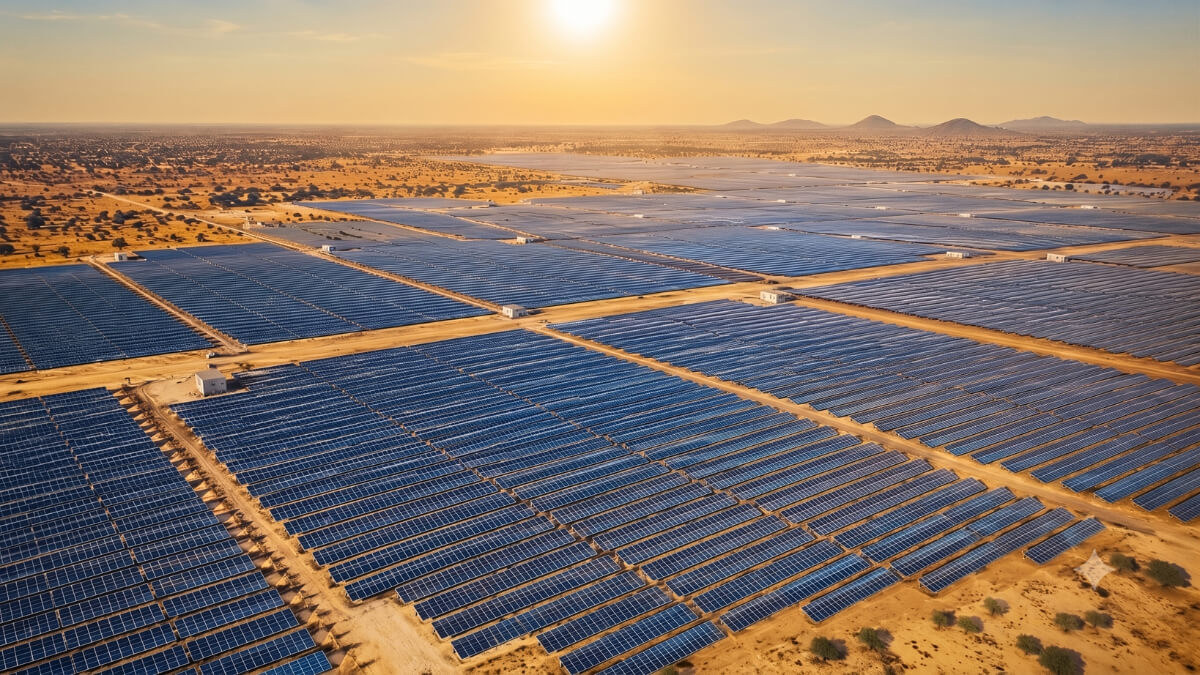
India is one of the leading countries in the world in clean energy generation. It is rapidly growing its power grid, including mega renewable energy projects in areas of solar and wind energy. As of June 2026, Bhadla Solar Park, located in the Thar Desert in Phalodi, Jodhpur, Rajasthan, is the largest solar power plant in India. The total power generation capacity of this solar power plant is 2,245 megawatts (MW). It covers an area of 14000 acres in the dry Thar desert.
Although Bhadla is the largest operational solar power plant in India, another large solar power plant is set to become fully operational in Gujarat soon. More than 9.4 gigawatts (GW) of hybrid solar and wind energy have already been commissioned at the Khavda Renewable Energy Park. This solar power plant houses over 10 million solar panels which is sufficient to provide power to 4.5 million houses.
Largest Solar Plant in India: Key Facts at a Glance
|
Feature
|
Details
|
|
Official Name
|
Bhadla Solar Park
|
|
Location
|
Jodhpur District, Rajasthan
|
|
Total Capacity
|
2,245 Megawatts (MW)
|
|
Total Covered Area
|
56 square kilometers (approx. 14,000 acres)
|
|
Developing Agencies
|
Rajasthan Renewable Energy Corporation Limited (RRECL) and joint ventures
|
|
Key Benefit
|
Capable of powering over 4.5 million homes and cuts 4 million tonnes of CO₂ annually
|
Which is the Largest Solar Power Plant in India?
Bhadla Solar Park is the largest operational solar power plant in India. It is a four phase process that has been designed by various state and central organizations. The project was a big undertaking funded by the central government and international development banks.
The plant has automated cleaning robots that ensure that the solar panels stay dust free. This technology is very important as the desert area is prone to sandstorms. Climate is local and provides over 300 days of sunshine annually. This is a lot of solar energy, which is why it is an ideal place for solar energy.
Related Stories
Which are the top 5 Operational Solar Plants in India?
The top 5 operational solar power plant in India are listed below:
1. Bhadla Solar Park situated in Jodhpur, Rajasthan has a capacity of 2245 MW.
2. Pavagada Solar Park also known as Shakti Sthala located in the Tumakuru district of Karnataka has a capacity of 2,050 MW. It is the second largest solar power plant in India.
3. Kurnool Ultra Mega Solar Park located in Panyam Mandal, Kurnool district of Andhra Pradesh with a capacity of 1,000 MW.
4. Rewa Ultra Mega Solar located in Gurh tehsil of Rewa district in Madhya Pradesh operated at 750MW capacity.
5. Kamuthi Solar Power Project is a 648 MW capacity plant located in Kamuthi, Ramanathapuram district, Tamil Nadu.
MCQ to Test your Knowledge
MCQ’s are very important for competitive exams such as UPSC Prelims, SSC CGL, SSC CHSL, IBPS PO, Railways and other similar exams.
Question: Which is the second largest solar power plant in India?
A) Kurnool Ultra Mega Solar Park
B) Kamuthi Solar Power Project
C) Pavagada Solar Power Park
D) Khavda Renewable Energy Park
Answer: C) Pavagada Solar Power Project located in the Tumakuru district of Karnataka is the second largest solar power project in India.
Where is the future of Solar energy in India?
The future of clean energy in India is shifting towards hybrid project, which involves integration of solar panels, wind turbines and large battery systems. The Indian government wants to achieve 500 GW of non-fossil fuel capacity by the year 2030.
The largest project that is going to be fully operational in 2029 is the Khavda Renewable Energy Park in Gujarat. It is situated in the desert area of Rann of Kutch. It will have a total power of 30 GW when completed in 2029. As of mid-2026, it has already started producing over 9.4 GW from its completed phases. This includes the world's biggest single site battery storage system to provide power during the night when the sun is down.
Massive solar power plants Bhadla and Pavagada are reducing India’s heavy reliance on coal. Mega hybrid projects like Khavda have also started generating sufficient power already. The progress is evident as India added 37 GW of solar capacity in 2025 thereby putting India in the league of leaders in renewable energy.
Check out some more interesting articles from the general knowledge section to boost your knowledge of national and international topics. Stay connected with Jagran Josh for more topics like this.