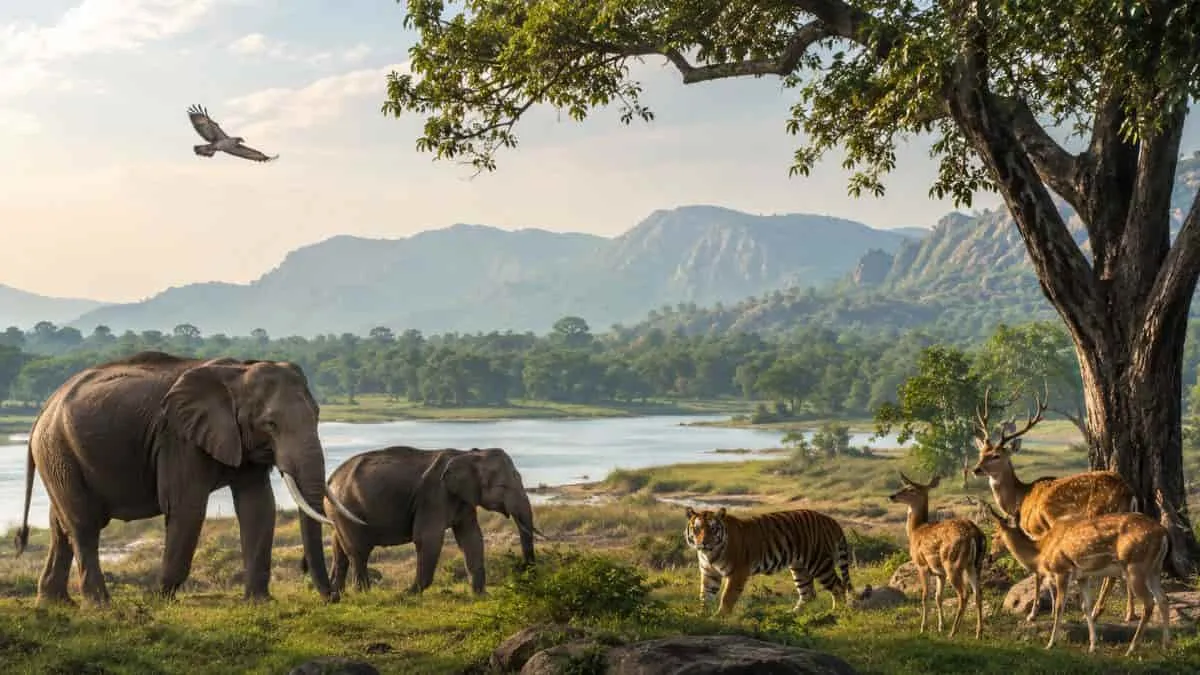
When the wildlife, plants, animals, or ecology of a wildlife sanctuary becomes important enough to warrant the highest level of legal protection, it is upgraded to a national park.
This upgrade is not automatic. It is a fixed legal process under the Wildlife (Protection) Act, 1972, and can be initiated only by the state government (or in some cases, the central government) after determining that the area satisfies some conditions specified in the law.
Let's understand this in a simple way, step by step.
Key Takeaways
-
When a sanctuary becomes a national park, it comes under section 35 of the Wildlife (Protection) Act, 1972.
Related Stories
Upgrading primarily for high ecological, faunal and floral, geomorphic and/or zoological values.
A national park provides greater protection than a sanctuary. Grazing is not permitted and private rights have minimal access and are not permitted, with limited human activity.
Boundaries of a national park can be changed only on the recommendation of the National Board for Wildlife.
According to the latest government statistics, there are 106-107 national parks and approximately 573 wildlife sanctuaries in India.
Some well-known examples of sanctuary to national park conversions are Kuno, Madhya Pradesh and the Rajaji (which is created by combining three sanctuaries) in Uttarakhand.
What is a Wildlife Sanctuary?
A wildlife sanctuary is a protected area primarily used to preserve the natural environment and the wildlife that inhabit it.
However, there is still some activity that can be done inside it, with the permission of the Chief Wildlife Warden. For example:
-
Restricted grazing by local people
-
Collection of forest produce in a controlled way
-
Private land rights may exist within the sanctuary to a certain extent.
So a sanctuary is protected, but not completely inaccessible to man.
What is a National Park?
A National Park is a much more stringent designation. Once an area becomes a national park:
-
No grazing of livestock is allowed
-
No right of ownership exists for private use of land or forest products.
-
Very little human activity is allowed inside, other than as approved by the Chief Wildlife Warden.
-
The park cannot be "downgraded" to a sanctuary later on.
Hence, national parks are considered the highest level of protection for the wildlife in India.
Sanctuary vs National Park: Quick Comparison
|
Aspects
|
Wildlife Sanctuary
|
National Park
|
|
Human activity
|
Some activities allowed with permission
|
Almost none allowed
|
|
Grazing
|
Permitted in a limited way
|
Not permitted
|
|
Private land rights
|
May continue to exist
|
Must be fully removed
|
|
Boundary change
|
Easier, by state notification
|
Only on the National Board's recommendation
|
|
Level of protection
|
Moderate
|
Highest
|
|
Can it be downgraded later?
|
Yes, in some cases
|
No
|
What is the legal basis to upgrade a Wildlife Sanctuary into National Park?
The transformation of a wildlife sanctuary to a national park is subject to the provisions of Section 35 of this Act. To put it simply, the law is as follows:
Whenever the state government feels that an area, whether it is already a sanctuary or not, is important because of its:
-
Ecological value
-
Faunal value (animal life)
-
The value of plants (biodiversity)
-
Geological value (earth's formations)
-
Zoological importance
Criteria Used for Upgrading a Wildlife Sanctuary to a National Park
Here are the main points the government checks before upgrading a sanctuary:
-
Rich and rare biodiversity
-
Ecological importance
-
Need for stronger protection
-
Settlement of rights
-
No grazing requirement
-
Scientific and conservation value
How the Upgrade Process Actually Works?
|
Step
|
What Happens
|
|
1
|
An initial notification is issued by the state government stating its desire to make the area a national park.State government issues an initial notification declaring its desire to make the area a national park.
|
|
2
|
The notification clearly specifies the precise spatial extent of the proposed park.
|
|
3
|
The local people's claims and rights in the case of land are explored and resolved.
|
|
4
|
If rights are concluded or cleared a final notice is sent
|
|
5
|
From the date mentioned in the notification the area is officially declared a national park.
|
|
6
|
Any future boundary change needs approval from the National Board for Wildlife
|
Section 38 of the Act also provides for the power of the Central Government. It can also assert a national park status for land transferred to it and for which the conditions of Section 35 are satisfied.
Real Examples from India
-
Kuno National Park, Madhya Pradesh, which was previously known as Kuno Wildlife Sanctuary. To improve and become a national park, it was upgraded, and it came to be known as the cheetah reintroduction project.
-
Rajaji National Park, Uttarakhand it is typically when the government desires to provide a locality with a much more robust long-term legal safeguard that upgrades generally occur.