The extraordinary life of the world’s largest icerb has quietly come to an end after nearly forty years. The British Antarctic Survey (BAS) and NASA satellites tracked this iceberg as A23a for 40 years. The trillion tonne iceberg originally broke away from the Filchner Ice Shelf of Antarctica in 1986. Now it has completely dissolved in the warm waters of the South Atlantic Ocean.
Recent reports further confirmed that its overall surface area has reduced to a mere fraction of its prime size before it fractured entirely. Let’s read more about the final moments of A23a and its magnificent journey that altered marine ecosystems and reshaped our understanding of ocean currents.
Historical Journey of the World’s Largest Iceberg
A23a icebergs barely moved a mile for almost three decades. But its base became anchored to the muddy floor of the Weddell Sea shortly after breaking away from the ice shelf and becoming a small frozen island.
It was only in 2020 that the world’s largest iceberg finally regained movement and began to drift 2,300 kilometres north through the Iceberg Alley.
Related Stories
Interesting Facts about A23a Iceberg
Here are some more interesting facts about the A23a iceberg during its major movement phase as per the historical tracking reports of the US National Ice Centre and NASA.
|
Metric
|
Measurement and Factual Detail
|
|
Peak Surface Area
|
~4,000 square kilometres
(Twice the size of Greater London)
|
|
Total Weight
|
Trillion tonnes
(Approximate initial mass)
|
|
Drift Distance
|
Over 2,300 kilometres into the South Atlantic
|
|
Final Tracked Size
|
Under 170 square kilometres
(March 2026 monitoring)
|
A23a Iceberg melting (Photo Credit: NASA)
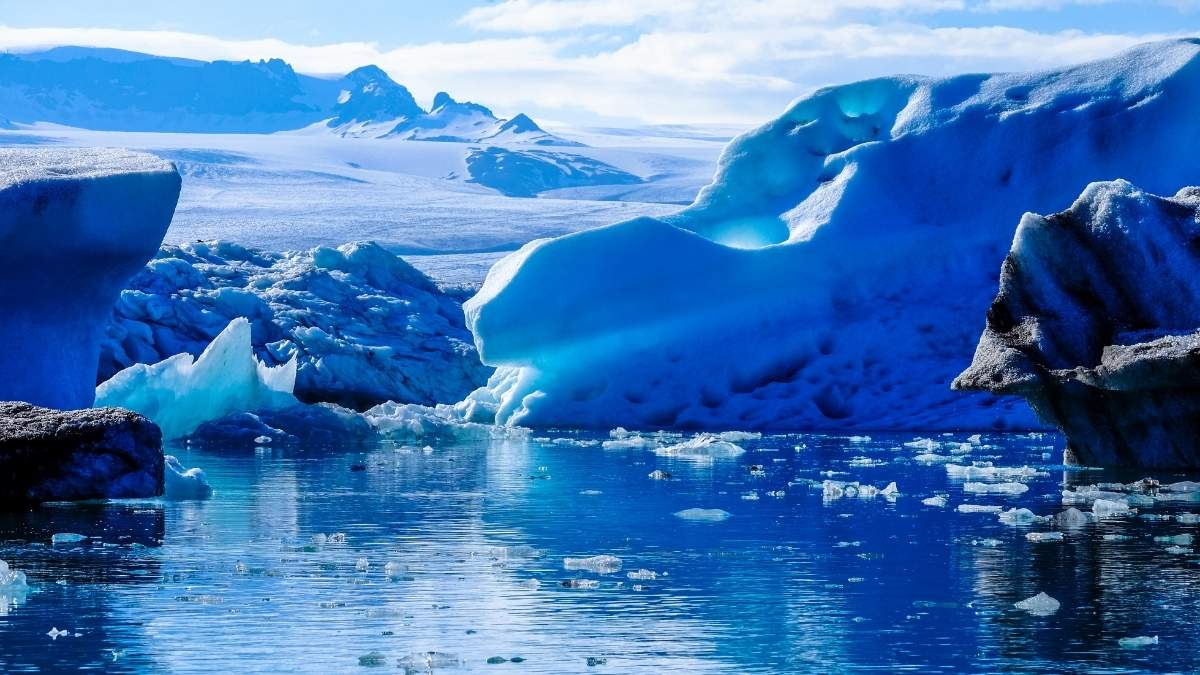
The major melting point for the iceberg came when it crossed the strong ocean waves and the warm atmospheric temperatures of South Georgia Island. It weakened the berg structure until it broke by creating deep blue pools of meltwater across its surface.
Impact of Vanished Megaberg on the Ocean Ecosystem
The melting of world’s largest iceberg indeed marks the end of an era but it also becomes a fuel for the vast ecosystem of the ocean. Icebergs act as large vessels for land based nutrients that store mineral rich dust gathered over centuries on the Antarctic mainland.
A23a iceberg released a huge amount of bioavailable iron and freshwater directly into the salty ocean after melting down.
NASA’s PACE mission satellite observes that the melted berg has left behind signs of green organisms called phytoplankton behind. The bloom right where the iceberg has vanished.
The rich minerals it left behind will feed krill, fish, seabirds, and whales for years to come due to the melting of the biggest iceberg.
Meet D15A as the Current Largest Iceberg in the World
The next in line to be the largest Iceberg in the world when A23a is gone is D15A. It measures roughly 94 kilometres long and is currently drifting off from the Eastern part of Antarctica. D15A iceberg too is under close watch of scientists to see if it will survive for decades like A23a or melt quickly given the current climatic conditions.