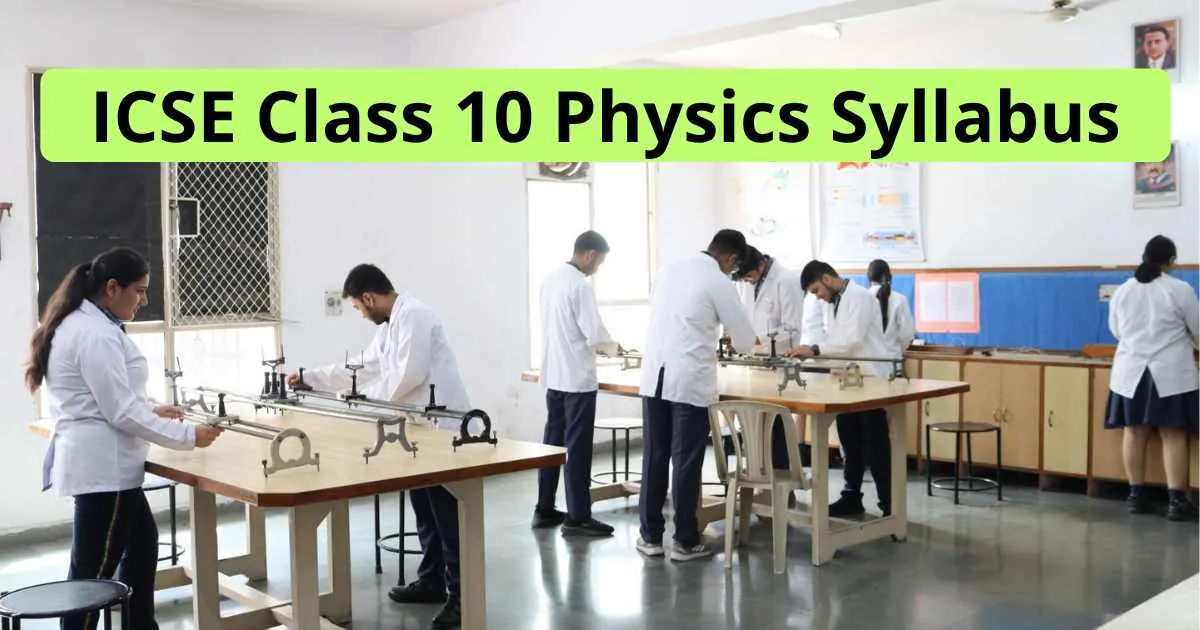
The ICSE Class 10th Physics Syllabus 2026 covers important topics such as force, work, energy and power machines, light, sound electricity and magnetism, heat and modern physics. As per the syllabus prescribed by the Council for the Indian School Certificate Examinations (CISCE), students should review the chapter wise topics and understand the theory and numerical concepts required for the board exam. The physics paper includes a theory exam and internal assessment. Students can refer to the official CISCE Class 10 Physics syllabus PDF for the prescribed topics and exam details. Scroll to get names of topics and units.
ICSE Class 10 Physics Syllabus 2026: Overview
The following table provides an overview of the ICSE Class 10 Physics syllabus, including the main topics, examination pattern and internal assessment. Students should refer to the official CISCE syllabus PDF for the prescribed details.
Related Stories
|
Particulars
|
Details
|
|
Board
|
Council for the Indian School Certificate Examinations (CISCE)
|
|
Class
|
10
|
|
Subject
|
Physics
|
|
Examination
|
ICSE Board Exam 2026
|
|
Theory Paper
|
80 marks
|
|
Internal Assessment
|
20 marks
|
|
Total Marks
|
100 marks
|
|
Theory Exam Duration
|
2 hours
|
|
Main Topics
|
Force, Work, Power and Energy; Light; Sound; Electricity and Magnetism; Heat; Modern Physics
|
|
Syllabus PDF
|
ICSE Class 10 Physics Syllabus 2026–27: Unit-Wise Topics
The table below is based on the official CISCE Physics syllabus for the ICSE Class 10th Board exam 2026. It covers the unit names and topics for class 10th science students.
|
Unit name
|
List of topics
|
|
1. Force, Work, Power and Energy
|
Turning forces and moment of force; equilibrium; centre of gravity; uniform circular motion; work, energy and power; different forms of energy; machines, levers and pulleys; principle of conservation of energy.
|
|
2. Light
|
Refraction through glass blocks and triangular prisms; laws of refraction; refractive index; total internal reflection and critical angle; converging and diverging lenses; image formation; lens formula and power of a lens; dispersion, electromagnetic spectrum and scattering of light.
|
|
3. Sound
|
Reflection of sound waves; echoes and their applications; vibrations and resonance; loudness, pitch and quality of sound; frequency and sound wave characteristics.
|
|
4. Electricity and Magnetism
|
Ohm’s law; potential difference, current and resistance; resistors in series and parallel; electrical power and energy; household circuits; magnetic effect of electric current; electromagnetic induction and related applications.
|
|
5. Heat
|
Calorimetry; specific heat capacity; method of mixtures; loss and gain of heat; latent heat and changes of state.
|
|
6. Modern Physics
|
Radioactivity; atomic and nuclear structure; alpha, beta and gamma radiations; radioactive decay; uses and harmful effects of radioactivity; nuclear fission and fusion.
|
ICSE Class 10 Physics Evaluation
The ICSE Class 10 Physics exam comprises written theory paper and practical assessment. The marks are distributed as follows refer to the table below.
|
Assessment component
|
Details
|
Marks
|
|
Theory examination
|
Written paper of 2 hours
|
80
|
|
Internal assessment
|
Practical work and project work
|
20
|
|
Total
|
Theory + Internal Assessment
|
100
|
Theory paper pattern
|
Section
|
Description
|
Marks
|
|
Section I
|
Compulsory short-answer questions covering the syllabus
|
40
|
|
Section II
|
Six questions; candidates must answer any four
|
40
|
|
Total
|
80
|
Internal assessment evaluation
The subject teacher and external examiner assess practical or project work independently. The school submits the final internal assessment marks to CISCE.
|
Examiner
|
Marks
|
|
Subject teacher (Internal Examiner)
|
10
|
|
External Examiner
|
10
|
|
Total
|
20
|
ICSE Class 10 Physics Practical Work
Students are expected to perform experiments, take accurate reading, record observations systematically and interpret results. They may also need to draw graphs and apply concepts such as least count, significant figures and basic error handling.
|
No.
|
Practical experiment
|
Main objective
|
|
1
|
Lever using a metre rule
|
Determine the mass of a metre rule and calculate mechanical advantage (MA) and velocity ratio (VR).
|
|
2
|
Pulley system
|
Determine the mechanical advantage and velocity ratio of a given pulley system.
|
|
3
|
Refraction through a rectangular glass slab
|
Trace light rays, measure angles of incidence, refraction and emergence, and determine lateral displacement.
|
|
4
|
Focal length of a convex lens
|
Determine focal length using the distant-object method and a needle with a plane mirror.
|
|
5
|
Convex lens using two pins
|
Determine focal length using object and image distances.
|
|
6
|
Refraction through a triangular prism
|
Trace light rays, measure angles and verify the relationships between the angles.
|
|
7
|
Normal incidence on a prism
|
Trace the ray path and measure the angle of deviation for different prism angles.
|
|
8
|
Specific heat capacity of a calorimeter
|
Calculate specific heat capacity using the masses and temperatures of water and the mixture.
|
|
9
|
Specific heat capacity of a metal
|
Determine specific heat capacity using the method of mixtures.
|
|
10
|
Specific latent heat of ice
|
Determine the specific latent heat of ice experimentally.
|
|
11
|
Verification of Ohm’s law
|
Set up an electric circuit, verify Ohm’s law, plot a graph and calculate its slope.
|
|
12
|
Household wiring model
|
Study a model of household wiring, including the ring main circuit, switches and fuses.
|
Also Read:
ICSE Class 10 Mathematics Syllabus for Board Exam 2026-27
ICSE Class 10 English Syllabus for Board Exam 2026
ICSE Class 10 History & Civics Syllabus for Board Exam 2026
ICSE Class 10 Syllabus 2026-27: Download Subject-Wise PDFs for CISCE Board Exam