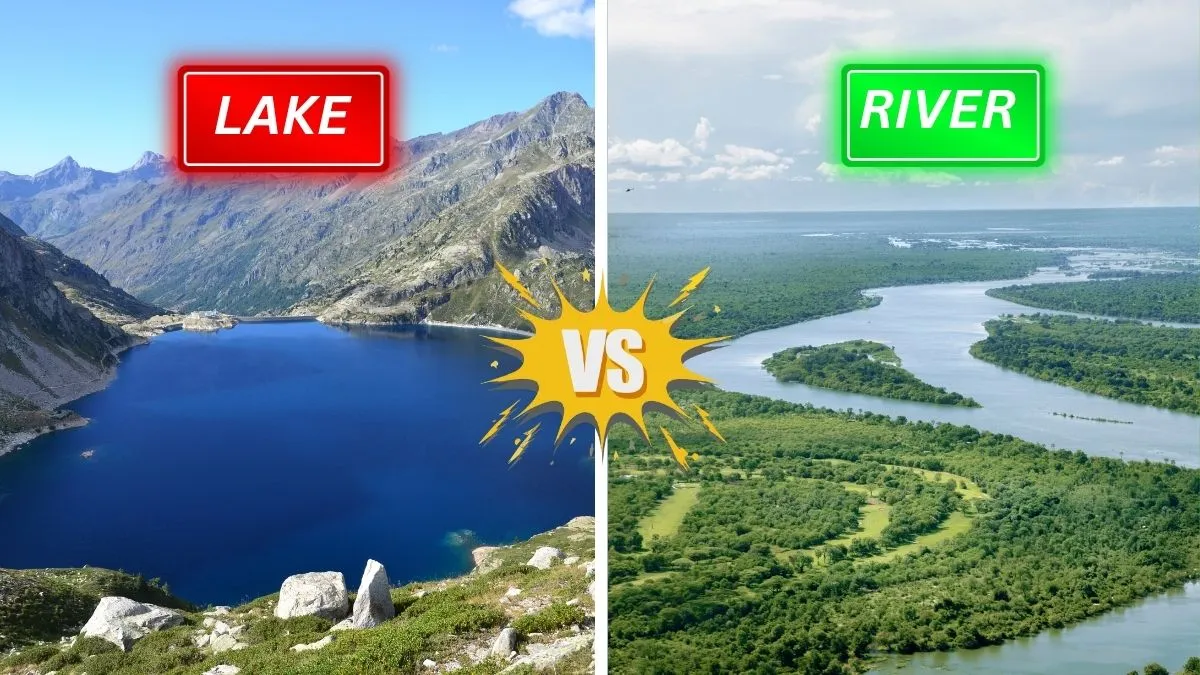
The most common explanation that you have heard when asked about the difference between river and lake is that one flows and the other doesn’t. But the same assumption falls apart when it comes to real world examples such as Caspian sea is a lake and Nile river in some stretches is slow that it appears as a lake.
Here's the fuller picture and it explains what actually separates a river from a lake, and why there are certain exceptions.
Difference Between Lake and River
The following are the differences between the river and lake:
Related Stories
|
Feature
|
River
|
Lake
|
|
Water movement
|
Continuous, directional flow
|
Relatively still, no single current
|
|
Shape
|
Long and narrow, follows a channel
|
Basin-shaped, more wider than long
|
|
Formation
|
Carved by erosion over time, following the landscape's slope
|
Formed in depressions such as glacial scouring, tectonic rifting, volcanic craters, or dammed valleys
|
|
Water source
|
Fed by rain, snowmelt, tributaries, groundwater
|
Fed by rivers, springs, rain, groundwater; some have no outlet at all
|
|
Typical depth pattern
|
Fairly uniform, shallow relative to width
|
Can be very deep near the center, shallow at the edges
|
|
Example
|
The Amazon, the Nile, the Mississippi
|
Lake Superior, Lake Baikal, Lake Victoria
|
The Key Difference between River and Lake
The fundamental difference between a river and lake lies in the way water moves, a river for instance is one where a channel of water is moving consistently in one direction driven by gravity and starting from a higher point towards a lower point.
A lake on the other hand is a body of water that sits on a basin, water can flow in or out of the lake, but it does not move as a single current. In essence, the lake stores water rather than transporting it.
Exceptions to the Definition
The following are some of the exceptions to the definition.
Great Salt Lake, Utah
Great Salt Lake in Utah is exception to the definition of a lake, water flows to the lake from various rivers such as Bear, Weber and Jordan, but it has not outlet, no water flows out, whatever water is lost it is through evaporation. This makes the lake highly saline as pure water is evaporated leaving the salt residues.
Caspian Sea
Caspian Sea is technically a lake, it meets all the criteria for being a lake, it sits on a basin, and has no connection to any ocean. Covering an area of 371,000 square kilometers, it is the largest salt lake in the world. Due to its salt water people referred it to as a sea in ancient times.
Oxbow Lakes
Oxbow lakes are not lakes technically, instead they are former section of rivers that got cut off when the river chose a narrower path, the abandoned loop becomes a crescent shaped body of water which over time behaves like a lake.
Check out other interesting articles from the general knowledge section to boost your knowledge of national and international topics. Stay connected with Jagran Josh.