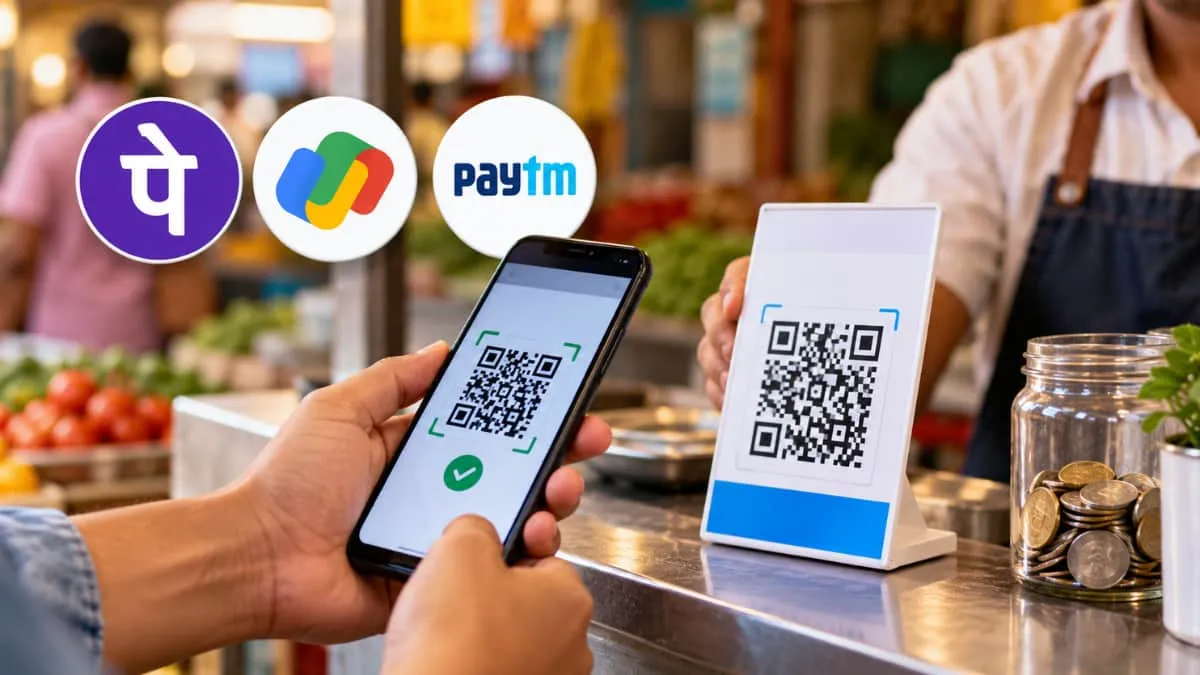
UPI MDR Rules 2026: The new rules for UPI payments will impact some businesses regarding how they will accept digital payments in India. In this new model, the UPI will charge a Merchant Discount Rate (MDR) of 0.4% on some payments received by merchants worth more than ₹2,000 and impose a cap or fixed fee on others.
However, is this a problem for people using PhonePe, Google Pay and Paytm if they have to pay an additional amount for scanning a QR code at a shop? As per the announcement by the Ministry of Finance on 15th September, 2026, customers will continue to pay via UPI without any transaction charges.
According to NPCI, the new framework will come into effect from October 15, 2026. Read on to understand the new UPI MDR rules in layman's terms.
What Is MDR in UPI Payments?
MDR, which stands for Merchant Discount Rate. A cost that a company charges for offering digital payment options via specific forms of payment.
For instance, while purchasing a mobile phone from a shop via UPI, the payment will be deducted from your bank account and credited to the shopkeeper's bank account. This transaction completes with the help of banks and payment service providers.
The fee that the merchant pays for taking the payment is called the MDR. Not a cost that comes out of, or must be paid by, the customer.
This fee, under the new UPI concept, will be levied on specific merchant transactions. The money will be shared among the payment service providers involved in processing the transaction.
| Important: According to the NPCI, UPI and Services Steering Committee decided on October 13 that,keeping in mind the festive season, Merchant Discount Rate (MDR) on select Person-toMerchant (P2M) UPI transactions, shall be implemented immediately post Diwali at a date to be notified separately. |
What Are the New UPI MDR Rules for 2026?
The new rules introduce different charges depending on the payment amount and the type of business receiving the money.
|
UPI transaction
|
MDR under the new framework
|
|
If the consumer has made a payment of ₹2000 or less to a merchant
|
There will be no MDR for the merchant
|
|
If the merchant receives a payment of more than ₹2000
|
There will be a charge of 0.4% for covered transactions
|
|
If the merchant receives a payment of more than ₹75000 or more
|
There will be a charge of a maximum MDR of ₹300 per transaction
|
|
If you send money to your friends or family
|
There will be no charge
|
|
Eligible small merchants under the P2PM category
|
No MDR
|
|
Selected essential services, such as fuel and insurance
|
Fixed MDR of ₹5 for covered payments above ₹2000
|
|
Eligible capital market payments
|
0.02%, subject to a maximum of ₹300
|
These rates apply according to the transaction category and merchant eligibility. Not every business will pay the same fee.
Will PhonePe, Google Pay and Paytm Users Be Affected?
No, there will be no additional charge for ordinary users for using UPI to make payments.
A person may pay for their daily transactions through PhonePe, Google Pay, Paytm and other UPI apps, without having to pay an MDR charge.
The rules are intended to levy on the merchant, not the consumer, for allowing certain payments.
The rules will impact various types of payments as follows:
1. Sending Money to Friends and Family
If you send ₹5,000 to a friend through Google Pay or transfer ₹10,000 to a family member using PhonePe, you will not have to pay an MDR fee.
Person-to-person (P2P) payments will remain free, regardless of the amount transferred.
2. Paying at a Local Shop
Let's assume you make a purchase of ₹800 in a local grocery store and use Paytm to pay for it.
There will be no extra charge as the transaction is under ₹2000.
It is the same if the other merchant makes any merchant payment of ₹2,000 or lower under the same conditions.
3. Buying an Expensive Product
Suppose you buy a television worth ₹50,000 from a large electronics store and pay through UPI.
Under the new framework, the merchant may have to pay MDR of 0.4%.
For a ₹50,000 transaction, the fee would be ₹200. However, this is the merchant's payment-processing cost, not an additional charge for the customer.
4. Paying ₹1 Lakh Through UPI
For an eligible merchant transaction worth ₹1 lakh, the normal 0.4% calculation would amount to ₹400.
However, the new framework caps MDR at ₹300 for covered transactions of ₹75,000 and above.
Therefore, the merchant's MDR would be limited to ₹300 rather than ₹400.
How Much MDR Will Merchants Have to Pay?
The amount depends on the value of the transaction and the type of merchant.
Here are some simple examples to understand the calculation.
|
Purchase amount
|
MDR rate or limit
|
Fee paid by the merchant
|
|
₹2000
|
0%
|
₹0
|
|
₹3000
|
0.4%
|
₹12
|
|
₹10000
|
0.4%
|
₹40
|
|
₹50000
|
0.4%
|
₹200
|
|
₹75000
|
Maximum cap
|
₹300
|
|
₹100000
|
Maximum cap
|
₹300
|
These examples show the standard MDR calculation for covered merchant transactions. Special categories and exempted merchants follow their respective rules.
Will Small Shopkeepers and Street Vendors Pay MDR?
The new approach will provide protection for street vendors and other qualifying micro-business owners.
According to the reference document, the Person-to-Person-Merchant (P2PM) whose transactions are up to ₹1 lakh per month via QR code will continue to get zero MDR.
The good news for the eligible small vendors is that they will still be able to accept digital payments without having to pay MDR, even if a single transaction exceeds ₹2,000.
Suppose a street vendor receives ₹3000 from UPI the payment will not automatically be charged with MDR if the street vendor falls under an exempted P2PM category.
The fee is not based on the amount of money received in one transaction, but rather the merchant's category.
Will Petrol Pumps, Insurance Companies and Other Services Be Affected?
The 0.4% rate will not apply to some businesses which will be subject to special rules.
The reference document specifies that covered transactions of more than ₹2000 will be charged with a fixed MDR by selected sectors.
These include:
-
Railways
-
Telecommunications
-
Insurance
-
Fuel purchases
-
Selected public utility payments
Why Is MDR Being Introduced for UPI Payments?
In India, UPI has become a widely-used payment option for transactions involving goods and services. It is used in the grocery shops, restaurants, petrol pumps, online stores and at many other places.
But there are costs to running a large digital payment system. Banks and payment companies must keep their computer systems, ensure the security of transactions, enhance security measures, and offer assistance to customers.
The new framework will seek to address some of these costs by levying fees on certain merchant transactions.
It also seeks to build a more reliable payment services funding system, rather than relying solely on government assistance.
Meanwhile, the regulations safeguard the interests of ordinary users and qualified small businesses from further payment costs.
Can Shopkeepers Charge Customers Extra for UPI Payments?
No, merchants aren't able to push the MDR fee onto their customers.
The customer should not be forced to pay ₹5,020 if the product costs ₹5,000 and he/she decides to avail the payment option UPI.
The merchant has the responsibility for the applicable MDR.
Under the rules, UPI application providers also can no longer charge a platform fee or other fee on the customers for UPI payments.
Will UPI Become Expensive in 2026?
In the new agreement, UPI will be available to normal users free of charge. Individuals can send money to friends, pay family and make eligible merchant payments, without incurring transaction fees.
The primary difference is that some companies will be required to pay a charge on taking bigger UPI payments.
There are also exemptions for qualified small merchants, thereby reducing the tax rates for certain industries.
So, it does not mean that all UPI transactions will be chargeable with MDR.
Conclusion
The new UPI MDR rules for 2026 will apply only to the selected merchant transactions and not to customers needing to pay more for transacting via the mobile apps PhonePe, Google Pay or Paytm.
Payments to friends and family will remain free, merchant payments up to ₹2,000 will not attract MDR, and eligible small shopkeepers will continue to receive protection under the zero-MDR rules.
The main change is for businesses that accept certain larger UPI payments. Customers can continue using UPI for everyday purchases without worrying about an additional MDR charge.